


Research project Portraying the jewelers of the Universe
How to make gold and silver? This remains one of astronomy's most challenging open questions. Although we know that some of the most powerful cosmic explosions play a key role in creating these elements, the exact details remain a mystery. This project aims to explore the nature of the cosmic events that create gold and silver — the jewelers of the universe.
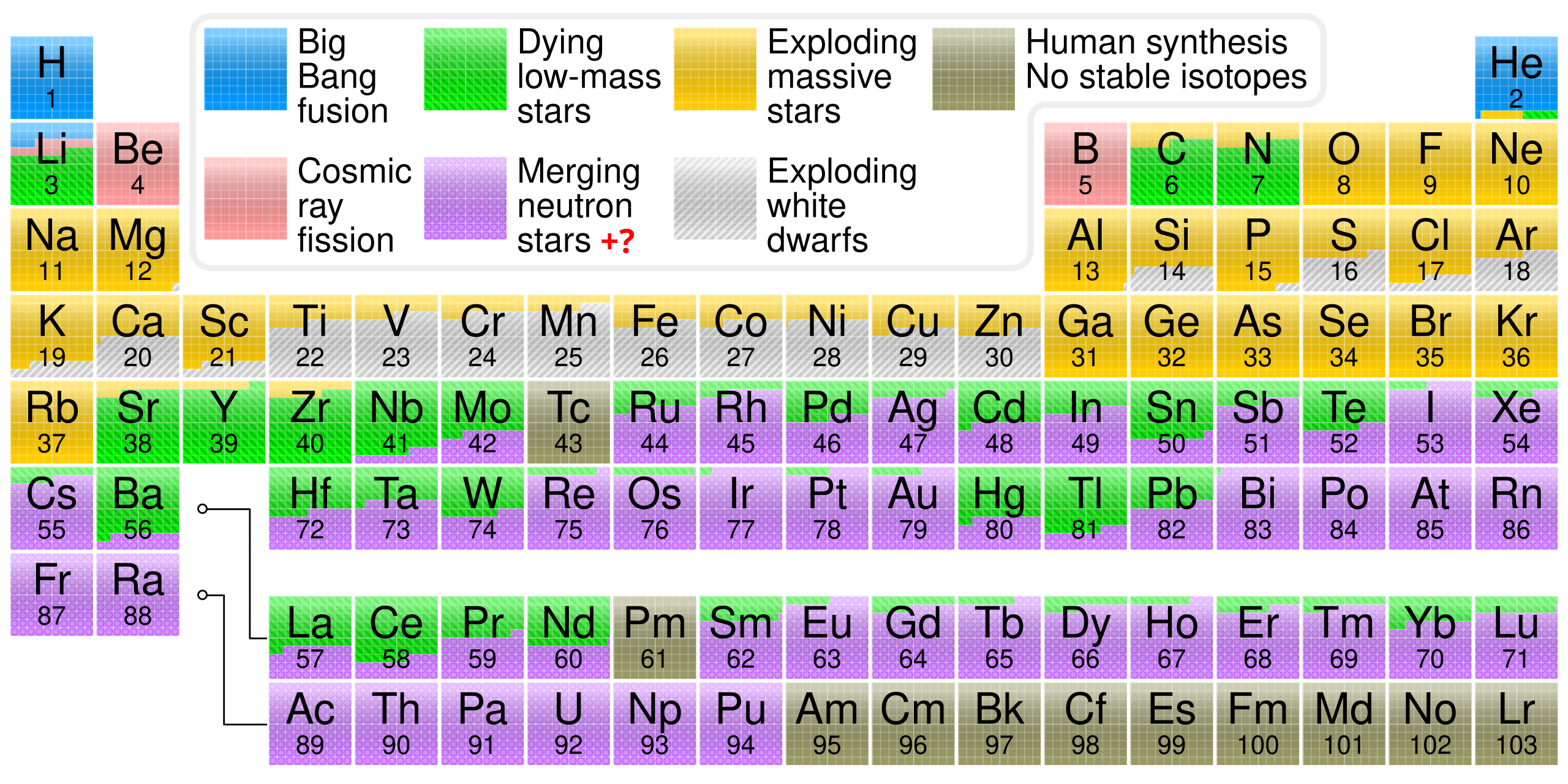
Periodic table of elements color-coded based on the astrophys-ical formation site of the elements. Purple represents elements created in the r-process. These make up a large share of the heaviest elements. Yet the astrophysical site(s) of the r-process are still strongly debated.
In this project we will examine the chemical fingerprints left behind in stars by the cosmic explosions. In the R-Process Alliance collaboration we have collected data for more than 2000 stars, by combining information of these stars chemical composition and their motions we can explore when and where the gold producing cosmic explosions happen, and figure out how much gold was produced.
Mapping and understanding the nuclear processes responsible for element production is a key goal of astrophysics. Yet our understanding of the astrophysical site(s) responsible for creating heavy elements like silver and gold, elements produced via the rapid neutron-capture (r-)process, is still minimal. Direct observation of this nucleosynthesis process is challenged by the extreme environments in which it occurs. Hence, most information has been gained from the generation of low-mass stars formed after the enrichment, keeping a record of the elements produced in previous enrichment events in their atmospheres. Most previous studies have analyzed single rare stars with high enhancement of r-process elements. This approach has significantly enhanced our knowledge of the r-process nucleosynthesis.
However, if we want to know when the r-process event took place or how much material was produced - essentially answering the question: At which astrophysical site(s) are the heaviest elements in our Universe formed? Environmental information is needed. In this project, we will use Gaia data to identify stars in the Milky Way that initially belonged to now-destroyed dwarf galaxies. By "reconstructing" these galaxies and collecting abundance data for the stars from extensive surveys like WEAVE and 4MOST, we can study their chemical evolution and investigate the cosmic explosions creating heavy elements - the jewelers of the Universe.