


Research project Theory Development for High-Resolution RIXS Experiments on Liquid Solutions and Solid Materials
The theoretical modelling of X-ray induced electronic transitions needs to be improved to describe resonant inelastic X-ray scattering (RIXS) in condensed phase due to the strong influence of the environment and dynamical effects.
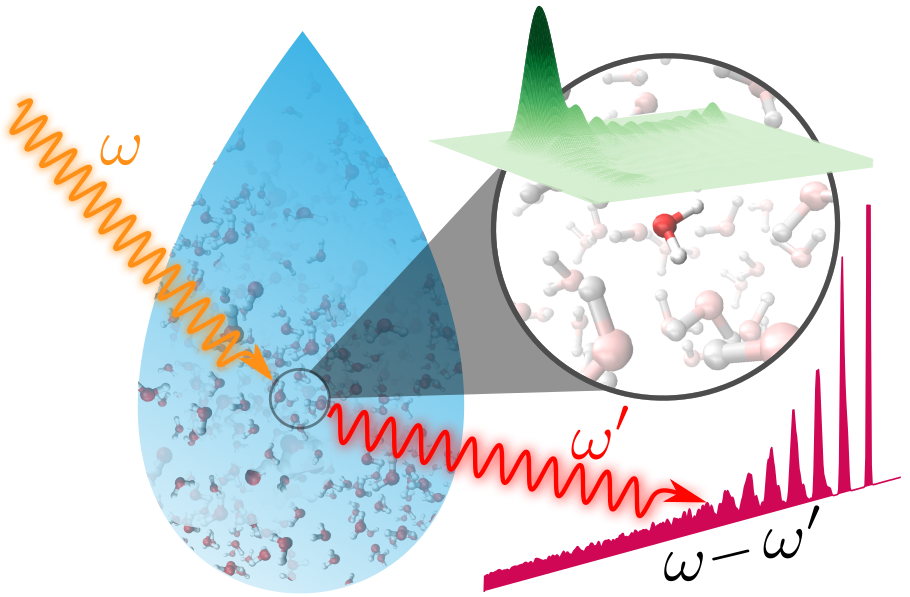
Resononant inelastic X-ray scattering can probe hydrogen bonding in water
Recently advances in high-resolution spectroscopy, in particular resonant inelastic X-ray scattering (RIXS), allows for detailed investigations of molecular interactions and electron-correlation. However, X-ray spectroscopy in condensed phase requires theoretical modelling at high quantum chemical level locally and inclusion of long-range effects for a reliable interpretation of the experimental data. This project addresses this bottleneck directly through a tightly integrated combination of method development, simulation, and frontier RIXS experiments. The scientific questions that motivate this work are at the boundary of what RIXS experiments can measure and what theory can currently explain.
To close the gap between measurable and interpretable quantities, we will develop a multi-level RIXS simulation toolkit within the open-source CP2K code. This framework will uniquely bridge molecular and solid-state RIXS simulations, integrating complementary levels of theory into a unified approach. The project is financed by Swiss National Science Foundation (SNSF) under the International Co-Investigator Scheme (SNSF10.009.485). The work is led by Prof. Marcella Iannuzzi in Department of Chemistry at the University of Zurich (UZH) together with Prof. Michael Odelius in Department of Physics at Stockholm University (SU), in partnership with Dr. Thorsten Schmitt at the Paul Scherrer Institute (PSI), Dr. Lothar Weinhardt (Karlsruhe Institute of Technology, KIT Light Source), Prof. Markus Kowalewski (Stockholm University), and Dr. Teodoro Laino (IBM Research).