


Research group Quantum materials characterization
The Quantum Materials Characterization group at Stockholm University investigates superconductivity, magnetism and quantum phase transitions through thermodynamic, transport and structural measurements. We combine experimental studies of quantum materials with the development of sensitive instruments for small samples at low temperatures and in strong magnetic fields.
Nanocalorimetry
Our central experimental platform is a miniature, membrane-based calorimeter developed for high-resolution heat-capacity measurements on small crystals and thin films. Its combination of high resolution, very low thermometer magnetoresistance and a temperature range from 50 mK to 300 K makes it particularly well suited to studying quantum materials across widely different experimental conditions. A key advantage over conventional calorimeters is its very high resolution, which allows small electronic contributions to the heat capacity and weak signatures of phase transitions to be resolved.
Integrated thin-film heaters and thermometers measure small thermal signals while keeping the heat capacity of the platform low. Careful control of thermal coupling and measurement frequency combines sensitivity with reliable absolute measurements. The low magnetoresistance of the thermometers is especially valuable when following subtle changes in heat capacity with magnetic-field strength and direction.
The platform provides access to phase transitions, electronic excitations and entropy changes in samples that are difficult to study using conventional calorimetry. It also supports local temperature control and simultaneous calorimetry and synchrotron X-ray diffraction, connecting thermodynamic and structural changes in the same sample.
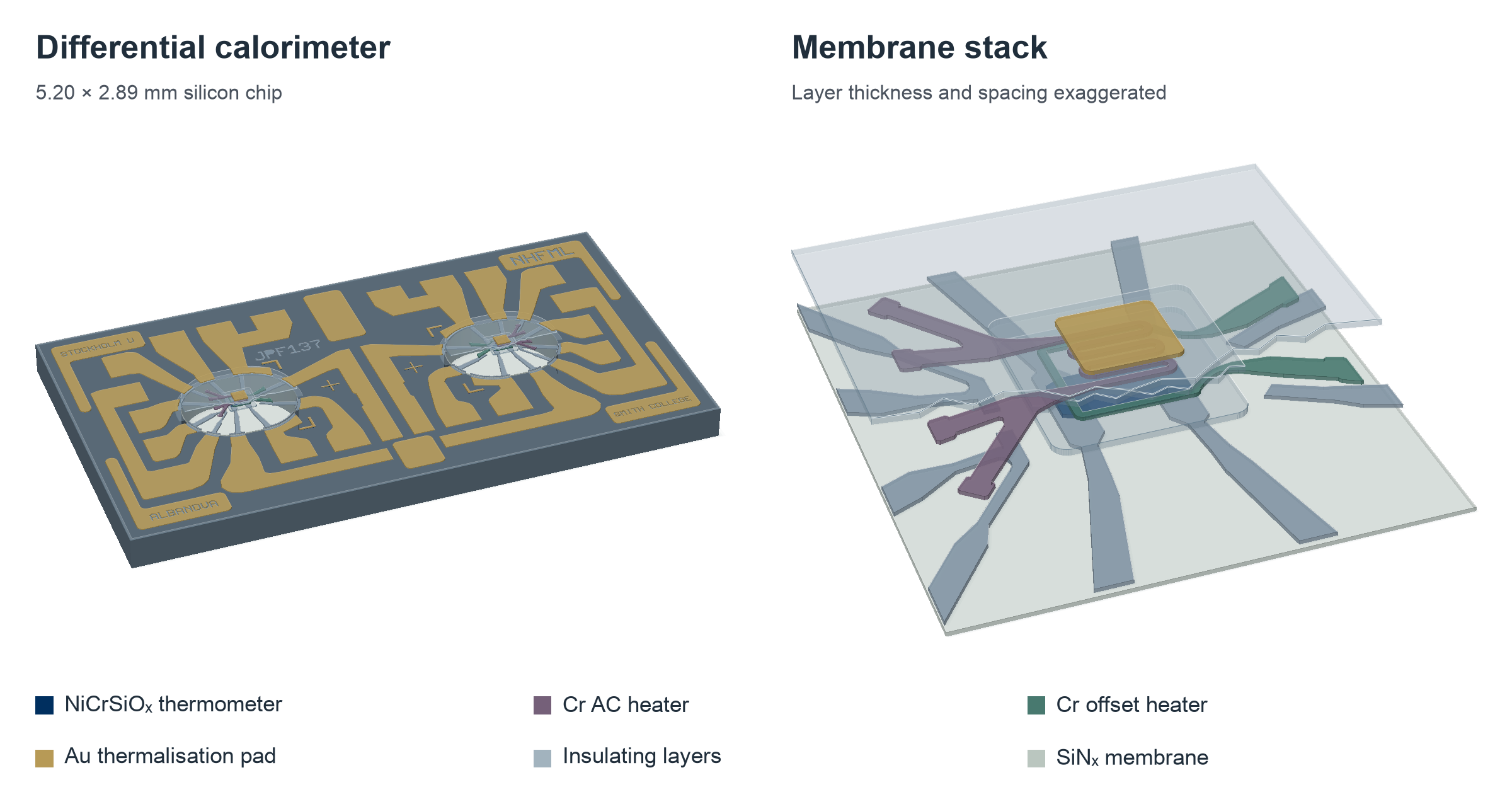
Figure 1. Differential nanocalorimeter (left) and an enlarged view of the membrane stack (right), showing integrated heaters, thermometry and a thermalisation pad. The illustration follows the fabrication masks; layer thicknesses and spacing are exaggerated for clarity. Illustration: QMC group.
Membrane-based nanocalorimetry ·
Measurement accuracy
Low-magnetoresistance thermometry ·
Calorimetry with X-ray diffraction
Research
Superconductivity and magnetism
We investigate how superconducting and magnetic states emerge, coexist and compete in quantum materials. High-resolution heat-capacity measurements reveal phase transitions, entropy changes and low-energy excitations, including small electronic contributions that can be difficult to resolve with conventional calorimetry. We combine these measurements with electrical transport, magnetic measurements and structural characterization to connect thermodynamic signatures with the underlying material properties.
In unconventional superconductors, we study the structure of the superconducting energy gap and how it changes with composition and magnetic field. Particular interests include multicomponent superconductivity in iron-based materials, broken time-reversal symmetry and proposed electron-quadrupling states. In magnetic materials, we investigate ordering, anisotropy and fluctuations, including systems in which magnetic order coexists with superconductivity. Measurements with different field orientations help establish phase diagrams and distinguish competing states.
Keywords: Unconventional superconductivity; superconducting gap; multicomponent order; time-reversal symmetry; magnetism; phase diagrams.
Superconducting gap structure · Broken time-reversal symmetry
Quantum criticality
We study how strong electronic correlations change the behaviour of metals near quantum phase transitions, where fluctuations can remain important even at very low temperatures. Our work focuses on heavy-fermion compounds, quasicrystals and related crystalline approximants. By following the temperature and magnetic-field dependence of heat capacity and magnetic response, we probe entropy and low-energy excitations and test departures from conventional metallic behaviour.
We investigate scaling relationships that reveal whether temperature and magnetic field control the same fluctuations. In the Yb–Au–Al quasicrystal, specific-heat measurements identify a crossover between temperature-limited and field-limited quantum-critical regimes. Comparisons with periodic approximant crystals help us examine the roles of atomic structure and magnetic interactions, and distinguish collective critical behaviour from responses caused by the splitting of local magnetic energy levels.
Keywords: Quantum criticality; heavy fermions; quasicrystals; approximant crystals; electronic correlations; scaling.
Quantum critical scaling in a quasicrystal · Ce–Au–Al approximant crystals
Thermal dynamics
We investigate how energy is exchanged between electrons, lattice vibrations and spin systems, and how slow relaxation affects measured thermodynamic properties. Thermal impedance spectroscopy applies periodic heating and measures both the amplitude and phase of the temperature response over a range of frequencies. This allows us to separate contributions with different relaxation times and determine when the measured heat capacity represents thermal equilibrium.
One application is the calorimetric measurement of nuclear spin–lattice relaxation, which provides access to microscopic dynamics alongside electronic and nuclear heat capacities. We also study frustrated magnets such as spin ice, where slow magnetic excitations make the thermal response strongly frequency dependent. These measurements connect heat capacity and entropy with relaxation dynamics and help explain why different experimental timescales can give different apparent thermodynamic responses.
Keywords: Thermal impedance spectroscopy; dynamic calorimetry; spin–lattice relaxation; frustrated magnetism; spin ice; relaxation dynamics.
Nuclear spin–lattice relaxation · Magnetic relaxation in spin ice
Laboratory capabilities
Low temperatures and magnetic fields
- Dilution refrigeration with a cryostat base temperature below 7 mK.
- Electrical transport measurements down to 10 mK.
- Membrane-based calorimetry from 50 mK to 300 K.
- Magnetic fields up to 12 T and two-axis sample rotation.
- Thermal impedance spectroscopy and synchronized multichannel measurements.
- Torque-magnetometry capability and optical access through installed fibres and a cryostat window.
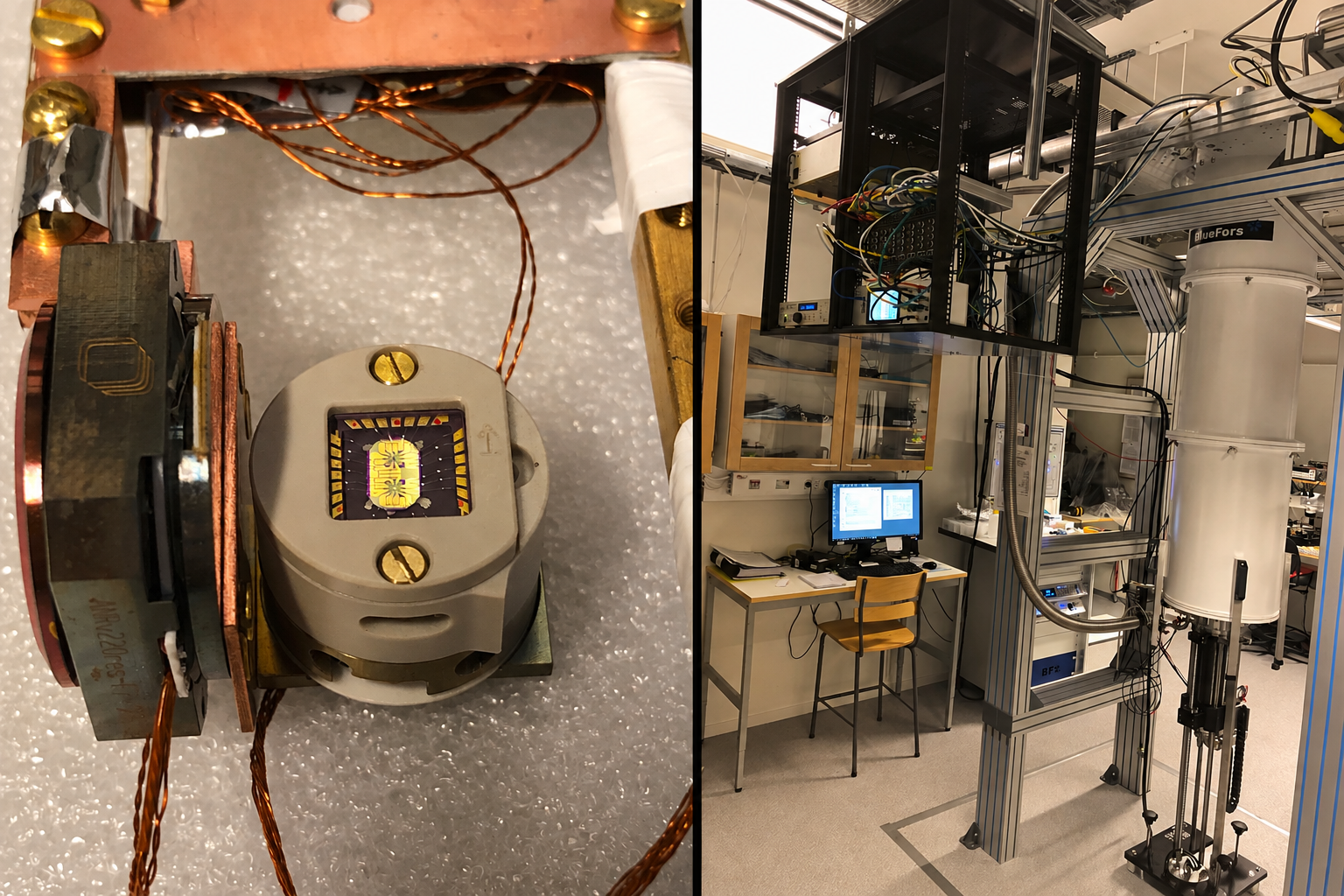
Figure 2. Left: nanocalorimeter mounted on the two-axis sample rotator. Right: the Bluefors dilution refrigerator and measurement electronics in the QMC laboratory at AlbaNova.
Fabrication and sample preparation
- Hands-on device fabrication at AlbaNova Nanofab, next door to the QMC laboratory.
- Integrated thin-film heaters and low-magnetoresistance thermometers.
- Crystal polishing and pressure-cell gasket drilling.
- Pressure determination using ruby-fluorescence spectroscopy.
- Custom low-noise electronics and FPGA-based measurement systems.
Methods under development
Our development work includes membrane-based thermal-conductivity devices, which have been fabricated and tested, and miniature calorimeters for pressure cells.
Miniature pressure-cell calorimeters
Contact
The group is led by Andreas Rydh at the Department of Physics, Stockholm University, at AlbaNova. We welcome enquiries about research collaborations.
There are no research project connections.
Selected doctoral theses describe the development of our experimental methods and their application to materials physics:
Stella Tagliati, 2011
Donato Campanini, 2019
Thermodynamic characterization of superconducting and magnetic materials using nanocalorimetry
Akash Khansili, 2025
Experimental investigation of heavy fermion quantum criticality
Neha Kondedan, 2025
Miniaturized calorimeters for high pressure, strong magnetic field, and low temperature conditions