


How do evolutionary shifts reshape pollen evolution?
How reproduction occurs is crucial to the evolution of an organism, both in terms of appearance and function. Changes in how organisms reproduce affects, among other things, which traits are prioritized by evolution.
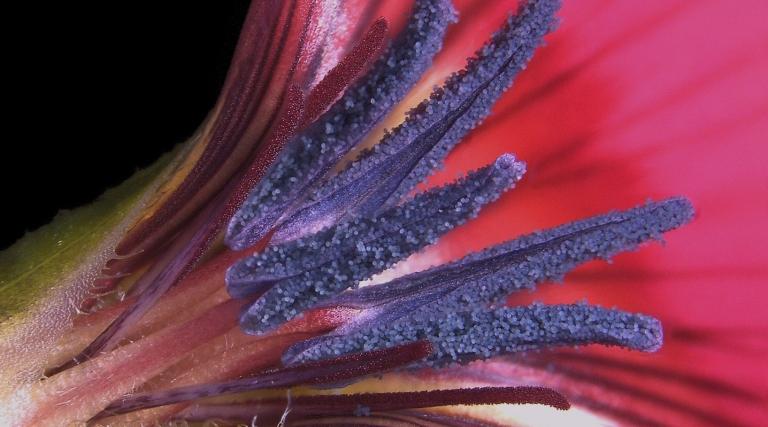
The inner parts of the flower of flower flax (Linum grandiflorum) with purple pollen grains visible. Photo: Aleksandra Losvik/Stockholm University
Combining technologies opens up new possibilities
By combining machine learning, computer vision, and large-scale DNA sequencing, it will be possible for the first time to collect and compare large amounts of data on pollen to understand how major evolutionary shifts between insect and wind pollination affect the genetics of the plant kingdom.
Research area: evolutionary genomics
Project: "Using evolutionary transitions, machine learning, and genomics to decipher pollen evolution and unravel mechanisms of sexual selection shared across kingdoms"
Researchers: Tanja Slotte, John Fitzpatrick, Allison Hsiang and Catarina Rydin, Stockholm University
Grant: SEK 31,000,000 over five years
The method of spreading is important
How reproduction occurs is an important factor that influences how organisms evolve. For example, pollen dispersed by wind are more widely dispersed in the environment than pollen dispersed by insects or other pollinators. This difference in dispersion can have important evolutionary consequences. In animals, current research shows that the evolutionary shift between internal and external fertilization has had a major impact on the evolution of sperm shape, structure, and size. This is thought to be the result of a "dilution effect," which occurs when sperm and pollen are more widely dispersed prior to fertilization. However, how the shift from insect to wind pollination in the plant kingdom affects genetic selection in flowering plants is a relatively unknown area of research.
”Although there have been more than 40 evolutionary shifts between insect and wind pollination throughout history, we still lack knowledge about how this has affected pollen evolution and variation in plant DNA,” says Tanja Slotte, professor at the Department of ecology and environmental sciences at Stockholm University.
Traces in plant genes
In the research project, the research group wants to find out whether dilution effects have affected plant evolution to the same extent as they have affected evolution in the animal world.
”If this is the case, it should have left clear traces at the DNA sequence level, since a large proportion of plant genes are expressed in pollen,” says Tanja Slotte.
New efficient methods
One reason for the lack of knowledge about pollen in particular is that it has so far been difficult to collect sufficient amounts of data for analysis. With the help of new high-tech methods in machine learning, computer vision and large-scale DNA sequencing, it is now possible to automate the process of generating data in an efficient way.
”With the help of the project, we now have the opportunity to develop completely new methods for the automated quantification of pollen morphology and pollen size in flowering plants,” says Tanja Slotte.
Change analysis
The research group will then be able to use the large amount of data to study the evolution of pollen, both in terms of appearance and changes at the DNA level, on the basis of an evolutionary family tree, a so-called phylogenetic tree. The automated recognition of pollen will streamline the analysis of large amounts of quantitative pollen data.
”The goal is to clarify whether dilution effects are an important mechanism in both the plant and animal kingdoms, knowledge that improves our understanding of the evolution of reproductive cells. But we also hope that the new, effective research methods will contribute to future research in this field,” says Tanja Slotte.
Last updated: 2025-11-28
Source: Communications Office