


ARTofMELT2023 expedition studies the arrival of summer in the Arctic
The fast-changing Arctic climate is determined by a balance between heat imported from the south, most of it in the atmosphere, and energy lost to space by radiation at the top of the Arctic atmosphere. The expedition ARTofMELT2023 (Atmospheric Rivers and the Onset of Sea Ice Melt 2023), led by researchers from Stockholm University has collected unique observations of the processes that govern the transition from winter to summer in the high Arctic, the time when the Arctic ice starts melting.
Calendar
EGU session
27 April - 2 May 2025, Vienna, Austria
2nd ARTofMELT Open Science Workshop
April 23-25 2025, Stockholm University (registration will follow soon)
Sea ice - polar art exhibition and lecture
November 30-December 22, 2024, Slipvillan, Stockholm
Read more about the exibition and lecture
The melting Arctic
November 7, 2024. Event at the Swedish Museum of Natural History (including Julia Asplund and Ida Rödén)
1st ARTofMELT 2023 Open Science Conference
22-24 April 2024, Stockholm University, DeGeer Salen, Geo Building
Read programme for the conference
Read article from the conference "1st ARTofMELT Science Workshop"
EGU Session AS4.2 As spring arrives: Processes leading up to annual Arctic sea-ice melt
14–19 April 2024, Vienna, Austria and online
Films about the expedition ARTofMELT
The Artic expedition ARTofMELT
Watch this 22 minutes long film with film clips form the expedion and interviews with reseachers about the expedition and the research.
Inflow of warm and moist air
For weeks the scientists have been awaiting a strong inflow of warm and moist air. Finally, the warm air arrives ‒ and spring is coming to the Arctic. Watch short film with two of the chief scientists.
Polar bear visit
When a polar bear approaches the research vessel Oden everyone in the crew must enter the ship. Follow one of the expedition's rpolar bear visits in the video below, leaving the research equipment behind with a curious bear. (Drone photo: Christoffer Groop)
Chasing atmospheric rivers
Get a glimpse of life as chief scientist for ARTofMELT2023 in the video below. Michael Tjernström is following the weather forecasts to know when a so called atmospheric river could be expected. The researchers’ hypothesis is that this transition from winter to summer is triggered by strong inflows of warm and moist air coming from further south, atmospheric rivers.
Watch the film where Michael Tjernström, Professor at Stockholm University and Chief Scientist for ARTofMELT2023, and Paul Zieger, Associate Professor at Stockholm University and Co-Chief Scientist, answers three questions about the expedition.
“We have a lot of measurements from when the freeze starts in the autumn but we don’t have enough measurements from the onset of the ice melt”, says Michael Tjernström.
Observations of the central Arctic in general, and the atmosphere in particular, are rare. The onset of the summer melt in the high Arctic – when and how it happens – has not been studied in detail since the late 1990s as very few research expeditions have ventured into the region in the spring. Most detailed observations come from icebreaker expeditions usually carried out during the late summer and autumn when the ice is easier to navigate.
“We know with great certainty that the melting season will begin while we are there. With the help of advanced weather forecasts, we will also see exactly where we need to be five to seven days prior,” says Michael Tjernström.
Films about the preparations for the expedition
Are atmospheric rivers behind the abrupt transition to summer?
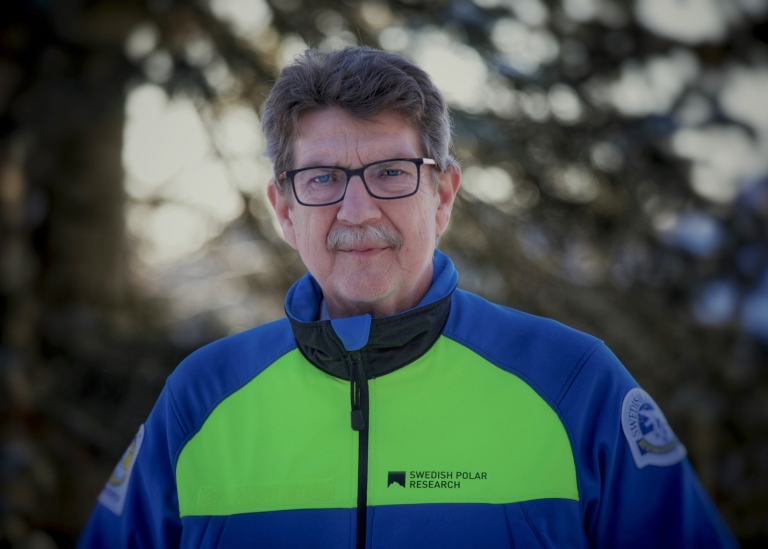
Michael Tjernström Photo: Stella Papadopoulou
“The ultimate goal is to increase our knowledge of the Arctic climate system, and we do that by going there during a time of year with very few direct observations,” says Michael Tjernström.
While summer comes gradually on land, the transition between the seasons in the Arctic Ocean may be more abrupt. The researchers’ hypothesis is that this transition may be triggered by strong inflows of warm and moist air coming from further south that feed into feedbacks between the frozen sea-ice-snow surface and the atmosphere. These so-called atmospheric rivers occur at all times of the year but are most common in the winter.
“We know almost nothing about what these atmospheric rivers look like, especially their vertical shape, and in this expedition we want to study them and their effects on the surface. For example, how the sea ice and snow change, but also how the frozen surface affects the warm air coming from south – how the air becomes ‘Arctic air.’ Primarily, the air is cooled from below, and therefore clouds or fog often form. But the clouds, in combination with the warm air, also contribute to the surface warming,” explains Michael Tjernström.
Some studies suggest that atmospheric rivers have become more frequent, stronger and longer lasting in a warmer climate. To more reliably predict future climate – in the Arctic and globally – current computer models must factor in both the atmospheric rivers and their effects on the surface.
Atmospheric rivers transport climate-relevant particles to the Arctic
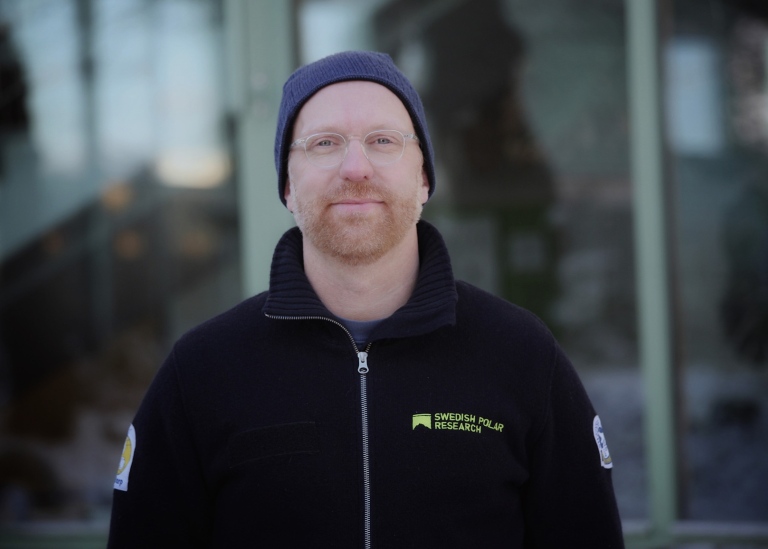
Paul Zieger Photo: Stella Papadopoulou
"By measuring the physical and chemical properties of aerosols, we can obtain information about their sources. Are they natural – or manmade pollutants, and how much of each type is there?” says Paul Zieger.
Atmospheric rivers can also bring large amounts of tiny particles in the air to the high Arctic. These particles, known as aerosols, can be of natural origin, such as sea salt, pollen or bacterial spores, or they can be manmade, such as soot, formed from the incomplete combustion of biomass and fossil fuels.
Aerosols can act as nuclei for ice crystals in the atmosphere, “seeding” the formation of Arctic clouds, which, in turn, affects the amounts of sunlight and thermal radiation that reach the sea ice. They can also be deposited on the snow and ice, which darkens the surface and accelerates melting by absorbing more sunlight. During ARTofMELT2023, the researchers hope to learn more about the properties, size and distribution of different aerosol particles transported by atmospheric rivers, as well as the clouds these particles help form during these events.
“In the high Arctic, aerosol concentrations can be extremely low. Since aerosols are essential for cloud formation, if we were to change their concentrations there, we could potentially be changing cloud properties which, in turn, would affect how much energy can be transported to and from the ice. The latter could impact the onset of the sea ice melt,” says Paul Zieger.
According to the latest climate report by the IPCC, clouds and aerosols contribute the largest uncertainty to estimates and interpretations of the Earth's changing energy budget. Zieger hopes that the data from the expedition could provide some of the answers.
”Our observations will hopefully help reduce the uncertainty by providing much needed field data to better understand how aerosols and clouds influence Arctic climate. This information would help us improve our climate models, which are essential for future climate predictions both in the Arctic and globally,” says Paul Zieger.
Scheduled and continuous measurements
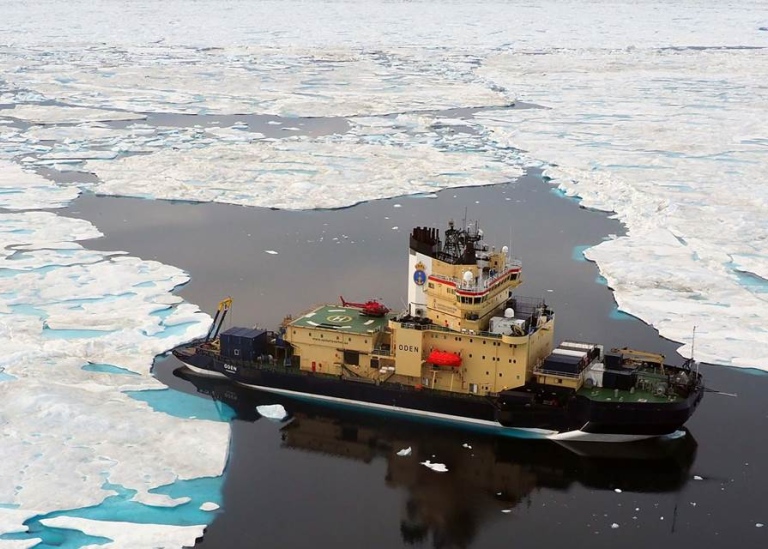
The Swedish icebreaker Oden Foto: Martin Jakobsson
“We will use helicopters and drones to see how the atmosphere behaves over a larger area. At the same time, a mini-submarine will be used to study how the atmosphere affects the ice,” says Michael Tjernström.
When Oden is in an area of an atmospheric river, many different scheduled measurements will be carried out simultaneously in a so-called column ‒ from the upper part of the ocean, up through the ice and through the atmosphere.
The lowest atmosphere will be studied with the help of a tethered balloon, drones and instruments suspended below a helicopter, but also with different types of so-called remote sensing techniques, such as radar, lidar and microwaves.
The researchers will complement the scheduled measurements with continuous ones, which will provide high-resolution information about the composition of the atmosphere near the surface.
“We will continuously and in high detail study the properties of atmospheric gases, particles and clouds as well as the energy exchange at the surface. It will be a challenge not to contaminate our observations with emissions coming from Oden though, so we will turn the ship into the wind as much as possible,” says Paul Zieger.
The scientists will also carry out additional activities, such as weather balloons released every six hours and similar instruments lowered into the sea. The results from the former will be sent to weather services worldwide to improve the weather forecasts we all depend on so much.
Finally, taking measurements on the ice surface will also be on the list.
“It will be possible to work on the ice, but only with equipment that can be taken onboard in one day,” says Michael Tjernström.
QnA on ARTofMELT2023
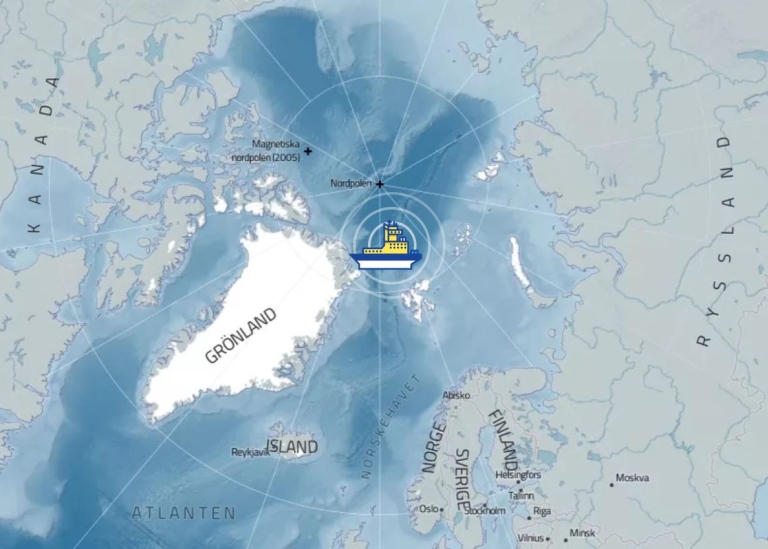
Map of the target area for the expedition ARTofMELT2023. Source: Mapbox/The Swedish Polar Research Secretariat
Logotype for ARTofMELT
What is ARTofMELT2023?
The project ARTofMELT2023 (Atmospheric rivers and the onset of Arctic melt) is an international interdisciplinary research expedition (with researchers from a broad range of fields). The research is done from the Swedish research icebreaker Oden to the central Arctic Ocean.
The Swedish icebreaker Oden set sail from Longyearbyen on Svalbard, Norway, on 7 May 2023 carrying 40 scientists from Sweden, Finland, Switzerland, Germany, United Kingdom and USA, and 20 crew members for a six-week research cruise in the Arctic Ocean.
The icebreaker Oden is owned by the Swedish Maritime Administration but is used by the Swedish Polar Research Secretariat during the summer for expeditions to the Arctic Ocean.
Who is leading the expedition?
The expedition is led by Professor Michael Tjernström (Department of Meteorology) and Associate Professor Paul Zieger (Department of Environmental Science) with logistical support provided by the Swedish Polar Research Secretariat.
What will ARTofMELT2023 investigate?
The researchers will study in detail when the sea-ice surface of the Arctic Ocean starts to melt in spring, an under-observed phase in the Arctic annual cycle. Specifically, they will explore if the so-called “atmospheric rivers” play a role in the timing of the melt onset. This date is important for the annual sea-ice melt-back that has increased substantially over the last several decades, as a consequence of global warming.
How will the research be done?
On site in the Arctic Ocean they will use advanced weather forecasts to guide the team to optimal locations. The nature of the problem necessitates an expedition when the sea ice is at maximum, challenging the capacity of icebreaker Oden and the logistics. When successful they will bring back unique observations of the processes that contribute to determining the time for when the summer melt starts.
What are “atmospheric rivers”?
Atmospheric rivers are warm and moist air coming in from the south.
What is their role in the Arctic?
Atmospheric rivers have a very large effect on the surface energy budget, and also bring pollutants aerosols and other trace gases from lower latitude into the Arctic. In spring, they are thought to have the capacity to trigger the onset of the summer sea-ice melt by altering the surface characteristics. The connection between Atmospheric Rivers and the start of the summer melt season is poorly understood and under-sampled, which is why the expedition ARTofMELT2023 has an important role to understand the melt.
Who is financing the expedition?
ARTofMELT2023 is organised by the Swedish Polar Research Secretariat and is mainly financed through the Secretariat’s own grants but also through international collaborations. The work of the teams of Professor Michael Tjernström and Associate Professor Paul Zieger is financed primarily by The Knut and Alice Wallenberg Foundation and the Swedish Research Council. In addition, crucial funding towards setting up instrumentation for measuring air particles was provided by the Carl Trygger Foundation and the European Research Council (ERC).
Find more material about ARTofMELT2023
The research project
Read more about ARTofMELT2023 at the research project site
Material from the Swedish Polar Research Secretariat
Read more about ARTofMELT2023 at the Swedish Polar Research Secretariat
Read more about the ice breaker Oden
More about the chief scientist for the expedition
Last updated: 2025-12-18
Source: Communications Office