Matthew O'Regan Professor of Marine Geology

Contact
Name and title: Matthew O'ReganProfessor of Marine Geology
Mail: matthew.oregan@geo.su.se
Phone: +4686747857
ORCID0000-0002-6046-1488 Länk till annan webbplats.
Workplace: Department of Geological Sciences Länk till annan webbplats.
Visiting address Room R223Svante Arrheniusväg 8 C, Geohuset
Postal address Institutionen för geologiska vetenskaper106 91 Stockholm
About me
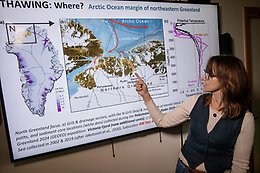
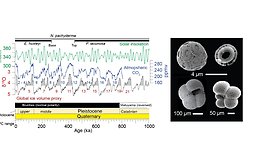
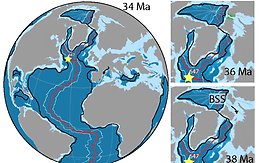
My research integrates marine sediment cores and geophysical data to reconstruct environmental change in the Arctic on centennial, millennial, and million-year timescales. I investigate the evolution and variability of sea ice, marine-terminating glaciers, and oceanographic conditions while examining how major tectonic events during the Cenozoic shaped the region and influenced ocean circulation and global climate. A necessary focus of my research is advancing geochronological methods and age models for Arctic marine sediments, providing the temporal framework needed to reconstruct past environmental change.
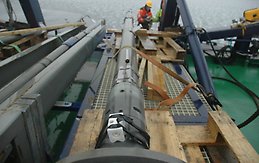
Complementing this research line, I have broad expertise in the physical, geotechnical, and geothermal properties of marine sediments. I routinely acquire geotechnical and marine heat-flow data from both the Arctic and the Baltic Sea to investigate sedimentary processes, characterise subsurface fluid-flow systems, assess submarine slope stability, and investigate marine methane hydrate dynamics.
I co-manage the core processing laboratory at Stockholm University, which provides state-of-the-art analytical facilities for both internal and external users. The laboratory houses an X-ray fluorescence (XRF) core scanner, a Multi-Sensor Core Logger (MSCL), hyperspectral imaging system, X-ray computed tomography (CT), and an automated triaxial testing system, supporting high-resolution, non-destructive characterisation of marine and terrestrial sediment cores across a broad range of geoscience disciplines.