


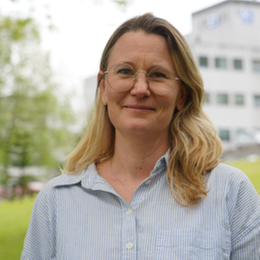
Jenny Sjöström Postdoctoral researcher
Contact
Name and title: Jenny SjöströmPostdoctoral researcher
Workplace: Department of Archaeology and Classical Studies Länk till annan webbplats.
About me
I am a postdoctoral researcher working at CRETUS research centre, Universidad de Santiago de Compostela (Spain), affiliated to Dept. of Archaeology and Classical Studies, Stockholm University. My research focuses on reconstruction of past climate and environmental change, for time periods prior to observation data, using peatlands as a natural archive. I have broad interest in peatlands and how they function over time, on centennial to millennial time-scales. My main research activities are currently focussed on 1) reconstruction of past pollution levels and its effects on human health, 2) past storminess variability in eastern North Atlantic (Ireland, Faroe Islands, Norway and Sweden), 3) peatlands carbon dyanamics, and 4) past hydroclimate and fire variability in eastern South Africa.
I defended my PhD thesis in June 2021 at the Department of Geological Sciences, and before that I have studied physical and human geography at the Department of Physical Geography, Stockholm University. I have a BSc in Geography and a MSc in Quaternary Geology, and a MSc in Geography.
Reconstruction of Storminess variability
Storm intensity has increased in the last decades, but uncertainties on how storminess patterns will change in the future still exisits. Within this project we use natural archives, such as peat bogs and aeolian sand dunes, to reconstruct how storminess patterns have varied in the past. Our field areas are located in coastal regions in the North-Atlantic (Ireland, Scotland, The Faroes, Norway and Sweden). This project aims to both increase the knowledge on how storminess variability is recorded in different climate archives (bogs vs dunes), as well as to understand how storminess patterns have shifted in the past, both in terms of frequency, location and in intensity. By increasing the knowledge on how storminess patterns have varied in the past, we can hopefully improve the predictability of how storminess patterns might shift ahead in a future, wamer, climate.
More information on this project, and its members, can be found in the project link.