Lotta Granqvist Postdoc
Contact
Name and title: Lotta GranqvistPostdoc
Workplace: Department of Culture and Aesthetics Länk till annan webbplats.
Visiting address Room B341Frescativägen 22B-26
Postal address Institutionen för kultur och estetik106 91 Stockholm
Scandinavian Women Artists at Atelier 17
Artistic Practices, Collective Processes, and Transnational Networks, 1950–1970
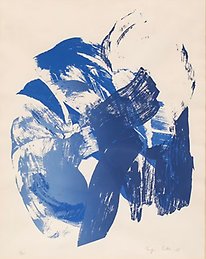
In this project, I examine the printmaking workshop Atelier 17, with particular emphasis on the studio as a space for Scandinavian women artists between 1950 and 1970. Founded in Paris in 1927, Atelier 17 became a pivotal site for the development of modern printmaking. Techniques such as automatic drawing using dry point on copper plates generated spontaneous and surreal etchings and engravings, while simultaneous colour printing through viscosity printing introduced new, painterly possibilities of expression. The workshop functioned as an interdisciplinary meeting place for artists, writers, and poets. By fostering collaboration between established practitioners and less experienced participants, it developed working methods centred on process and the exchange of knowledge. Many of the artists involved were women who, in various ways, contributed to the development of postwar abstract modernism, Surrealism, and Expressionism. Several of them shared a commitment to challenging established conventions of printmaking in terms of style, scale, and technique, thereby paving the way for new aesthetic expressions through their etchings, engravings, and woodcuts.
This project takes Atelier 17 as its point of departure as a site not only of graphic production but also as a central node for knowledge exchange and technical innovation within a transnational network of artistic, material, and institutional actors. Five women artists constitute the empirical foundation of the study: Brita Molin (1919–2008) and Joy Egnel (1920–2001) from Sweden; Inger Sitter (1929–2015) and Anne Breivik (1932–2012) from Norway; and Jette Thyssen (born 1933) from Denmark, all of whom were active at Atelier 17 in Paris between 1950 and 1970.
An Artist Unfolds : Contextualizations and Processes of Becoming in the Artistic Work of Eva Klasson During the 1970s.
The subject of the dissertation is the practice, progress and conditions of the artistry Eva Klasson during the 1970s. The aim is to deepen and simultaneously broaden the understanding of the artistry by analysing Klasson's context and network, artistic method, and a large number of works she created during the 1970s. Prior scholarly inquires have focused on a photographic historical perspective resulting in interpretations that primarily place Eva Klasson in contexts where a photographic craftsmanship is predominant. By studying archival materials and paying special attention to artistic processes as well as corporeal themes within the artworks, this study demonstrates connections and affiliations with the French body art movement, art corporel.
Three overarching questions focusing on the development of the artist, performative processes, and the relationship with contemporary artistic practices underpin the study. The first question addresses the development of the artist. It examines actors, places, processes, and networks that have influenced the shaping and direction of Eva Klasson's artistry. The second question investigates the relationship between verbal statements and practical methods in relation to Eva Klasson's performative and process-oriented artistic practice. The third question focuses on Eva Klasson's affinity with artists who also worked with the body as subject and material.
The theoretical framework is built upon the concepts of performativity and becoming. Together, they form a theoretical framework that helps trace the processual nature of the artist, both in terms of the practice and the works created during the 1970s. The concepts operate on different levels and in various ways within the chapters. They illuminate the developments of the artistry in relation to a contemporary artist identity, while also allowing for a theorization and contextualization of Klasson’s works and methods as performative. The study introduces the term becoming camera as a lens through which to analyse Klasson’s conceptualization of the camera as an extension of her body combined with an integration of creative and technical aspects of the artistic method. Additionally, these concepts also enable analyses of the artworks in relation to performative photography, performance photography, and works that create performance.
The dissertation, grounded in a material-centred approach, incorporates an extensive array of visual content, juxtaposing artworks with archival sources. Central to the analysis is Le troisième angle, a photographic series comprising 42 works (1975–1976) and an accompanying artist’s book featuring reproductions from the series (1976). These serve as a pivotal node, from which diverse materials and thematic inquiries radiate.