Ayco Tack Professor
Contact
Name and title: Ayco TackProfessor
Mail: ayco.tack@su.se
Workplace: Department of Ecology, Environment and Plant Sciences Länk till annan webbplats.
Visiting address Room N420Svante Arrhenius väg 20 A
Postal address Institutionen för ekologi miljö och botanik106 91 Stockholm
About me
I am broadly interested in the ecology and evolution of species interactions. I currently aim to combine experimental, theoretical and molecular techniques to study interkingdom interactions between plants, microbes and insects. For this, I have worked extensively on the spatial dynamics of the insect and pathogen community on the oak tree Quercus robur and the below- and aboveground food web surrounding the perennial herb Plantago lanceolata. More recently, I expanded my research to the diseases and insects on semi-wild coffee in SW Ethiopia, and started to explore new study systems associated with Sweden’s perennial plants, such as the beautiful fungi on the wood anemone and the bird's eye primrose. Overall, I am broadly interested how ecological and evolutionary interactions between plants, insects and microbes play out in a spatial setting.
Group members
Group members are Álvaro Gaytán(PhD student), Biruk Nurihun(PhD student), Beyene Hailu (postdoctoral researcher), Laura van Dijk (postdoctoral researcher), Francesco Zignol(postdoctoral researcher), Xenia Gomm (MSc student) and Maansi Sharan (MSc student). I co-supervise David Åhlen(PhD student), Firew Bekele (PhD student) and Petter Madsen (PhD student).
I am coordinating the course Statistics for Biologists III (7.5 ECTS) in early winter (December / January). In spring I co-organize the course Interactions in Ecological Communities (15 ECTS) and lecture in the course Molecular Plant-Microbe Interactions.
Master's projects
If you are looking for a master's project, there are currently three opportunities to join the projects described below. Alternatively, you are welcome to suggest your own project idea within my areas of research, which include plants, microbes and insects. Projects could be carried out in Sweden, Ethiopia or potentially elsewhere. Please feel free to send me an informal email or drop by my office to discuss your ideas. You can also browse my publicationsand personal website to get a feel for the topics I work on.
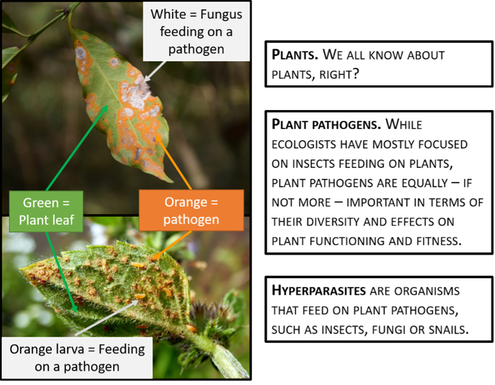
The insects and fungi that feed on fungi that feed on plants
While many studies have focused on the natural enemies of insects that feed on plants, we know surprisingly little about the organisms that feed on plant pathogens. We call these organisms hyperparasites, and they can include fungi, insects and snails. This project offers opportunities for MSc students to use observational, experimental or genomic approaches to explore how hyperparasites shape the ecology and evolution of species interactions, food webs and ecosystems.
Testing the ecological and evolutionary consequences of changes in the order of bud burst of Swedish trees from Linnaeus to the present
We recently discovered that the order in which trees burst their buds has changed during the three centuries since Linnaeus began measuring phenology in Sweden. In this project, we will take an experimental approach to explore the ecological and evolutionary consequences of these changes. In other words, does it matter which tree species flushes its leaves earlier, and which flushes later?
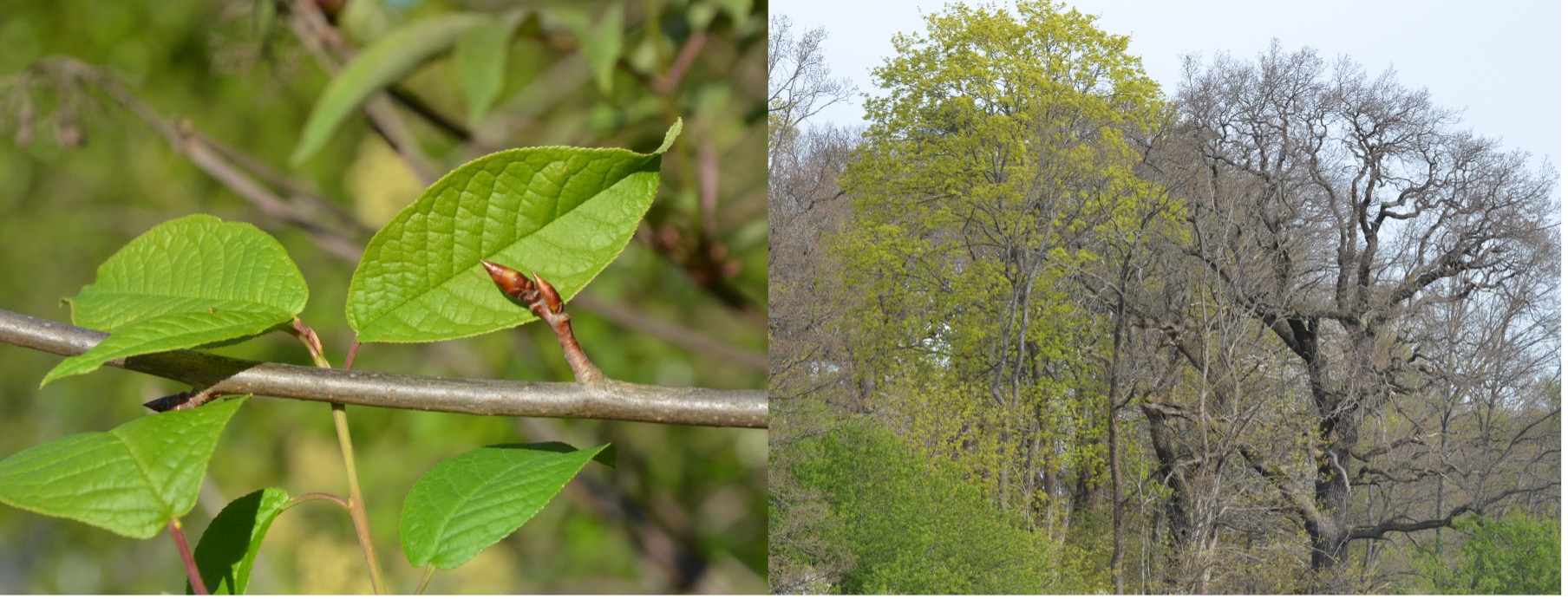
Asynchrony in leaf budburst among trees is a common phenomenon. In the left panel, bird cherry (Prunus padus) leaves are fully open while neighboring European aspen (Populus tremula) has not yet begun budburst, near Stockholm, Sweden, spring 2025. The right panel shows this variation in the status of budburst at a larger scale, among a variety of trees in a woodlot. Photos: Kristoffer Hylander.
Connectivity and movement mapping for planning support
This project aims to enhance spatial planning tools by improving how ecological connectivity and species movement are represented in urban contexts. Focusing on the Stockholm Region, it investigates how selected species groups interact with landscape structures using selected GIS-based models. The study combines detailed habitat data with literature-based assumptions on species movements to evaluate connectivity under varying conditions. This approach seeks to assess the robustness of spatial models and their practical applicability for integrating biodiversity into planning processes. This is a collaboration with Ulla Mörtberg at KTH.
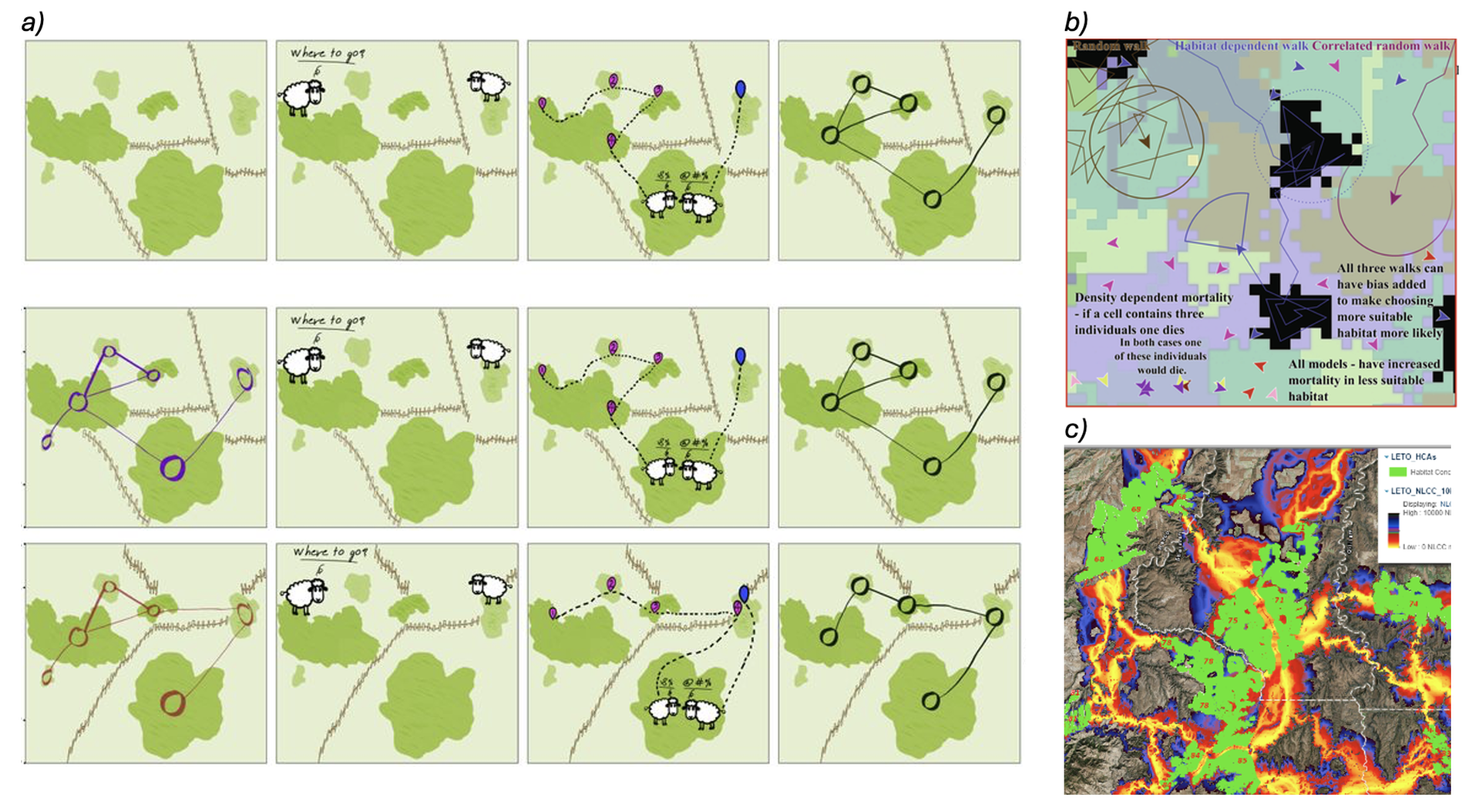
a) Role of habitat configuration in shaping animal population (or community) structures (He et al. 2021), b) habitat dependent walk and random walk (Chetcuti et al. 2022), which are examples of advanced models that illustrate recent contributions to the knowledge base, but are most likely too complicated to be used as planning support. c) illustrates results from Linkage Mapper (Gallo et al. 2019), aiming to support planning, but this type of model is highly simplified and need to be critically examined. Images from Ulla Mörtberg.