


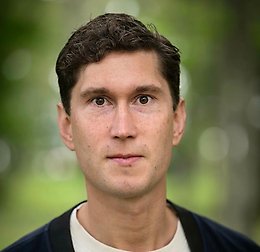
Andreas Sarling PhD Student
Contact
Name and title: Andreas SarlingPhD Student
Mail: andreas.sarling@su.se
ORCID0000-0002-9033-6303 Länk till annan webbplats.
Workplace: Department of Psychology Länk till annan webbplats.
Visiting address Albanovägen 12
Postal address Psykologiska institutionen106 91 Stockholm

About me
I joined the PhD program at Stockholm University to explore the intersection of organizational psychology and the evolving digital work context. My research interest lie in understanding social and digital mechanisms in remote and hybrid work models in relation to well-being and mental health.
Education
- B.S. in Behavioral Science (Education), Mid Sweden University, 2017
- B.S. in Psychology, Kristianstad University, 2018
- M.S. in Emotion Psychology, Mid Sweden University, 2020
- Doctoral Student, September 2023—
Supervisors
I am actively involved in teaching at both undergraduate and graduate levels, primarily focusing on quantitative methodology and occupational health:
- Applied Questionnaire Methods (Master’s Level): Seminar leader focusing on survey design and factor analysis.
- Psychology III: Lecturer and seminar leader in quantitative methods and survey methodology.
- Stress and Health in Work Life: Leading discussion seminars that bridge psychological theories with practical experiences from organizational life.
Preliminary title of PhD research project: Social Connectedness in the Digital Workspace: Mechanisms of Well-being and Mental Health in Remote Work
My doctoral project consists of four interrelated studies that examine how social and digital dynamics influence employee health in remote work:
- Study 1 (published): Investigates the associations of option and extent of remote work, technostress, and sex differences, on mental health, highlighting how having the autonomy to choose remote but staying on-site (the "option" vs. "action" effect) can serve as a psychological resource.
- Study 2: Utilizes Bayesian longitudinal models (random intercepts – cross-lagged panel models) to explore how interpersonal justice from supervisors possibly can act as a protective mechanism against stress and provide job satisfaction across different remote work trajectories over time.
- Study 3: Focuses on psychometric development, creating and validating a new self-report instrument designed to measure perceived social support from Generative AI agents.
- Study 4: Evaluates the longitudinal effects of AI-mediated social support on perceptions of connectedness, well-being, mental health, while exploring the moderating role of remote work extent.
Sarling, A., Jansson, B., Englén, M., Bjärtå, A., Rondung, E., & Sundin, Ö. (2021). Psychometric properties of the Swedish version of the experiences in close relationships – relationship structures questionnaire (ECR-RS global nine-item version). Cogent Psychology, 8(1). https://doi.org/10.1080/23311908.2021.1926080
Sarling, A., Sundin, Ö., Åhs, F., Gu, J., & Jansson, B. (2022). Factor structure and psychometric properties of a Swedish version of the Sussex-Oxford Compassion Scales (SOCS). Nordic Psychology, 76(1), 78–96. https://doi.org/10.1080/19012276.2022.2156381
Sarling, A., Sundin, Ö., & Jansson, B. (2024). Psychometric evaluation of the Swedish version of the Empathic Experience Scale (EES). Psychological Test Adaptation and Development, 5, 192–200. https://doi.org/10.1027/2698-1866/a000079
Sarling, A., Leineweber, C., & Peristera, P. (2026). Option better than action? Autonomy over remote work, technostress, and mental health disparities in Sweden during the COVID-19 pandemic. Acta Psychologica, 262, Article 106185. https://doi.org/10.1016/j.actpsy.2025.106185