


Attractive male guppies may spread more parasites than expected
Male guppies with larger, more colourful orange ornaments are generally more resistant to parasites. But new research published in Proceedings of the Royal Society B reveals a surprising twist: when these attractive males become infected, they can transmit more parasites to other fish than their less colourful counterparts. The findings highlight how sexual selection, social behaviour and infectious disease can interact in unexpected ways.
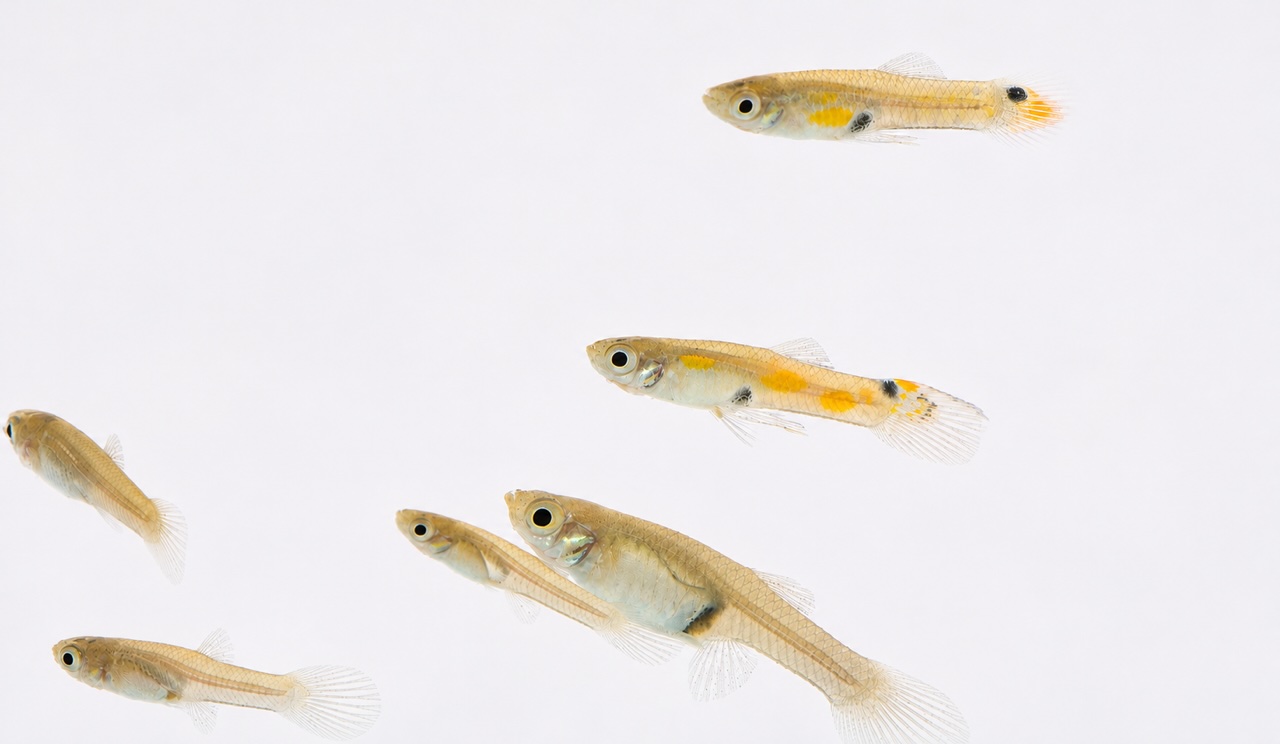
Male guppies with larger orange ornaments were found to transmit more parasites when infected. Photo: Faith Rovenol
In many animal species, elaborate ornaments such as bright colours signal good health and are preferred by potential mates. Previous studies have shown that male guppies with larger orange colour patches tend to be more resistant to the ectoparasite Gyrodactylus turnbulli.
Researchers from Stockholm University and international collaborators investigated how the size of male guppies' ornaments influences their social interactions and parasite transmission. They paired infected and uninfected Trinidadian guppies and recorded their interactions, while measuring ornament size and the number of parasites transferred between fish.
The results showed that uninfected males with larger orange ornaments had fewer contacts with infected fish, suggesting that they experience or initiate fewer potentially risky interactions. However, when these attractive males became infected themselves, they transmitted particularly large numbers of parasites to other fish.
“Our results challenge the idea that more attractive, parasite-resistant males necessarily pose a lower infection risk to others. Although these males tend to avoid contact with infected individuals, once they become infected themselves, they can be surprisingly effective at transmitting parasites,” says Jessica Stephenson, Wallenberg Academy Fellow at the Department of Zoology, Stockholm University.
Respond to the condition of their host
Why these males become especially effective transmitters remains unclear. One possibility is that parasites respond to the condition of their host. More resistant males may provide a more challenging environment for parasites, encouraging them to leave the host and establish themselves on another fish.
The study highlights an important distinction between avoiding infection and preventing its spread. An individual that is less likely to become infected does not necessarily pose a lower transmission risk if infection occurs.
The findings also have broader implications for our understanding of sexual selection. Attractive males are often assumed to provide benefits because they carry traits associated with health and parasite resistance. However, the new results suggest that the relationship between attractiveness and disease risk is more complex than previously thought.
“To understand how diseases spread, we need to look beyond how many parasites an individual carries. We also need to understand who interacts with whom, which individuals initiate those interactions, and how readily parasites leave one host and establish themselves on another,” says Jessica Stephenson.
More broadly, the research demonstrates how traits shaped by sexual selection can influence not only reproductive success, but also the spread of infectious diseases through populations.
The article Male ornaments predict contact and parasite transmission between pairs of guppies, Poecilia reticulata is published in Proceedings of the Royal Society B.
The study was conducted by an international research team, with collaborators from the University of Pittsburgh, University of Denver, University of British Columbia, Duke Kunshan University, University of California Santa Barbara and Stockholm University.
Last updated: 2026-11-11
Source: Communications Office