


Fully booked conference highlighted humanities perspectives on AI
More than 120 participants gathered at Aula Magna on 15 October when the Faculty of Humanities at Stockholm University hosted the conference AI and the Humanities. Researchers from Sweden and international universities discussed the significance of AI for language, knowledge, culture, and society.
Interest in the conference was considerable, and the programme brought together researchers from a range of humanities disciplines alongside representatives from research funding bodies and research policy organisations.
According to Stefan Helgesson, Dean of the Faculty of Humanities, the issues addressed by the conference have become increasingly urgent.

Stefan Helgesson. Photo: Stockholm University
“The conference was planned over the course of a year, but the relevance of the topic has certainly not diminished, quite the contrary. It is becoming ever clearer that AI in its various forms already poses challenges for higher education and research, and that these challenges will only grow in the future.”
He argues that these developments raise fundamental questions about education and research.
“The technology forces us to ask questions about the skills we teach and assess, such as subject knowledge, writing abilities, and research methods. Looking at the broader picture, this is a development that individual countries do not control, but which is driven by a small number of companies. This requires us in academia to be proactive and to help steer the discussion in a direction that benefits society.”
Throughout the day, participants explored topics including language models, human intelligence, visual culture, research policy, and the implications of AI for research and education. Speakers included researchers from Stockholm University as well as international guests from institutions such as Rutgers University, Aarhus University, and the University of London.
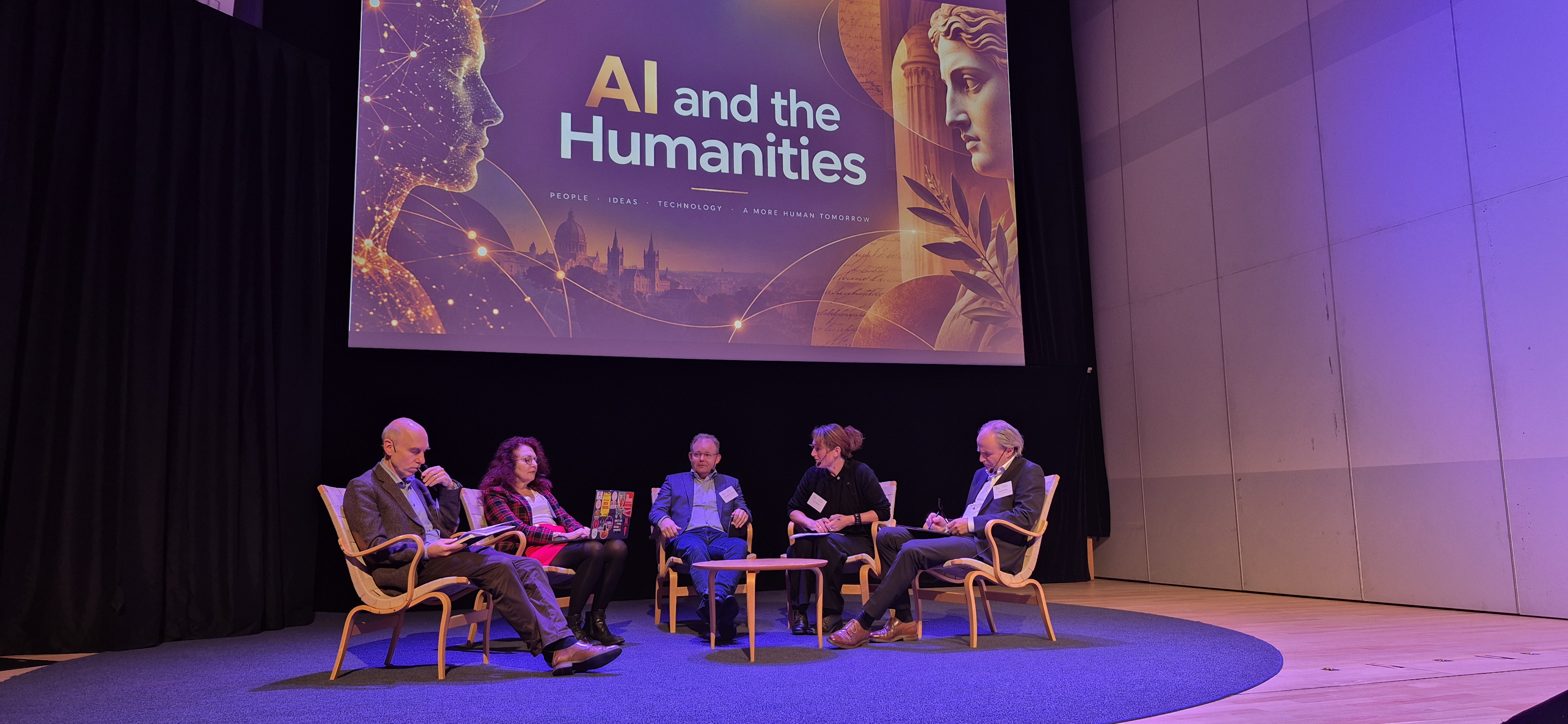
From the left: Stefan Helgesson, Dean of the Faculty of Humanities, SU, Lauren Goodlad, Professor of English, Rutgers University, Christofer Edling, Programme Director, WASP-HS, Jenny Björkman, Director of Collaboration, Riksbankens Jubileumsfond and Henrik Ekengren Oscarsson, General Secretary of Humanities and Social Sciences, The Swedish Research Council. Photo: Amanda Gonzalez Bengtsson.
Humanities Are Essential to Understanding AI
The conference highlighted both how humanities research can contribute to a deeper understanding of AI and how the technology can create new opportunities for humanities scholarship.
“Expertise in areas such as language, text analysis, the history of technology, learning, epistemology, and critical theory plays a crucial role in enabling society to engage wisely with accelerating technological change,” says Stefan Helgesson.
At the same time, AI may become an important tool for developing new research methods within the humanities.
“Clearly defined uses of AI technology can enable new forms of humanities research, in line with the examples presented during the conference.”
Conference Insights Will Inform CAISSA
The conference concluded with a roundtable discussion on future research agendas and the need for continued collaboration across disciplines. The work will now continue within the framework of Stockholm University’s upcoming AI centre, CAISSA.
“The next step following the conference is to bring the insights gained from the event into the development of the forthcoming AI centre, CAISSA, which will be launched after the turn of the year,” says Stefan Helgesson.
Read more about the conference in the blog written by the dean, Stefan Helgesson
Last updated: 2026-10-29
Source: The Faculty of Humanities