


Tropical–Antarctic connections offer clues to slow climate fluctuations
Interactions between tropical oceans and Antarctica could help explain why Earth’s climate fluctuated over thousand-year timescales during the past 8,000 years. A new study combines a long climate simulation with palaeoclimate records to investigate how these slow fluctuations may be sustained within the climate system.

Iceberg floating in the sea at Antarctica. Photo: Henryk Sadura/Mostphotos
In a new study published in the journal PNAS, researchers identify prominent temperature variability with a period of approximately 1,350 years in a simulation using an EC-Earth earth system model. Their analysis suggests that connections among tropical ocean temperatures, Southern Hemisphere winds, Antarctic sea ice and deep-ocean circulation can reinforce warming and cooling phases, while competing processes eventually help reverse them.
“Palaeoclimate records tell us that climate varied on millennial timescales even during the relatively stable Holocene, our current geological epoch. The challenge is to explain the physical processes behind that variability,” says Qiong Zhang, a climate modeller at the Department of Physical Geography and the Bolin Centre for Climate Research, Stockholm University and a senior and corresponding author of the study.
“Our results suggest that we need to look beyond the North Atlantic and consider how the tropics, Antarctica and the deep ocean interact as parts of a connected climate system.”
A possible explanation for millennial variability

Qiong Zhang Photo: Zhenqian Wang
Millennial-scale climate variability has long been recognised in palaeoclimate records, but its physical causes remain debated. Many explanations have focused on solar activity or North Atlantic circulation. This study proposes a different mechanism: interactions linking tropical ocean temperatures with Antarctic winds, sea ice and deep-water formation could both sustain temperature fluctuations and help reverse their warming and cooling phases.
In the simulation, tropical Pacific temperature patterns are linked to atmospheric circulation changes near Antarctica. These wind changes, together with changes in Antarctic sea ice, influence the formation of cold, dense water that sinks into the deep ocean. The resulting changes in ocean layering affect how heat is exchanged between the surface and deeper waters.
The analysis suggests that the competing effects of winds and sea ice on deep-water formation could help both sustain a warming or cooling phase and eventually bring about its reversal.
“Finding a recurring timescale is only part of the problem. We also need to understand what amplifies a fluctuation and what eventually turns it around,” says Zhang. “This study proposes a physical mechanism connecting those two parts of the cycle.”
Combining a long simulation with evidence from natural archives
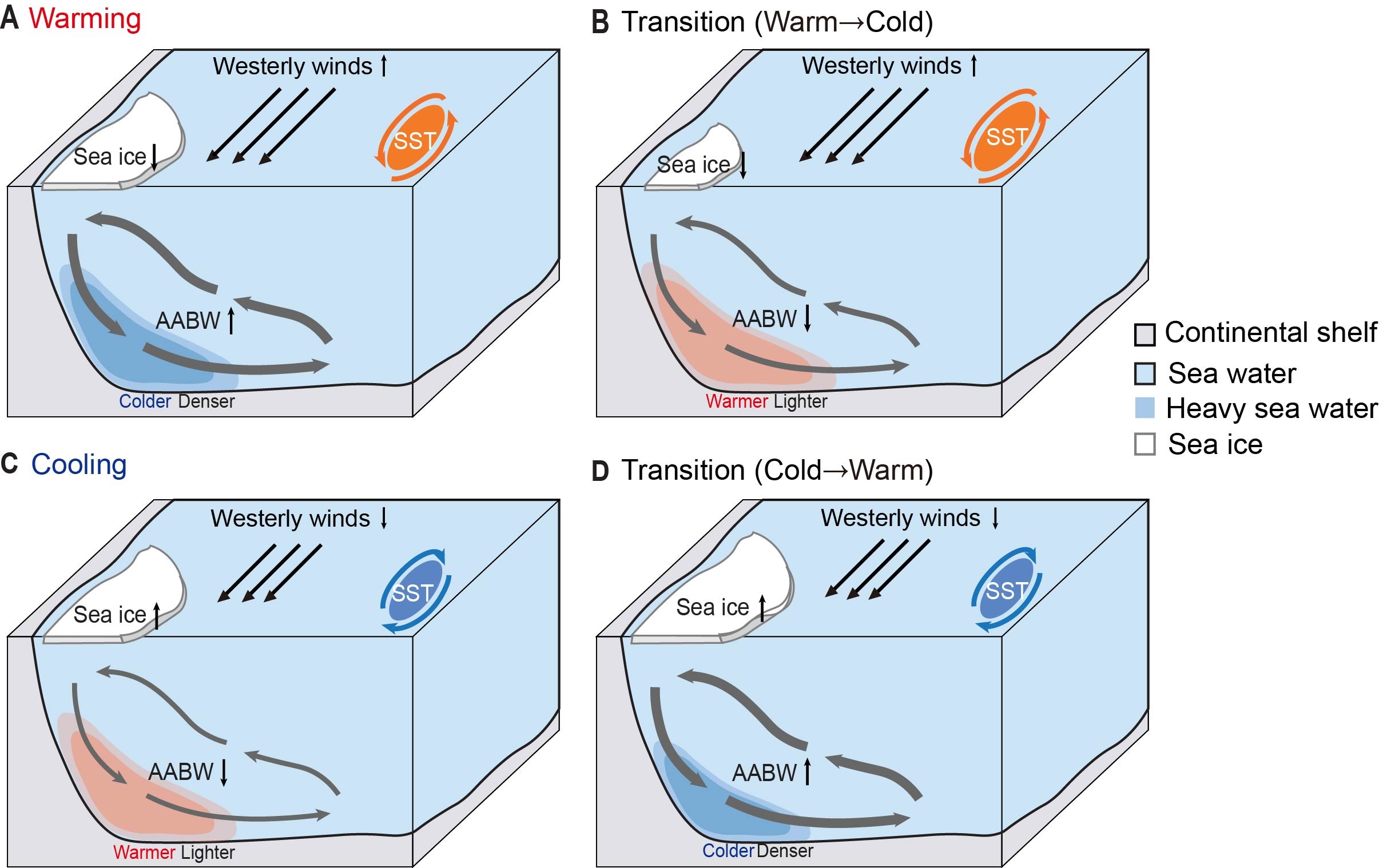
The diagram shows how connections between the tropical Pacific and Antarctica may sustain alternating phases of warming and cooling over thousands of years.
The main analysis uses an EC-Earth simulation spanning 8,000 years, with interacting atmosphere, ocean, sea ice and land. The simulation follows changes in Earth’s orbit and reconstructed greenhouse gas concentrations. Periodic changes in solar activity were not prescribed, so the simulated oscillation cannot be attributed to imposed solar-activity cycles.
The researchers compared the simulation with a global compilation of 304 published palaeoclimate records drawn from natural archives, including marine and lake sediments and ice cores. They examined recurring temperature variations after removing long-term trends. Two additional climate simulations, IPSL and TRACE, also show prominent millennial-scale variability, although the detailed mechanism was investigated using EC-Earth.
“The long simulation allows us to examine slow processes that cannot be resolved from the instrumental record alone,” says Zhang. “The palaeoclimate records provide evidence that variability on similar timescales occurred in the past, while the model helps us investigate how it could arise.”
Implications for climate modelling
The findings provide a mechanism to test in climate models, rather than a ready-made adjustment to climate projections. They draw attention to whether models adequately represent the connections among tropical climate, Southern Ocean winds, Antarctic sea ice and deep-water formation.
“Understanding climate variability across timescales helps us assess whether models capture the processes that shape both the background climate and its fluctuations,” says Zhang. “A model’s representation of these slow interactions matters when we interpret long simulations and investigate how natural variability may evolve under changing climate conditions.”
The proposed mechanism still requires further testing. Similar periodicity in different simulations does not establish that all models produce it through the same processes, and uncertainties in palaeoclimate dating limit comparisons of individual events.
“The next step is to test the mechanism with targeted experiments and examine whether the same feedbacks operate in other models,” says Zhang. “We also need to understand what initiates the oscillation and how its behaviour depends on the background climate.”
The research is an outcome of Zhang’s Swedish Research Council funded project “Investigating multi-centennial climate variability using the Earth System Model (2023-2026). She conceived the study, developed the analytical approach, carried out the 8,000-year EC-Earth simulation, and supervised first author Peng Zhou’s work on the project during her visiting PhD stay at Stockholm University.The study involved an international team and additional model data and interpretation.
Scientific contact:
Qiong Zhang
Professor at the Department of Physical Geography and Bolin Centre for Climate Research,
Stockholm University
qiong.zhang@natgeo.su.se
Last updated: 2026-10-28
Source: Communications Office