


New vehicles to reach hard-to-access parts of the polar regions
What is happening beneath thick sea ice, under ice shelves, and in other parts of the polar regions that are difficult for researchers to reach? Researchers now want to develop smart vehicles and sensors that can collect data in places that are difficult for people and research vessels to access.
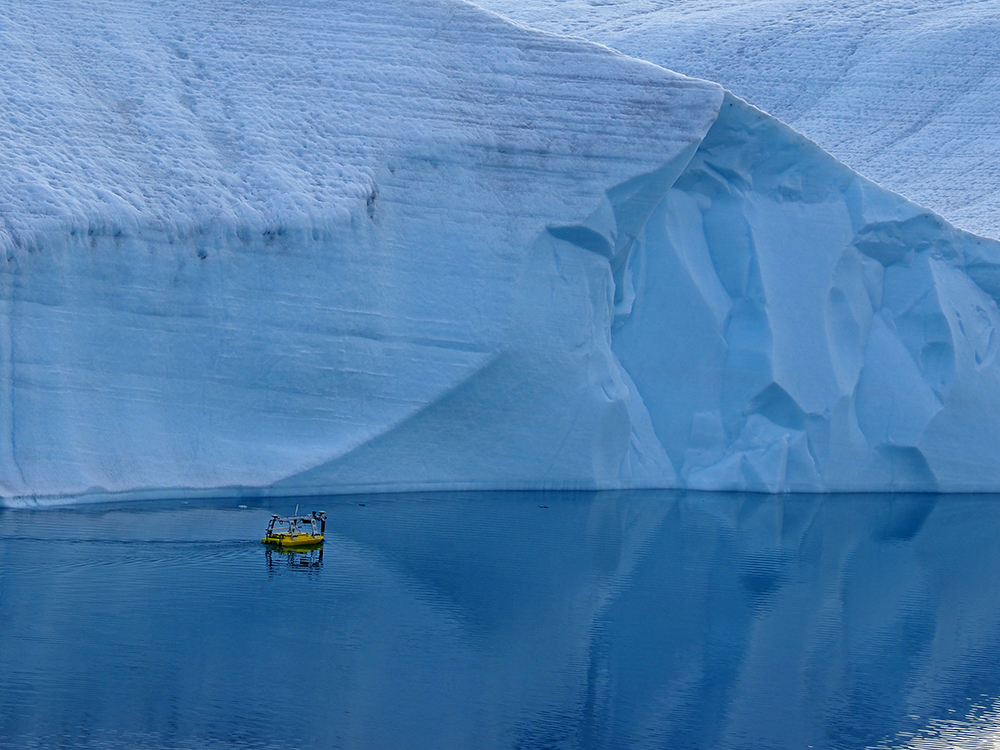
“Echoboat”, a radio-controlled survey vessel that can be used in environments where access with conventional crewed vessels is difficult, expensive or dangerous. Photo: Martin Jakobsson
Satellites, fixed monitoring stations and research expeditions provide important knowledge about the polar regions, but they cannot reach everywhere. Observations are particularly difficult to make beneath the ocean surface, under the ice and in the ground. Another challenge is collecting data in these extreme and hard-to-access environments.
“We need to be able to reach places that are currently very difficult or impossible to observe,” says Martin Jakobsson, Professor of Marine Geology and Geophysics at the Department of Geological Sciences, Stockholm University.
The researchers therefore want to develop autonomous vehicles, drones and sensor networks that can work together and collect data over long periods without constant human control.
Autonomous vehicles to make measurements beneath the ice
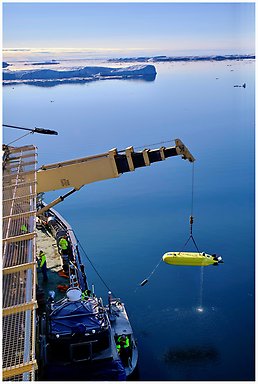
KTH’s autonomous underwater vehicle LoLo. Photo: Björn Eriksson
One area the researchers want to study more closely lies beneath floating glacier tongues and ice shelves (ice that extends out over the ocean while remaining connected to the glacier on land), where relatively warm seawater meets the ice in some places. Processes in these areas can have a major impact on how quickly the ice melts and can therefore affect sea-level rise. At the same time, these are also among the most difficult environments to study.
“We have already used autonomous underwater vehicles and managed to reach beneath some ice shelves. But we want to make these observations safer and more systematic across larger areas, and combine them with physical, chemical and biological sampling,” says Martin Jakobsson.
AI to help vehicles respond to new observations
In the longer term, the aim is for sensors and AI to enable the vehicles to respond to what they detect, rather than simply following a predetermined route. For example, an underwater vehicle that detects an unexpected change close to the ice could carry out additional measurements or take samples at that particular location.
“That would be a major step beyond programming a vehicle to follow a fixed route. The systems need to be able to interpret their surroundings and make decisions, while also navigating safely and planning how to use their limited energy,” says Martin Jakobsson.
Extreme environments place high demands on technology
Getting autonomous systems to operate for long periods in the polar regions is also a major technical challenge. Cold, ice, darkness and severe weather place high demands on power supply, sensors and navigation, among other things.
“Far beneath thick sea ice or an ice shelf, an underwater vehicle cannot surface to obtain a GPS position or communicate. If something goes wrong, it may also be impossible to recover the vehicle,” says Martin Jakobsson.
The systems therefore need to be able to deal with unexpected situations without constant contact with operators. This is also what makes the polar regions such a demanding test environment. Technology that works there could also have applications elsewhere, for example in environmental monitoring, shipping, critical infrastructure and emergency preparedness.
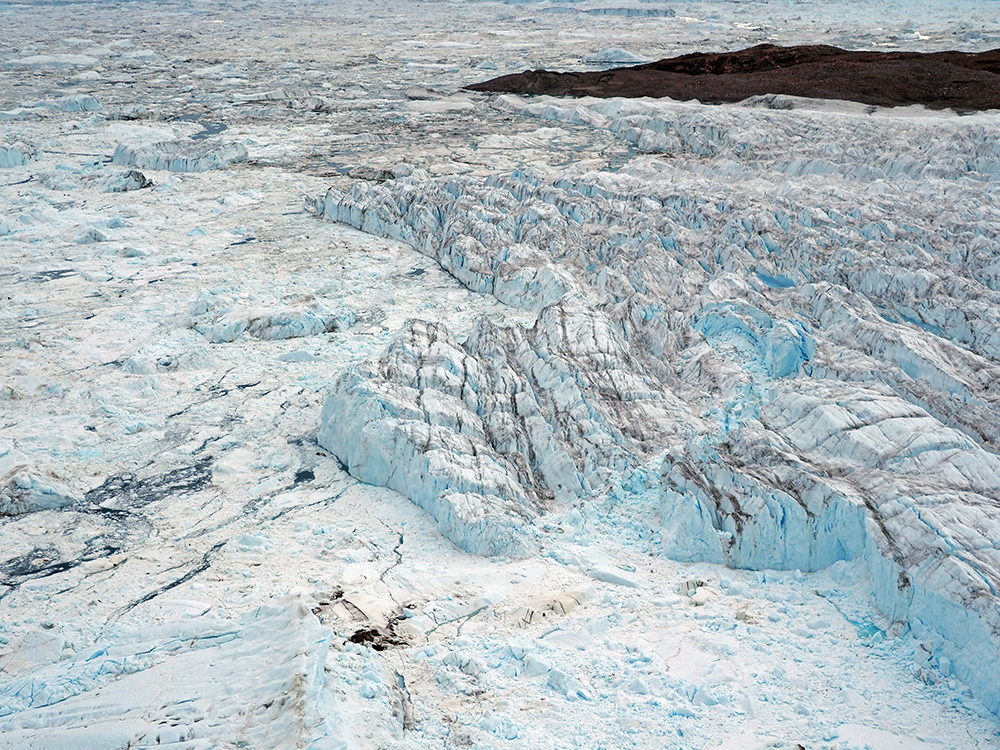
A so-called ice mélange, where the glacier’s ice tongue has broken up and pieces of iceberg can extend several hundred metres below the water surface. Researchers cannot carry out measurements here using traditional methods. Photo: Martin Jakobsson
Polar research meets robotics, AI and sensor technology
The scientific questions should determine which technologies are developed. Researchers in areas including climate science, oceanography, glaciology, geology, atmospheric science, permafrost and ecosystems therefore need to work together with researchers and engineers in robotics, AI, sensor technology, communications and autonomous systems.
At the same time, the technology raises questions around safety, responsibility, data and ethics, particularly in ecologically sensitive and geopolitically significant areas. Addressing these issues will also require perspectives from the social sciences and humanities.
“As we develop increasingly autonomous systems, we also need to consider how the technology and the data collected should be used responsibly,” says Martin Jakobsson.
Martin Jakobsson. Photo: Richard Kilström
In the longer term, the researchers hope that new observation systems will provide a more continuous and three-dimensional picture of changes in the polar regions.
“Today, we have fantastic observations from certain places and at certain times, but there are major gaps in between. I hope that in ten years’ time we will be able to monitor processes beneath sea ice, beneath ice shelves, in glacial fjords and across large permafrost areas for longer periods and in much greater detail,” says Martin Jakobsson.
Last updated: 2026-09-22
Source: Communications Office