


“Cyber security is a precondition for democracy”
For three days, researchers, business and government agencies in cyber security gathered at Stockholm University for CyberSweden 2026, one of Sweden’s largest conferences in cyber security.
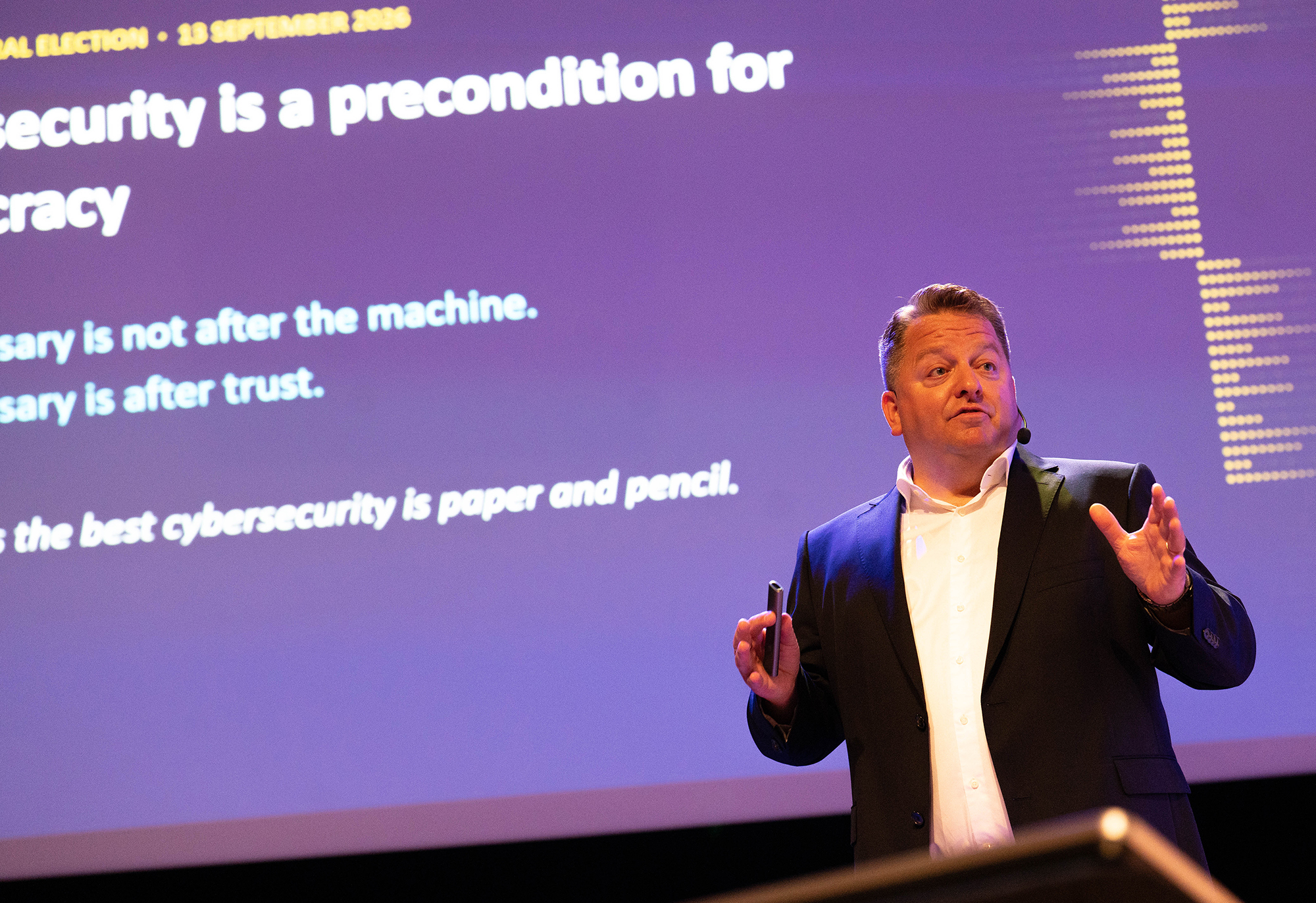
Fredrik Blix opening the conference Cybercampus Sweden in Aula Magna. Photo: Anette Gärdeklint Sylla
On 15–17 September, Cybercampus Sverige, together with Stockholm University and the research institute RISE, organised the conference CyberSweden 2026 in Aula Magna. The conference is one of the largest meeting places in Sweden where academia, business and the public sector discuss cyber security and cyber defence.
Fredrik Blix, researcher and teacher in cyber security at the Department of Computer and Systems Sciences at Stockholm University and a member of CyberSweden’s programme committee, opened the conference. He said that the venue, Aula Magna, hosts lectures with Nobel Prize laureates every year.
“Here, Daniel Kahneman talked about when human judgment fails, and Ben Bernanke talked about trust – about what happens when we stop trusting the banks. Both topics are highly relevant to those of us who work with cybersecurity,” said Fredrik Blix.
He emphasised that cybersecurity is so wide-ranging that it does not fit within a single academic discipline. He exemplified this by saying that at Stockholm University, there is research on cyber security in computer and systems science, psychology, law and political science, among others.
Without cyber security, there is no democracy
Fredrik Blix has worked with cyber security for thirty years and described two insights that shaped his view on the subject. The first came during his time as acting head of information security at the Swedish Election Authority during the 2006 and 2010 elections. There he led the work of certifying the authority’s management system for information security.
“It struck me then that if we don't have cyber security, we don't really have democracy. We went to the polls on Sunday, and Sweden has an election data system that is used to count the votes. The system that counts the votes must be secure – and the authority must be able to show that it is secure, not just claim it.”
The second realisation came when he was coaching a team in a cyber competition in Geneva.
“It was the first time I seriously understood that cyber security is not just about companies and individuals, but also about nations – about conflicts between states and about diplomacy. I came home with a new view on my subject.”
Invitation to conference participants
A new idea and a new contact. That was what Fredrik Blix hopes the conference would give the participants, regardless of whether they are at the beginning of their careers or have twenty years of experience in the field.
“If you work with technical cyber security, talk to someone who works with management and governance. If you work with cyber defence, talk to someone who works with data protection. If you are a lawyer, talk to a technician.”
Collect what no one can do alone
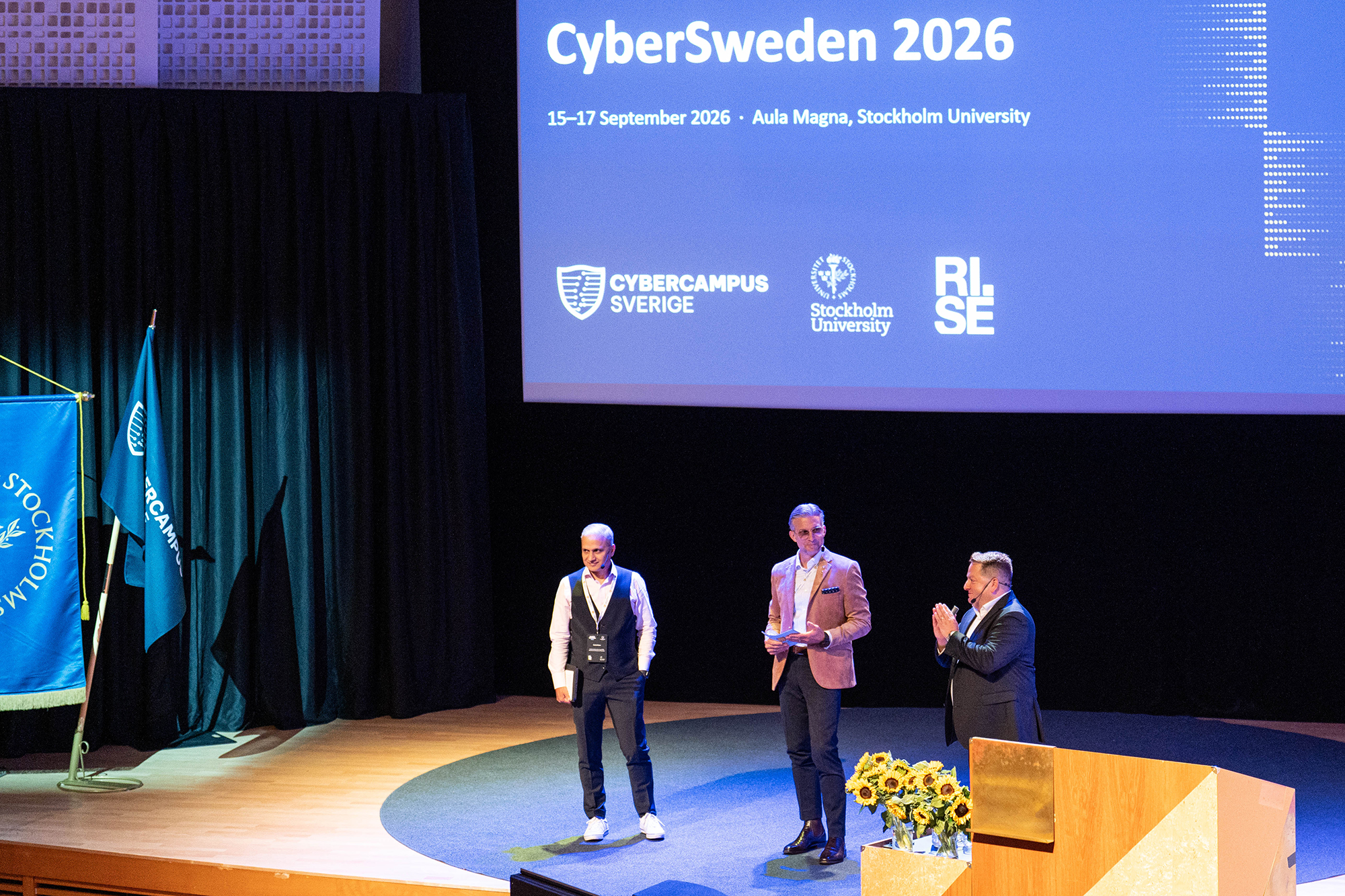
Shahid Raza, David Olgart and Fredrik Blix on stage in Aula Magna. Photo: Anette Gärdeklint Sylla
The next speaker at the inauguration was David Olgart, Director of Cybercampus Sverige. He described the basic idea behind the initiative: some challenges are too big, too complex or too urgent for a single organization to be able to solve. No single university has all the research expertise, no company can develop all the solutions and no government agency can build national cyber resilience on its own.
He said that in a few years, Cybercampus Sverige has grown into a national collaboration between industry, universities, research institutes, government agencies and the security and defence sector, where Stockholm University is one of the partners. The ambition, Olgart concluded, is to shorten the distance between knowledge and ability.
Shahid Raza, Research Director at Cybercampus Sverige and Professor at University of Glasgow, presented the research agenda for the organisation. He also said that Cybercampus Sverige has started a national graduate school with fifteen doctoral students and will in the future coordinate Swedish-led applications to the EU’s research and defense funds. Around 85 percent of the direct project funding has so far gone to sociotechnical rather than purely technical subjects – in line with what Fredrik Blix started with.
Professor Dongyan Xu. Photo: Anette Gärdeklint Sylla
The first keynote speaker was Dongyan Xu, professor at Purdue University. He spoke about different types of “cyber-physical” threats and exemplified, among other things, how drones and manufacturing can be disrupted.
During the three-day conference, the participants then listened to speakers and conversations between researchers from different universities and representatives from Sweden’s National Cyber Security Center, the Ministry of Defencse, Ericsson and RISE, among others.
Read more about CyberSweden 2026
Read more about Cybercampus Sverige
Sixty years of computer and systems sciences
2026 marks the 60-year anniversary of The Department of Computer and Systems Sciences (DSV) at Stockholm University. The department was founded in 1966 as a joint department with KTH and was one of the first in the country in computer science. Today, with Kista as its base, it is one of the Sweden’s largest departments in the subject – and through Cybercampus Sverige, among other things, DSV and KTH continue to work together.
Security research at DSV was initiated in the 1980s by Louise Yngström, today professor emeritus. This was long before the concept of “cyber security” was established – the research area was called “security informatics” back then. Yngström was Fredrik Blix's supervisor when he was a PhD student.
“We have almost fifty years of research and education in the field. The basics of data security remain, but the challenges are new,” he said.
The department has several research groups in computer and systems sciences. Many of DSV’s researchers collaborate with colleagues in subjects such as law, business administration, psychology and statistics. The department has one of Sweden’s largest master’s programmes in cyber security, and students from the programme were both in the audience andhelping out at the conference.
Research in cyber security at DSV
Master’s programme in Information Security
Last updated: 2026-09-17
Source: Communications Office