


Kebnekaise's southern peak continues to melt
This year's measurement of Kebnekaise's southern peak shows that the peak has decreased by 0.1 meters compared to last year. This is the eighth year in a row that the southern peak is lower than the northern peak.
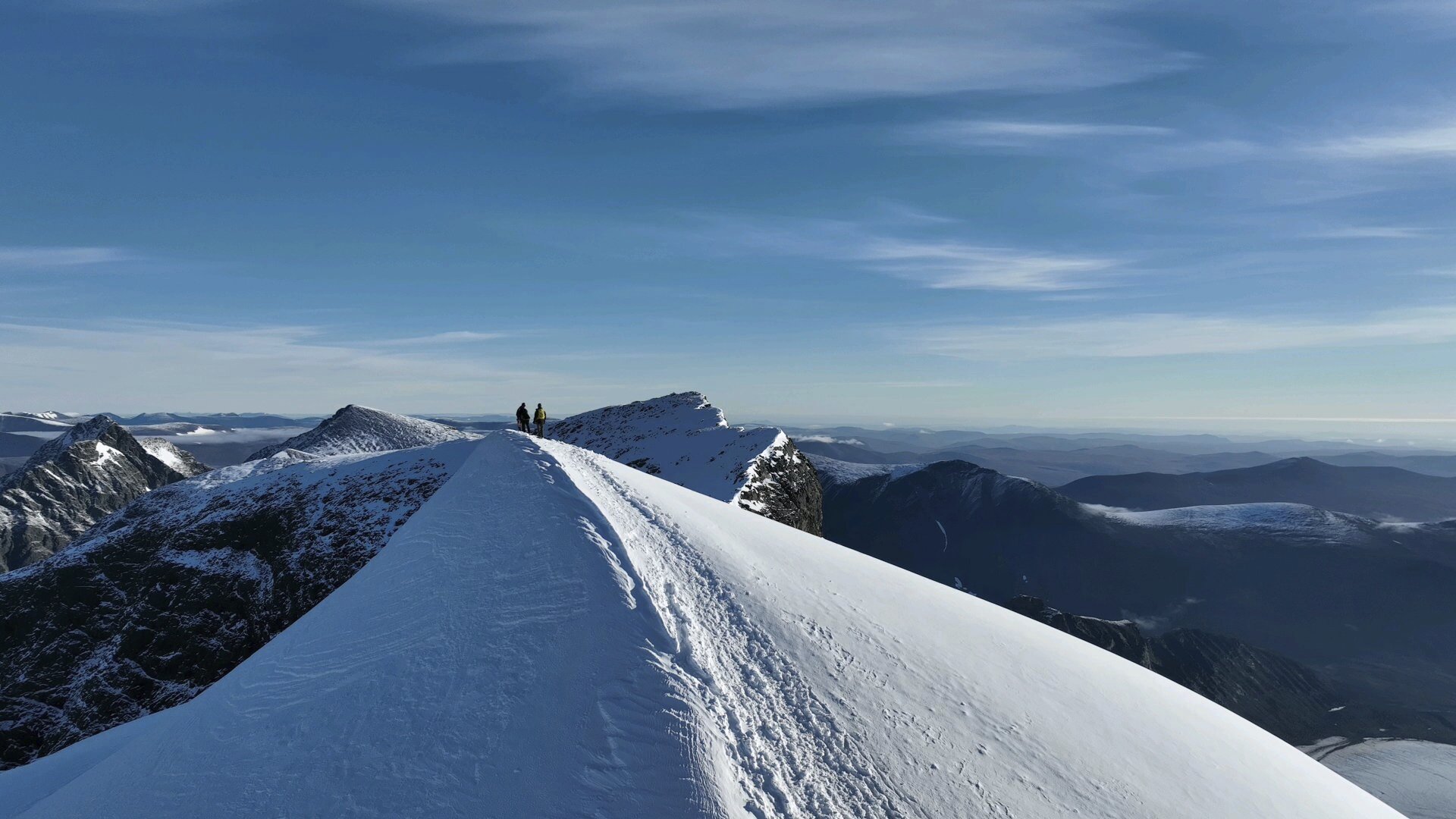
The southern peak of Kebnekaise now stands at 2,088.3 meters above sea level. The photo of the researchers from Tarfala Research Station was taken during the measurement on September 11. Photo: Tarfala Research Station.
In this year's annual measurement of Sweden´s highest mountain Kebnekaise, which is carried out by the Tarfala Research Station at Stockholm University, the ice-covered southern peak was measured at 2088.3 metres above sea level. This corresponds to a decrease of 0.1 metres compared to the same time last year. This also makes Kebnekaise's northern peak, which is ice-free and has a fixed height (2096.8 metres), Sweden's highest point for the eighth year in a row since 2019.
The southern peak is covered by a peak glacier whose height varies with snow accumulation during the winter and melting during the summer. The annual measurements, which are carried out at the end of summer, are made to be able to capture the lowest level of the southern peak before the snow starts to fall again. The melting of the southern peak varies over the years, for example, it melted by 1.5 meters last year, and by 3.4 meters during the record-warm year of 2024.
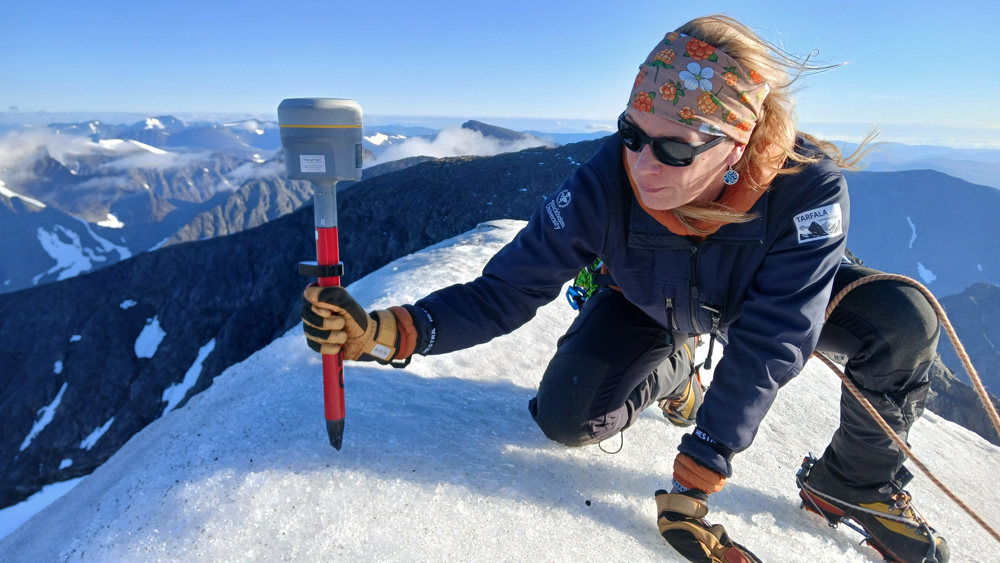
Nina Kirchner measuring Kebnekaise´s southern peak in 2025. Photo: Joachim Söderlind
“The melting of the southern peak continues, although it is slower this year compared to previous years. This is consistent with our observations on Storglaciären (the Great Glacier) and other nearby Swedish reference glaciers, where this year's final measurements are currently underway. Preliminary calculations for the glaciers' so-called mass balance* this year show mass losses. However, they are not as large as, for example, in 2024, where negative records were measured for all Swedish reference glaciers," says Nina Kirchner, Professor of Glaciology and Director of Tarfala Research Station.
Important with long-term measurements to show trends
This summer's melting shows the importance of long-term measurements that show trends instead of individual annual variations.
“The southern peak has decreased in height by about 30 metres since the first systematic measurements (in 1951 the southern peak was 2119 metres). In this context, this year's low melting is a small decrease compared to previous years, but still a decrease despite the cold summer," says Johanna Dahlkvist, station manager at Tarfala Research Station.
The peak measurement was carried out on 11 September 2026. The altitude is determined by so-called differential GPS measurement.
The mass balance of Storglaciären – continuously measured since 1946 – is the longest detailed mass balance series in the world.
Data for Kebnekaise's southern peak and the Storglaciären mass balance, as well as the other three Swedish reference glaciers (Rabot's Glacier, Rivgojiehkki and Moarhmmá Glacier) are freely available:
bolin.su.se/data/tarfala-sydtoppen-elevation-5
bolin.su.se/data/tarfala-storglaciaren-surface-mass-balance-2
bolin.su.se/data/tarfala-rabot-surface-mass-balance-2
bolin.su.se/data/tarfala-rivgojiehkki-surface-mass-balance-2
bolin.su.se/data/tarfala-marma-surface-mass-balance-2
Read more about Tarfala Research Station
*Mass balance calculations for a glacier can be compared to a bank account where income (here: snow that accumulates on the glacier during the winter and eventually becomes glacier ice) and losses (here: snow and glacier ice that melts during the summer) are added together to give either a positive balance (the glacier grows because income is greater than losses) or a negative balance (the glacier shrinks because income is less than losses).
Last updated: 2026-09-16
Source: Communications Office