


A warmer climate is changing the water cycle, but not in the same way everywhere
The water cycle is changing in different ways across the world as the planet warms. A new study shows that the amount of water evaporating from land is increasing in the Northern Hemisphere but decreasing in the Southern Hemisphere. Looking only at the global average hides these differences, with implications for drought, flooding and water availability.
Photo: Romantiche/Mostphotos
Warmer air can hold more moisture, increasing the potential for plant transpiration and evaporation of water from land to the atmosphere. But how much water actually evaporates also depends on how much water is available in soils and vegetation.
Opposite trends in the two hemispheres
In a new study published in Science Advances, researchers examined evapotranspiration, the amount of water returned from land to the atmosphere through evaporation and plant transpiration, between 2000 and 2022. The study shows that evapotranspiration increased in the Northern Hemisphere but decreased in the Southern Hemisphere. When the trends in the two hemispheres are combined, they largely cancel each other out.
“The global average can therefore give the impression that very little has happened, even though major changes are taking place in different directions. This hides changes that are important for the risk of drought, flooding and water scarcity,” says Gia Destouni, Professor of Hydrology and Water Resources at Stockholm University.
Warming does not automatically mean more evaporation
The differences between the hemispheres help explain an apparent paradox. A warmer atmosphere can create conditions for greater evaporation, while actual evapotranspiration can decrease if there is not enough water available in the landscape.
“The water cycle is not simply being turned up like a tap. It is being reorganised,” says Gia Destouni.
The results show that it is not enough to know whether temperature or precipitation is increasing or decreasing. It is also essential to understand, for example, how much water reaches rivers and streams, how groundwater and other water reserves are changing, and when during the year water is available.
“What explains why water fluxes differ between places is not always the same as what drives changes over time. We therefore cannot use today’s differences between wet, dry, warm and cold regions to predict how the water cycle will change as the climate changes,” says Gia Destouni.
About the study and related research
The study Hemispheric asymmetry in evapotranspiration reveals terrestrial water-flux redistribution is published in Science Advances. DOI: 10.1126/sciadv.aeg1633.
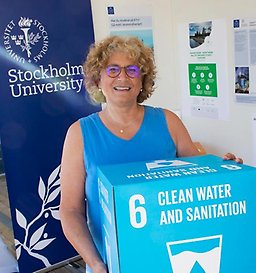
Professor Gia Destouni. Photo: Ingmarie Andersson
Gia Destouni is Professor of Hydrology and Water Resources at Stockholm University and Visiting Professor of Engineering Hydrology at KTH Royal Institute of Technology. She has also contributed to several previous studies examining how different parts of the water cycle change and interact.
An earlier study examined changes in precipitation, evapotranspiration and runoff between 1980 and 2020 in 3,614 drainage basins around the world. The results showed that these water flows often change in different directions, rather than as part of a uniform intensification of the water cycle.
Global patterns in water flux partitioning: Irrigated and rainfed agriculture drives asymmetrical flux to vegetation over runoff
Similar patterns have also been studied in the Baltic Sea region, including Sweden.
Hydro-climatic variations, changes, and extremes in the Baltic Sea Drainage Basin
A new study focusing on South America also examines precipitation, evapotranspiration and runoff together to understand changes in water flows and extreme conditions.
Enhanced extremes without intensification of South America’s water cycle from 1980 to 2010
Last updated: 2026-09-08
Source: Communications Office