


Heading to the mountains to survey curious Arctic foxes
In the coming days, doctoral students Julie Bommerlund and Chris Cockerill will head into the Swedish mountain region to spend just over a month surveying Arctic foxes, an endangered species.
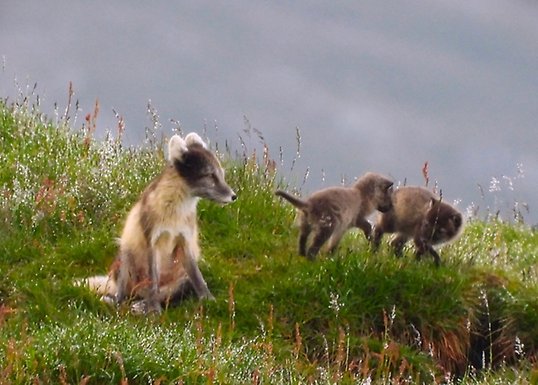
Within the framework of the Swedish Arctic Fox Project, researchers at Stockholm University and volunteers have, for more than 40 years, surveyed how many Arctic foxes are born in the Swedish mountain region. Photo: Chris Cockerill
For more than 40 years, researchers at Stockholm University have studied the Arctic fox and its behaviour, while also monitoring the Swedish Arctic fox population. Every summer since 1985, zoologists and volunteers have travelled to the Swedish mountains to observe, count and collect data.
This year’s data collection and survey of the Arctic fox population is now beginning. Two of the people heading to the mountains to study Arctic foxes are Julie Bommerlund and Chris Cockerill, both doctoral students in zoology at Stockholm University. On 2 July, they will hike into the Helags mountains, where they will stay until the end of the month. Once they have finished there, they will have a few days’ break before travelling to Padjelanta on 1 August to fit Arctic foxes there with GPS collars.
Other members of the team, Karin Norén, Docent in zoology and Johan Wallén, fieldwork coordinator, will travel to Vindelfjällen and Arjeplog a few days later, as the pups there emerge from their dens later. In Borgafjäll, there will also be a group of volunteers working. Other mountain areas will be surveyed by staff from the county administrative boards. The survey will continue until the entire mountain region has been covered. How long this takes depends on several factors, including how many pups there are, how large they are, the weather and how long the volunteers are able to stay and help.
Julie and Chris ready for the survey
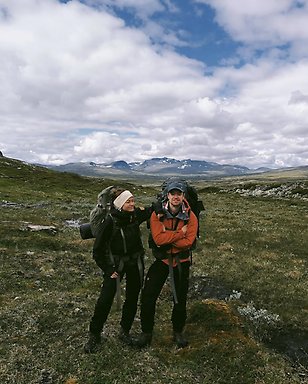
Julie Bommerlund and Chris Cockerill.
This will be Julie’s third season surveying Arctic foxes. For Chris, it will be his eighth season, meaning that he has been involved since long before he began his doctoral studies within the Arctic fox project.
According to Julie and Chris, the most important part of preparing for a survey is checking that they have all the equipment needed to move safely through the mountains, and that everything works as it should. There is also some equipment that must be in place for the survey itself to be carried out. It is very important to bring everything they need, as they cannot return to Stockholm to collect anything once they are out in the mountains. The necessary permits are also an important prerequisite for the survey work. Beyond that, much of the preparation involves coordinating the work with the volunteers. This includes selecting who will take part, allocating them to different mountain areas, and educating and training them for the work ahead.
What is most fascinating about Arctic foxes?
Julie: How they can survive in such extreme cold and travel such long distances, several thousand kilometres, despite being so small. And how incredibly cute they are.
Chris: How curious they are. It is surprising how unafraid they can be of humans. And how well adapted they are to the cold climate.
What is the best thing about being out surveying?
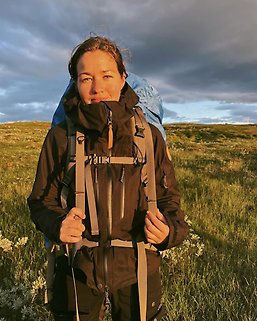
Julie Bommerlund
Julie: The days when you are at a den that you are going to monitor for a few days, the sun is shining, the view across the mountains is amazing, everything is calm and quiet, and all you need to do is observe lots of Arctic fox pups playing. The work is also an important part of conserving the species. You can basically forget all your other tasks then. And there are quite a few days like that.
Chris: Being out in nature. It is a huge relief after spending most of the time in the office. It is also fascinating to see the species you study out in the wild, where it belongs, instead of only seeing it in a zoo. It is wonderful to experience them in their natural environment. Of course, it also feels meaningful to be out there and contribute to the conservation of this species.
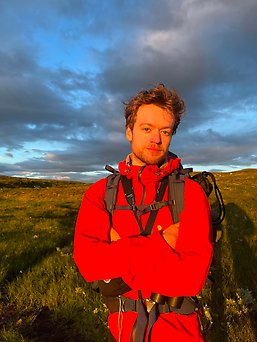
Chris Cockerill
What is the hardest part of the survey?
Julie: I know there is supposedly no such thing as bad weather, only bad clothing, but thunder and lightning when you are up in the mountains is absolutely terrifying.
Chris: The days when you have to stay at a den for several days and it is either extremely hot with no shade, or raining all the time, while the pups never come out of the den. Then the one-person tent starts to feel a bit like a coffin. There are quite a few days like that too.
What do you hope to experience during this year’s fieldwork?
Julie: I hope to experience a very active Arctic fox year, with many large pups at several dens, including dens that have not been active for a couple of years.
Chris: I hope for a lot of lemming activity, so I can experience a year like the documented lemming years, when lemmings are everywhere and “yap” at you, and the tundra really comes to life. I am sure the foxes are hoping for that too.
Surveys are needed
Chris and Julie emphasise that these surveys are needed to keep track of the Arctic fox, so that researchers can assess the state of the population, what measures are needed to help it, and whether previous conservation efforts have had an effect. This is becoming increasingly important as climate change alters the landscape and pushes the foxes higher up into the mountains, into smaller and more fragmented areas. As a result, the subpopulations also become more isolated from one another.
“I also use some of the information and DNA samples from the Arctic fox in my doctoral thesis, where I am trying to take a closer look at the foxes’ movement patterns and how the subpopulations in the Fennoscandian mountain region are connected. This region includes Norway, Sweden, Finland and parts of Russia,” says Julie.
At the turn of the millennium, the Arctic fox was close to extinction in Sweden, Norway and Finland. At that time, there were only 40 to 60 individuals. The Fennoscandian population is still classified as endangered today. During the 2025 fieldwork, a total of 97 Arctic fox litters were documented in this region: 56 in Sweden, 38 in Norway and 3 in Finland. The number of adult individuals was estimated at around 526. By comparison, the figure was around 50 individuals in 2000, so the measures that have been implemented to help the Arctic fox appear to have had a positive effect, and the trend is moving in the right direction.
Follow this year’s fieldwork on Instagram: @fjallravsprojektet
Last updated: 2026-06-29
Source: Communications Office