


Migratory birds’ songs reveal dialects between populations
Every spring, millions of migratory birds return to their breeding grounds. Once there, song plays a crucial role – both in establishing territories and in attracting a mate. Using new analytical methods, researchers at Stockholm University can now track how birdsong changes over time and how dialects emerge between different populations.
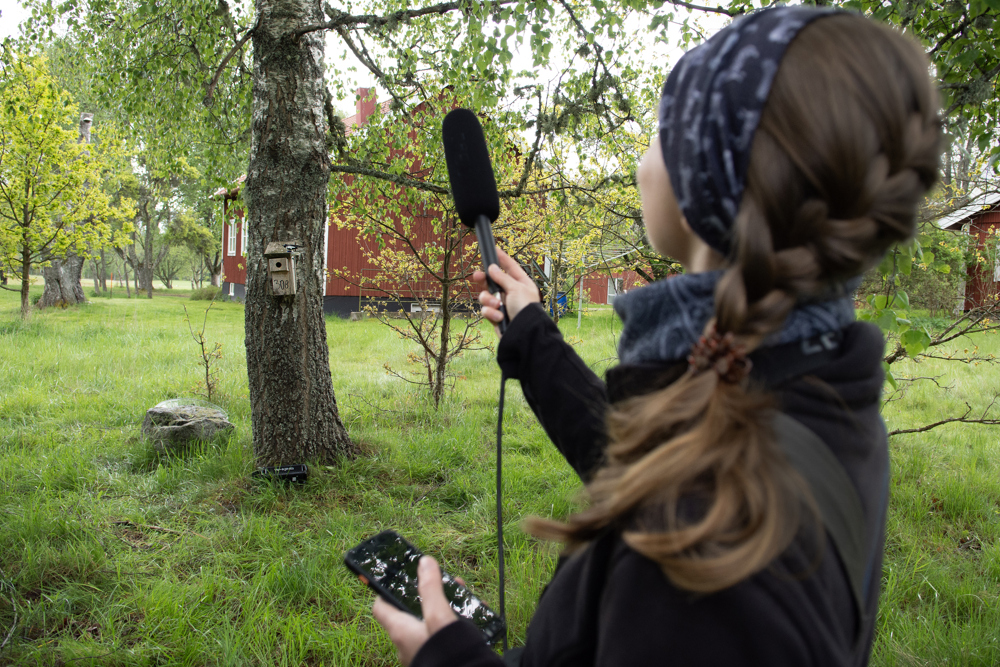
Recording of bird song at Tovetorp research station. Photo: Ingmarie Andersson/Stockholm University
“I always keep the recording equipment ready in my backpack when I’m out in the field,” says David Wheatcroft, Associate Professor of Zoology.
He is one of two directors of Tovetorp Research Station in Södermanland. There, he and his colleagues study pied flycatchers, small migratory birds that return to Sweden every spring after spending the winter in West Africa. After the long and risky journey, the males are the first to arrive at the breeding grounds and immediately begin singing intensely to establish territories and attract females.
How birds learn to sing

David Wheatcroft. Photo: Annika Hallman/Stockholm University
A large part of David Wheatcroft’s research revolves around a fundamental question: how do birds learn to sing?
“There are clear similarities with how humans learn language. Young birds listen to their surroundings and gradually develop their song,” says David Wheatcroft.
Just a few weeks after hatching, the chicks begin shaping their vocalisations through a combination of innate abilities and social learning. They listen to adult birds, especially their father, but their development involves more than simple imitation.
“They also seem to fine-tune their song through practice. Unlike humans, they receive no active feedback, yet they develop a functional song – without parents telling them when something is wrong.”
Song determines mating success
Birdsong changes over time, much like human languages. Small variations in how songs are learnt are passed on between generations and can eventually lead to clear differences between populations – known as dialects. To human ears these differences may sound subtle, but for the birds themselves they can be crucial.
Listen to the difference between pied flycatchers from Swedish and Spanish populations in the clip below:
What is a dialect in birds?
Dialects in bird vocalizations refer to consistent regional differences in songs within a single species. These differences may involve the sounds that make up a song (i.e., song syllables) or its overall structure. They arise when young birds learn their song locally and pass it on between generations, much like dialects in human language. Dialects can influence both recognition and mate choice.
Song plays a crucial role when birds choose a partner, but also when identifying members of their own species. Songs from other species attract no interest – birds prefer songs they recognise. Even variations within the same species matter.
“It seems that moderation works best. If the song differs too much, for example between populations that live far apart, it becomes less attractive.”
In pied flycatchers, song also changes over the course of the breeding season. Before mating it is more complex, but it becomes simpler once the male has found a partner and produced offspring.
“This is probably linked to hormones. Testosterone levels are high at the beginning of the season and decline later on,” says David Wheatcroft.
AI hears what we cannot
Understanding these changes requires large amounts of data. For a long time, researchers have been limited by how much recorded material could be analysed manually. This is where artificial intelligence has become a crucial tool.
“We can record enormous volumes of sound, but it’s impossible for a single person to analyse it all,” says David Wheatcroft.
Using AI, researchers can automatically detect birdsong in long recordings, identify species and analyse variation over time. This makes it possible to uncover patterns that are too complex for the human ear to perceive.
“It’s so extensive that you wouldn’t even know where to begin without these methods.”
The new technology also opens up entirely new research questions: which parts of the song actually change over time? How do dialects differ between populations? And what exactly are the birds themselves listening for?
The next step is to analyse recordings spanning several decades. The combination of classical fieldwork and advanced data analysis is giving researchers a more detailed picture of migratory birds’ lives than ever before.
Pied flycatcher
The pied flycatcher is a long-distance migrant that winters in West Africa and returns to Sweden each spring. The journey takes around three weeks and is demanding. When the birds arrive, they have almost no energy reserves left, making them particularly sensitive to cold weather.
At the same time, the species is in decline. Over the past ten years, the population has decreased by around 20 per cent, and the species is now red-listed in Sweden. The causes are likely multiple, including climate change, reduced insect availability, changes in habitats and risks along the migration route.
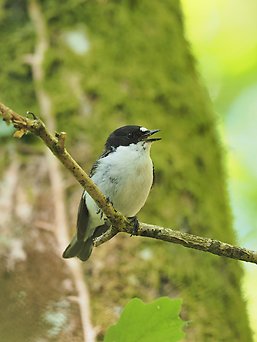
Pied Flycatcher. Photo: Tom Wallis
Last updated: 2026-05-04
Source: Communications Office