


Portuguese ambassador visits Stockholm University: Language, culture and collaboration in focus
When Portugal’s new ambassador to Sweden, Francisco Alegre Duarte, visited Stockholm University, the focus was on how language, culture and academic collaboration can support long-term international relations.
Duarte recently served in Angola as ambassador, where in a previous assignment he led one of Portugal’s largest cultural centres.
“In Angola, we focused a lot on culture. We worked with poets, writers and painters, giving them a platform to expose their work and grow as artists. Culture became a tool for education and later connected to universities, also through the Portuguese School of Luanda,” he says.
In Sweden, the context is different. Portuguese is a global language, but still has a limited presence in Swedish higher education. Duarte notes:
“The challenge is to promote Portuguese. It is one of the most spoken languages in the world, especially in the southern hemisphere, where it is the first language. It is a language of culture and business—you cannot do business in many of these contexts without Portuguese.”
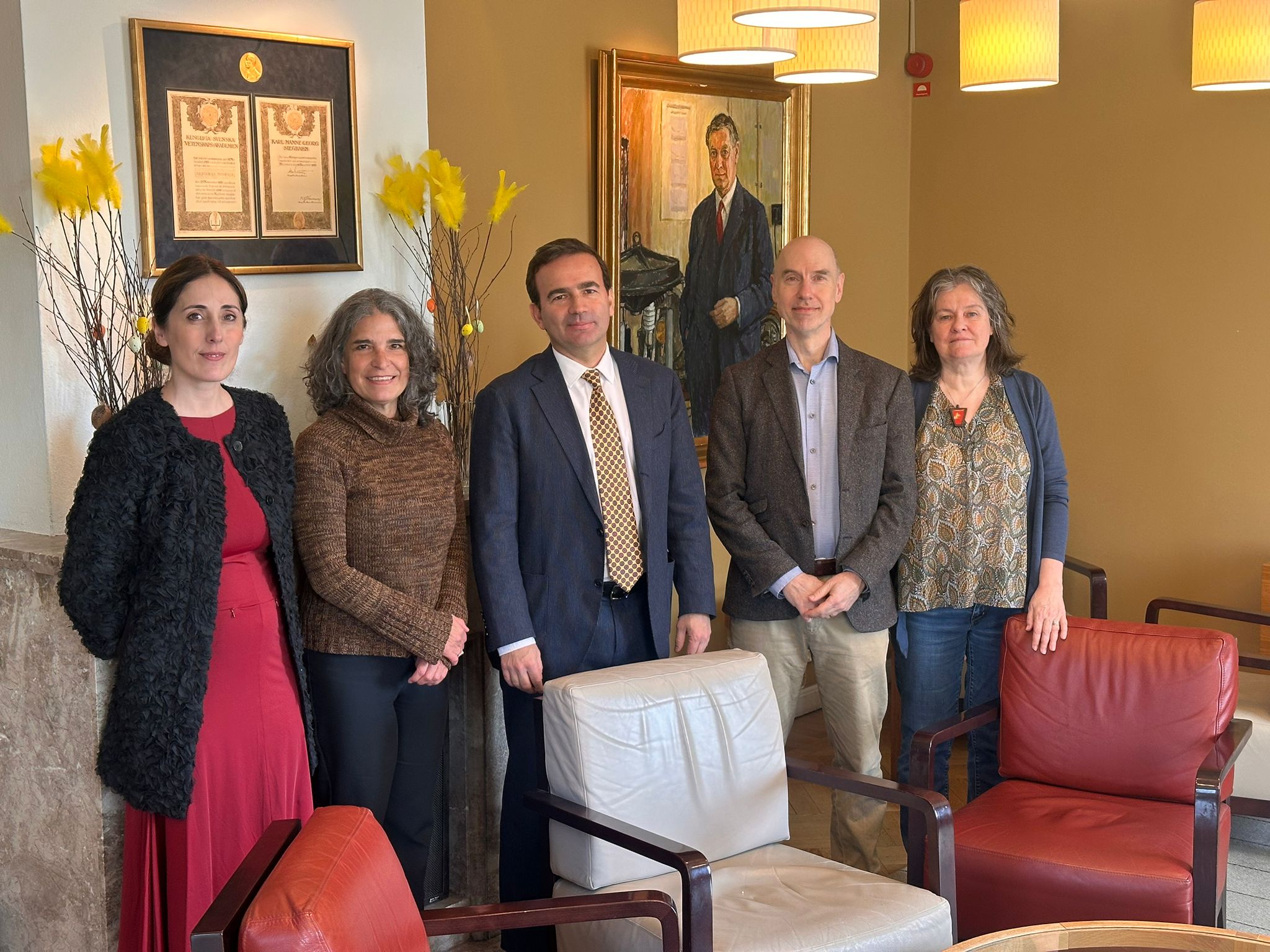
From the left: Vera Fonseca, guest lecturer at Stockholm University and runs Portuguese language centre, Laura Álvarez López, Vice-Dean of the Faculty of Humanities, who chairs the steering group leading the work of the Forum for Language and Literature, Stefan Helgesson, Dean of the Faculty of Humanities, Chatarina Edfeldt, literary scholar and associate professor of Portuguese at the Department of Romance Studies.
A platform for long-term collaboration
At Stockholm University, the Portuguese language centre, run by Vera Fonseca in collaboration with the Camões Institute and the embassy, plays a central role in this work:
“It has been, both professionally and personally, very fulfilling to, semester after semester, meet in the classroom at SU multicultural groups of students who come to learn not only the Portuguese language, but who in, general, are also eager to know more about the broad cultural universe this language has to offer. Organizing cultural activities around the Portuguese language for the students and the general public just enriches this experience even more” says Vera Fonseca.
Laura Álvarez López, Vice-Dean of the Faculty of Humanities, who chairs the steering group leading the work of the Forum for Language and Literature, adds:
”We highly value this collaboration with Portugal’s language institute, Instituto Camões, which is part of the Portuguese Ministry of Foreign Affairs. It is one of several partnerships with language and culture institutes that help sustain and develop languages with smaller student enrolments at our university.”
Through guest lectures, film screenings and participation in cultural events, the centre contributes to increasing the visibility of the Portuguese-speaking world in Sweden.
“These initiatives are essential. A language centre is not only about teaching a language, it is about building networks and creating long-term connections between countries,” Duarte emphasises.
From language to global relevance
Portuguese is a language shaped by multiple regions and influences.
“It is a very rich and diverse language. It has influences from Africa, from Brazil, from different cultural contexts. It is constantly evolving,” Duarte says.
He also highlighted the importance of increasing the international visibility of Portuguese literature:
“We would like to see more Portuguese speaking authors translated into Swedish. Translation is important, also in relation to recognition such as the Nobel Prize in Literature.”
Duarte further noted that there is potential to strengthen collaboration between the embassy and Swedish universities, as well as to connect Portuguese professionals working in Sweden in a more structured way.
Looking ahead
Duarte described Portugal and Sweden as countries with similar outlooks.
“Both countries have a global perspective. We invest in education and innovation, and in many ways, we are countries that punch above our weight in terms of culture and soft power.”
Looking ahead, he emphasised the importance of stronger engagement between Sweden and the Portuguese-speaking world.
“There is potential for Sweden to be more present and for us to establish partnerships, especially in countries like Angola, which will be increasingly important economically and demographically.”
Last updated: 2026-04-24
Source: Communications Office