


AI in Focus as Human Science Researchers Meet at Stockholm University
In March, researchers from several departments within the Human Science Area at Stockholm University gathered for an open seminar and community-building event on AI in research. The event combined short lightning talks with suggested themes for group discussions that aimed to open a dialogue on how AI is affecting research practice, methods, and academic culture.
The initiative was led by Teresa Cerratto Pargman, Professor of Human–Computer Interaction at the Department of Computer and Systems Sciences and AI coordinator for the Human Science Area. She explains that the event was inspired, on the one hand, by the town hall forum organized by the Natural Sciences area last year, during which colleagues expressed great interest in exchanging and discussing issues pertaining to AI across the research life cycle. On the other hand, the event was also inspired by an inventory of AI projects at our university, which identified more than 100 projects conducted between 2015 and 2025 in the human sciences.
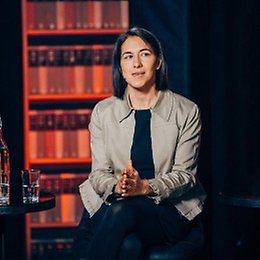
Teresa Cerratto-Pargman, Professor of Human–Computer Interaction at the Department of Computer and Systems Sciences and AI coordinator for the Human Science Area.Photo: Adam af Ekenstam
Yvonne Svanström, Dean of the Faculty of Social Sciences and Vice Rector for Human Science, and Stefan Helgesson, Dean of the Faculty of Humanities and Vice Rector for Human Science, welcomed everyone to the event.
“Motivation was twofold. First, at a similar event in the natural sciences we saw strong interest in discussing how AI is used in research and what risks and opportunities it brings. Second, our mapping showed there is great competence and epistemic capital on AI in the human sciences as illustrated by the many projects gathered in the mapping report,” says Teresa Cerratto Pargman.
She notes that critical perspectives from the human sciences are needed at a time when AI is often framed in terms of rapid technological development.
“We need to reflect on our relationship with technology and AI, contribute to a critical understanding of how AI is changing research practice and provide intellectual and sensible guidance on which research on AI is needed, where and why.”
Short talks and discussions to broaden the conversation
The programme featured lightning talks followed by group discussions. The format was chosen to give participants an overview of different research projects without making the event too extensive.
“We wanted to share examples from different projects so our colleagues could gain an initial understanding of the issues at the core of research on AI in our area, but also to create space for discussion and reflection across disciplines,” says Teresa Cerratto Pargman.
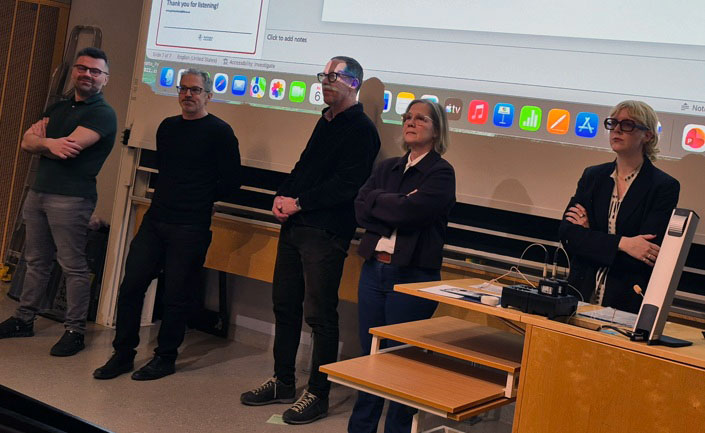
Panagiotis Papapetrou, Professor of Data Science, Stanley Greenstein, Associate Professor in Law and Information Technology, Håkan Fischer, Professor of Human Biological Psychology, Beáta Megyesi, Professor of Computational Linguistics, Nora Germundsson, Postdoctoral Researcher at the Department of Computer and Systems Sciences and the Department of Social Work.
Among the speakers were researchers from linguistics, data science, law, psychology, and social work. Several highlighted how AI is already reshaping research practice. Beáta Megyesi, Professor of Computational Linguistics, emphasizes the significance of language models:
“One transformative development is the rapid progress in language models that can analyze and generate human language at scale. In the coming years, an important focus will be learning how to guide and control these systems through careful selection of input data, transparent evaluation, and thoughtful design so they support rather than distort humanistic inquiry.”
Panagiotis Papapetrou, Professor of Data Science, also points to language models as central to research work:
“LLMs (Large Language Models) of course! They can substantially speed up related literature search, summarization, and even referencing. They can develop “seed” ideas and novel lines of research. They can also help in brainstorming and giving feedback to existing ideas.”
Håkan Fischer, Professor of Human Biological Psychology, instead highlights AI’s growing multimodal capacity:
“For me, the most important development is AI is its growing ability to work across different kinds of material at once, such as text, speech, images, and video. In the human sciences, that opens up new possibilities for studying human behavior and experience in ways that are both broader in scale and closer to real life. I think this will change not only how we analyze data, but also what kinds of questions we can realistically ask.”
Risks, opportunities, and critical thinking
Several themes recurred throughout the presentations and discussions, particularly questions around risks, critical thinking, and how AI should be used responsibly in the research process.
Stanley Greenstein, Associate Professor in Law and Information Technology, stresses the need for clear guidelines:
“Developments in the domain of large language models and generative AI will undoubtedly require us to re-evaluate the definition of knowledge itself. A risk with the use of AI in research is that it is used to cut corners, which in turn will have negative effects.”
Nora Germundsson, Postdoctoral Researcher at the Department of Computer and Systems Sciences and the Department of Social Work, highlights structural concerns:
“A currently underestimated risk is the uncritical procurement of US-based AI systems by universities, which raises both ethical and legal concerns – especially in light of recent political developments in the United States. Prioritizing EU-based alternatives could enable more sustainable investment in locally developed models, reducing reliance on providers like OpenAI and Microsoft.”
Panagiotis Papapetrou underscores the importance of critical scrutiny:
“One risk is to over-rely on what AI produces without any critical thinking. AI cannot always produce novel and groundbreaking ideas. It can however help develop ideas that it is given as input. All claims should not be trusted blindly. They should always be verified.”
Håkan Fischer points to how AI can create a false sense of neutrality:
“I think one underestimated risk is how easily AI can create an illusion of objectivity. Because the outputs often look fluent and systematic, it is easy to forget how much they reflect existing biases in data, models, and researcher choices.”
Teresa Cerratto Pargman notes that these discussions show how central AI has become to research practice.
“AI touches us at the core of our academic practice. The discussions were vivid, they reflected colleagues’ engagement and positions vis-à-vis AI in research and competence development, and it became clear how meaningful it is to talk with colleagues about these issues.”
AI as a tool – not a replacement
Several researchers shared concrete examples of how AI has changed research practice. Beáta Megyesi describes how natural language processing opens new possibilities:
“One clear example is the use of natural language processing to analyze large collections of texts that would be impossible to read manually.”
Håkan Fischer highlights how AI can support the analysis of open-ended textual data:
“One clear example is the analysis of large amounts of open-ended text, such as interview transcripts or survey responses.”
At the same time, Teresa Cerratto Pargman stresses that AI as the unprecedented technology it is, it should be explored critically, regulated, and used so that it challenges our thinking, not as a substitute for it.
“A key question is what competencies do we researchers develop with AI in research, and what knowledge and competence do Ph D students and young researchers need to develop today to meet AI in their workplace?”
Judgement more important than technology
In discussions about future competencies, one point stood out clearly: technical knowledge alone is not enough.
“The typical answer is AI literacy, but above all human judgement, meaning human reasoning is key. We need to be able to understand, assess and judge the responses provided by AI systems so we can generate common criteria to evaluate AI systems and discuss potential consequences of their use together with colleagues,” says Teresa Cerratto Pargman.
She sees the event as a first step in a longer-term effort. The hope is that participants will learn about others’ projects, identify new perspectives, concepts, methods from other disciplines, connect with colleagues and continue the conversation.
“It was insightful to realize how colleagues in linguistics, data science, law, psychology and social work approach AI in their disciplines. Creating spaces where researchers can meet and discuss disciplinary issues due to the use of AI in their research or teaching is both valued and needed.”
Plans are underway for further cross-faculty seminars and continued work related to AI development within the Human Science Area at Stockholm University.
Last updated: 2026-03-25
Source: Human Science academic area