


Forgotten romance novels shaped the image of the modern marriage
What should a happy marriage look like? Who carries responsibility for intimacy and shared life? And why do certain conflicts in contemporary relationships feel strangely familiar? In her research, historian Emma Flärd examines how marriage and intimacy are portrayed in Swedish marriage novels from the 1930s to the 1950s. Through these novels, it is possible to trace how ideals of love changed and how much still persists today.
“This genre is a cousin of the romance novel as we know it today. Whereas romance novels often end at the altar, the marriage novel begins after the wedding,” says Emma Flärd, a doctoral student in the Department of History.
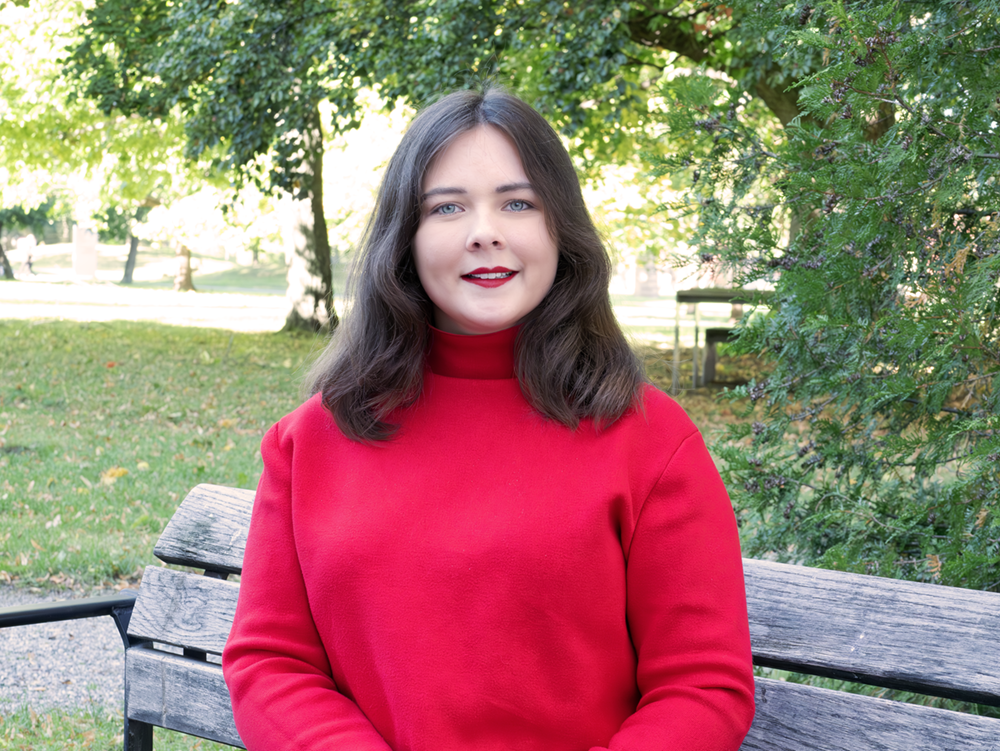
Emma Flärd, PhD candidate. Photo: Sofia Ekelund.
Love after the wedding
Marriage novels were a highly popular genre during the first half of the twentieth century. They did not centre on passionate infatuation, but on what followed: everyday life, conflict and the question of what a partnership actually demands.
“The novels focus on what comes next. Problems, expectations and sometimes unhappy endings. There is no guarantee that marriage brings happiness,” says Emma Flärd.
The genre’s popularity is linked to the fact that marriage was a political and social issue during this period. With a few exceptions, the novels depict the urban middle class.
“They address gender, family, work and financial provision. For example, until 1939 state employers had the right to dismiss women who married or became engaged. Major social questions like these were hotly debated and left their mark on literature.”
A happy home as a shared project
During this period, ideals began to shift. From an older model in which men and women had clearly separated roles, new ideas about companionship emerged.
“One can see a movement towards helping one another and sharing burdens. This concerns household responsibilities, but also sexuality and the idea of partners as equals,” Emma Flärd explains.
Marriage was increasingly portrayed as something that required emotional closeness.
“The ideal became to do things together and to share both burdens and happy moments. If distance grows, love risks fading and the marriage may fall apart.”
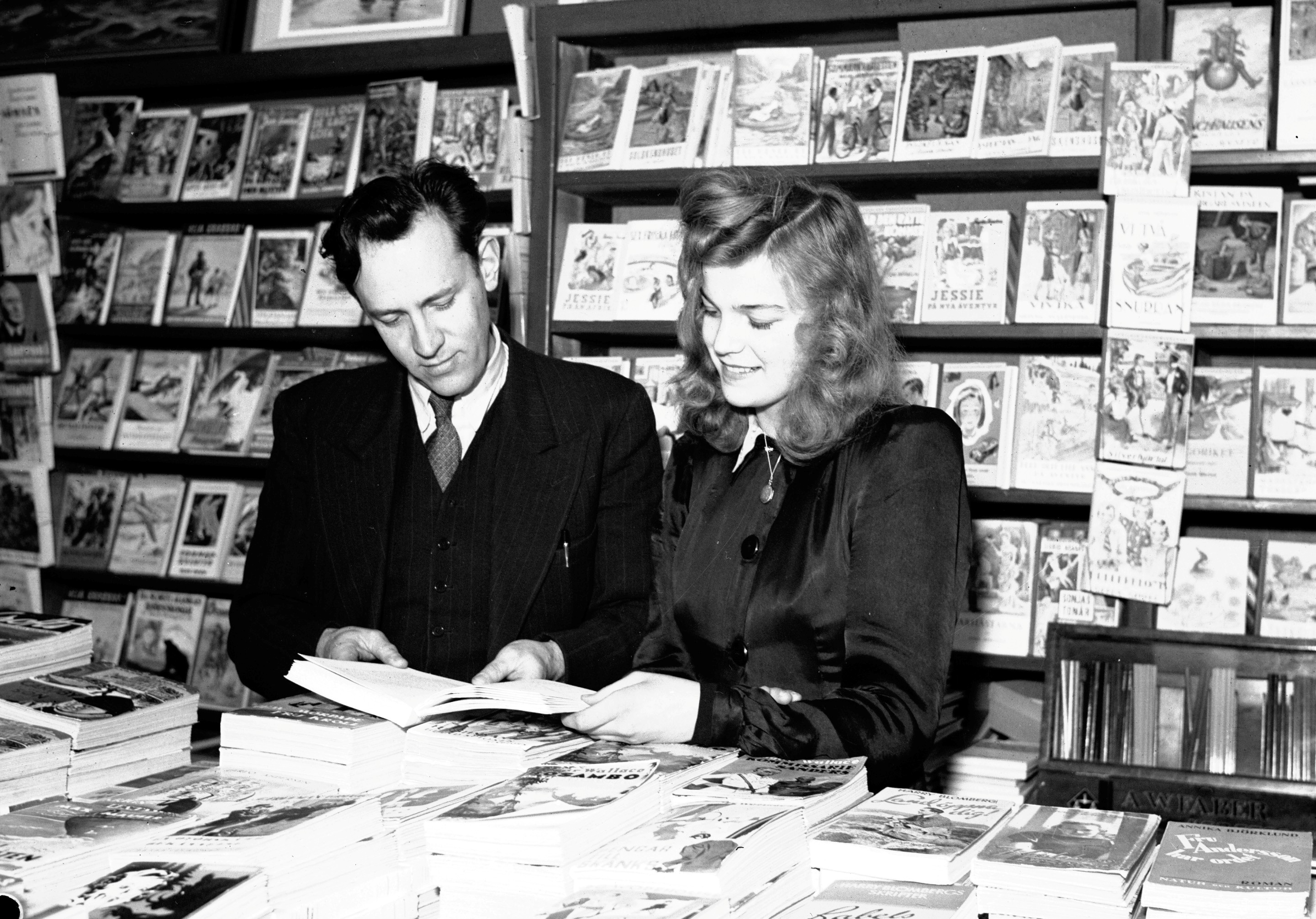
Bookshop in Gävle, Lucia Day 1943. From Norrlandsposten. Photo: Carl Larssons Fotografiska Ateljé AB, Gävle.
Infidelity, desire and threats to marriage
The novels are often filled with conflict. Infidelity and divorce are recurring themes, as is the fear that a relationship will stagnate. In the novel Så blankt havet ligger (1941), which won a prize for the best Swedish marriage novel, author Kerstin Göransson-Ljungman portrays a poor fishing couple over the first four decades of the twentieth century. They struggle with children and work, live apart for periods when the husband is called up for military service, are unfaithful to one another and fear that their marriage has broken down. Only towards the end of the novel, when they decide to live as equals in line with the new ideals of their time and to share “[o]ur joy and our work. Our sorrow and our hopes and our plans for the future”, are they able to find genuine happiness together. Marriage remains the primary ideal form of partnership, but it is a marriage that demands closeness and effort from both spouses.
“Another common motif is sexuality as both a threat and a liberating force. It may involve a middle-aged man who grows restless and falls in love with a younger woman, breaking up an otherwise successful marriage. This is presented as problematic but occurs frequently. It can also involve an unhappily married man or woman who finds happiness and personal development through an extramarital relationship,” says Emma Flärd.
Relationship difficulties and divorce are also central concerns.
“Divorce raises the question of when it is acceptable to separate and what happens afterwards. It is a major recurring issue. Divorce was widely debated in society throughout my research period. Some saw it as progress, others as a threat to marriage and morality. That tension is visible in the novels.”
Emma Flärd also notes that the novels were often marketed as more than simple entertainment.
“Publishers and critics described them as didactic tools. Readers were encouraged to use them to understand good and bad marriages and to apply that knowledge to their own relationships.”
Sexuality is more present than expected
One aspect that surprised Emma Flärd is how much space sexuality occupies in these novels.
“There is a great deal of sex. Not described in the same detail as today, but sexuality is extremely present in many of the books.”
This suggests that ideas about intimacy in the 1930s to 1950s were not only about duty, but also about pleasure and closeness.
“In the novel Tag min hand (1947), author Göte Ekström writes that ‘In the bedroom, paths either converge or diverge. In the long run, nothing can be kept hidden there.’ That feels very characteristic of the period. Sexuality is no longer solely about reproduction, but about emotions, pleasure and compatibility.”
Persistent tensions
Emma Flärd sees clear parallels between past relationship ideals and today’s discussions about love and equality.
“We tend to think we live in a highly equal society, yet in heterosexual relationships there is still a certain tension. That tension was present in the 1930s as well, even though the conditions were different.”
She argues that the novels help explain how powerfully marriage has been shaped as a life project.
“Discussions about balancing the ‘puzzle of everyday life’ and prioritising between love, family, work and personal interests may feel distinctly modern, but they were equally important in the mid-twentieth century. This was especially true for women, whether they worked outside the home or were housewives. It was something many people wanted to read about then, and that remains the case today.”
Novels as a mirror of our norms of love
Reading marriage novels from the mid-twentieth century reveals how ideas about love and partnership were formed, transformed and sometimes persisted. Even during a period when marriage was the dominant ideal, there was space for resistance and alternative voices.
“My favourite of all the marriage novels concerns two women who leave their rather ineffectual husbands and instead find love and intimacy with one another. It caused some controversy when it was published in 1949, partly because of its happy ending. Love and intimacy, and how we live with those we love, are deeply human questions, but they are also historically shaped. By turning our gaze to the past, we may better understand why we think about romantic relationships in the way we do today,” Emma Flärd concludes.
About the research
Emma Flärd is a doctoral student in the Department of History at Stockholm University. Her research focuses on ideas about intimacy and partnership in Swedish marriage novels from the 1930s to the 1950s.
An open lecture with Emma Flärd will be held at ABF-huset.
Date: Tuesday 7 April 2026
Time: 18.30–19.30
Venue: ABF-huset, Sveavägen 41
“‘A kind of marriage school’: Love and partnership in Swedish fiction, 1930–1950”.
Last updated: 2026-02-13
Source: Office of Human Science