


Microbial growth controls how carbon is stored in soils
Soils store more carbon than the atmosphere and all vegetation combined, but what determines how much of it remains in the ground? A new international study shows that microbial growth rate plays a key role in soil carbon storage and could help improve climate projections.
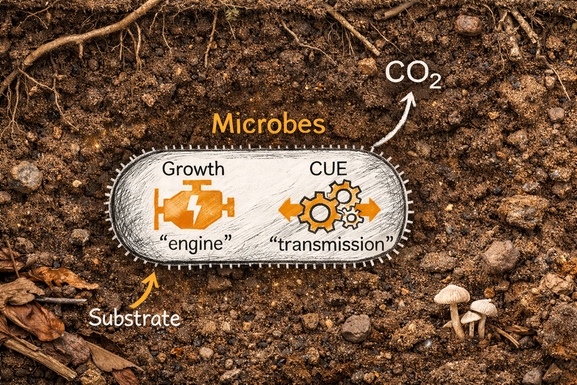
Microbes as engines. Picture by Xianjin He, made in ChatGPT.
Soils are the world’s largest land-based carbon reservoir, storing more carbon than the atmosphere and all vegetation combined. How much carbon remains in the soil, and how much is released as carbon dioxide, is largely controls by the activity of soil microorganisms. Despite their central role, it has long been unclear which microbial processes are most important for regulating soil carbon storage. Answering this question is key to understanding how vulnerable soil carbon is to loss under climate change, and how such losses could further accelerate climate change.
A new international study published in Nature Ecology & Evolution now provides a clearer answer. By combining a global observational dataset with simulations from four numerical models of the land biosphere, researchers show that microbial growth rate is a stronger and more consistent predictor of soil organic carbon than other characteristics of soil microorganisms.
Microbes as soil carbon pumps
Soil microbes can be compared to tiny carbon pumps operating beneath the surface transfering labile carbon components into stable compounds, and thus providing a critical service in driving carbon into soils. They feed on carbon released by plant roots and decaying organic matter. Part of this carbon is used to build new microbial biomass, while the remainder is released as carbon dioxide to the atmosphere through respiration.
“Microorganisms are like us – they respire to gain energy from their food. Respiration involves the release of carbon dioxide, which is an important greenhouse gas. But microbes at the same time help keep some carbon in the soil, because when they die, some of their remains bind to soil minerals and thus become stable soil organic carbon”, says professor Stefano Manzoni at Stockholm University, one of the co-authors of the article.
Growth rate outperforms efficiency
Using 268 paired measurements worldwide, the researchers focused on two key microbial properties: growth rate and carbon use efficiency. Growth rate describes how quickly microbes build new biomass, while carbon use efficiency reflects how much of the carbon is converted into biomass rather than respired as carbon dioxide.
The results show that soils with higher microbial growth rates consistently contain more carbon. In contrast, carbon use efficiency shows only a weak or negligible relationship with soil carbon storage.
“Growth rate acts as the engine driving carbon fluxes through the soil, while efficiency functions more like the transmission, playing a secondary role by regulating how carbon is partitioned between biomass production and carbon dioxide release,” says Rebecca Varney, a postdoc at Stockholm University.
Climate and soil properties also play a major role
The study also shows that climate and soil properties – especially temperature and clay content – are at least as important as microbial properties in explaining variation in soil carbon. This highlights that soil carbon storage is jointly controlled by microbial activity and strong physical constraints.
The team also analysed four widely used global models used for climate change projections. While the models reproduce the stronger link between microbial growth rate and soil organic carbon, they tend to overemphasise the role of microbial properties and underestimate the importance of soil texture and climate.
“Soil carbon models are built from our understanding of the underlying processes that guide the fate of soil carbon. But validating how different microbial processes influence soil carbon changes in these models is difficult. This study addresses this gap and we find that models deviate in the weighting of some important processes from observational data. This mismatch has important implications for developing soil carbon models and improving predictions of soil carbon fate in the future,” says Erik Schwarz, a PhD student at Stockholm University.
Improving our understanding of soils’ role in the climate system
Soils are central to climate mitigation strategies and long-term carbon storage. Accurately predicting how soil carbon will respond to climate change and land management requires models that capture the right biological and physical processes. This study identifies microbial growth rate as a key diagnostic variable for linking observations with Earth system models and for improving projections of soil carbon dynamics in a changing climate.
Read the full study
"Microbial growth rate is a stronger predictor of soil organic carbon than carbon use efficiency" is published in Nature Ecology and Evolution.
DOI: 10.1038/s41559-025-02961-8
Last updated: 2026-02-11
Source: Communications Office