


Transformation of the universe – when the first stars formed
Before stars and galaxies formed, the universe mostly consisted of a cold gas of neutral atoms. Matthew Hayes heads a project aiming to show how the universe was transformed when the first galaxies began to emit warming ionizing radiation. The new project is based on observations made using the James Webb Space Telescope.
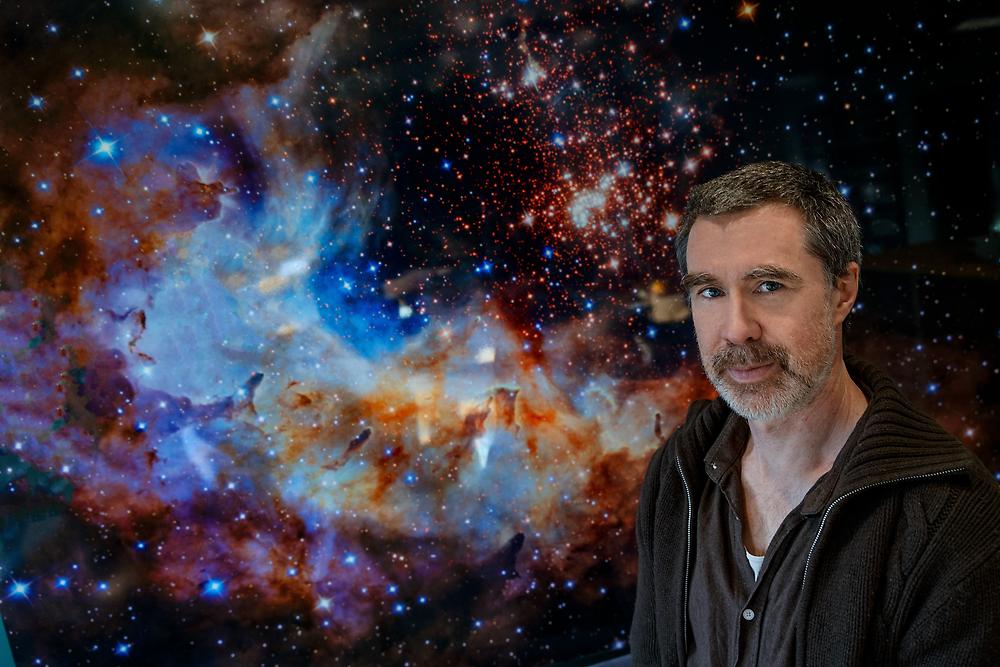
Matthew Hayes. Photo: Magnus Bergström/KAW
It has been established that the Universe began with the Big Bang some 14 billion years ago. But much remains uncertain about how the universe was transformed during its first 500 hundred million years – the era when stars formed and created the galaxies we see today.
At first the universe consisted of hot plasma made up of protons, electrons and photons. After about 400,000 years, the universe had cooled enough to transition into a neutral gas consisting mostly of hydrogen atoms.
“The period before the first galaxies and stars took shape is what we call ‘the dark ages,’ when the universe was completely black and fairly cold. No stars had yet formed – there were no astrophysical objects emitting any light,” says Hayes, who is based at the Department of Astronomy at Stockholm University.
When the first stars formed, some 200 million years later, they also created large amounts of ionizing ultraviolet radiation. That radiation broke apart the stable hydrogen atoms in the gas. Since then we have had an ionized universe with free electrons.
“The process whereby the universe went from being cold and neutral to warm and ionized is what we call reionization. Our project is about understanding this phenomenon,” says Hayes.
The research team comprises four researchers – all located along the same corridor at the AlbaNova University Center.
Read full article at Knut & Alice Wallenberg Foundation´s website
Last updated: 2026-01-12
Source: Communications Office