


International Master's Programme in Political Science
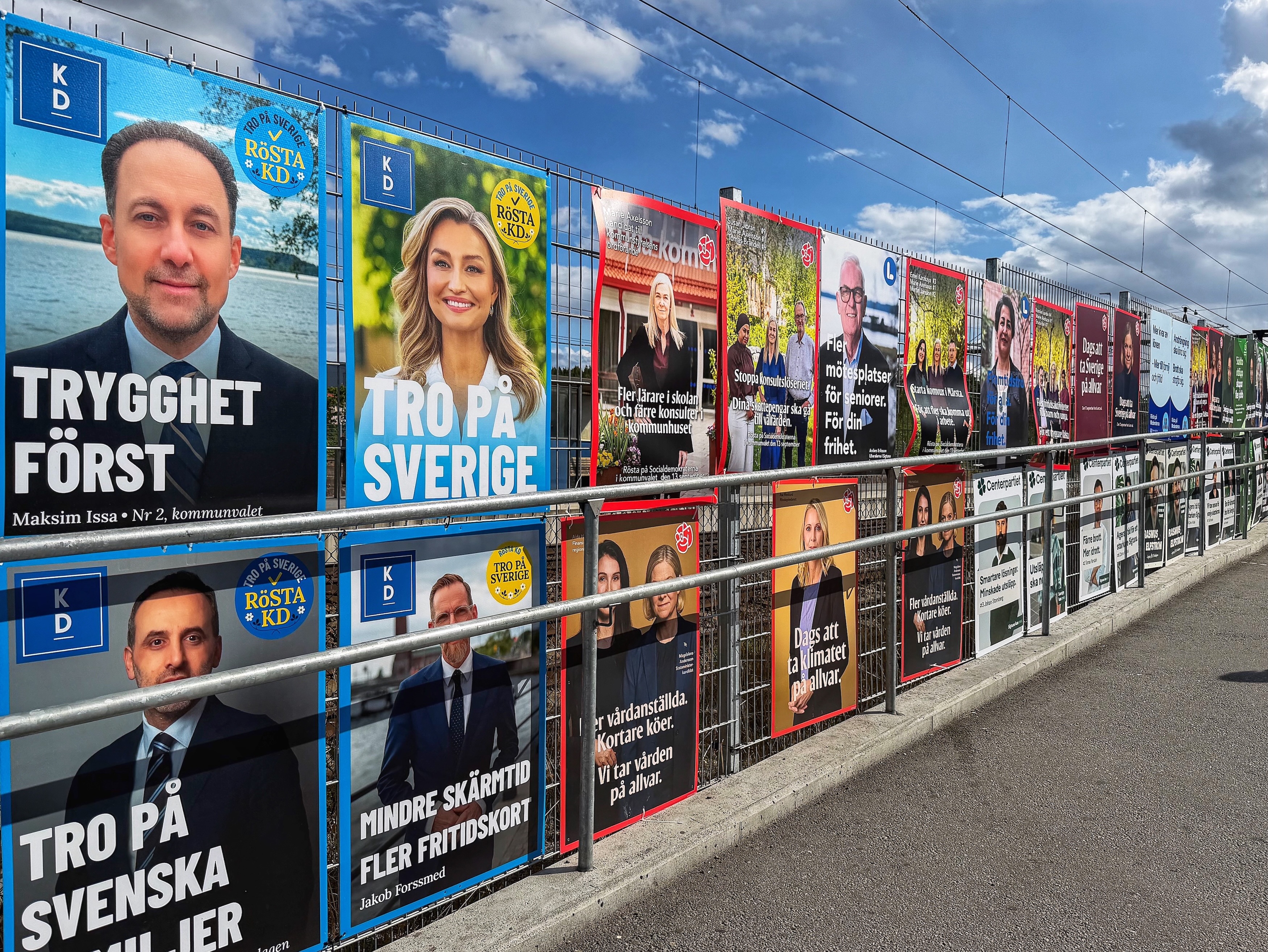
MÄRSTA, SWEDEN – AUGUST 17: A row of political election posters on a metal fence along a street on a sunny day. Photo: Krister Hägglöf/Mostphotos
The programme combines professional preparation with state of the art courses in political science, and includes both compulsory and elective courses. All courses are advanced level courses, and are taught in English.
The first year of the programme consists of compulsory core courses and elective thematic specialisation courses. Each elective period offers the student a set selection of courses taught at the department. The number of seats for each course is limited. Programme students are allocated places according to admissions merit value.
The independent research project (the Master’s Thesis) is written during the third semester. The topic is developed in consultation with a supervisor. During the final semester students undertake a workplace internship, study abroad as an exchange student, or take courses selected in consultation with the Director of Studies.
Year 1
Semester 1
Period A & B
Analytical approaches in social science and studies of politics, in English
Period C
Students choose one of the following elective courses:
Populism and Democratic Politics
-> International Security Politics
Period D
Students choose one of the following elective courses:
Global and Regional Governance
National and Global Equality Policies: Goals and instruments
Political Economy
Semester 2
Period A
Period B
Students choose one of the following elective courses:
-> Democratization and Autocratization
International Political Theory
Global Climate and Environmental Politics
Period C & D
Year 2
Semester 3
Period A-D
Independent research project in Political Science
Semester 4
Period A-D
During the fourth semester students on the International master’s programme in political science are offered the course “Professional internship in Political Science” 15, 22.5 or 30 credits.
See below for more information about internship within the programme:
Internship within the International master’s programme in political science
Admission to the International Master's Programme in Political Science is done once a year, for the autumn semester. All applications are to be submitted electronically through universityadmissions.se (English) or antagning.se (Swedish).
If the university where you gained your Bachelor’s degree does not implement the European Credit Transfer System (ECTS), alongside your academic transcript you will need to submit a statement detailing how the credit system from the university in question corresponds to the ECTS. The statement should contain the following information:
- Your personal information
- The name of your degree
- How many credits within your university’s system equals 1, 10 and 30 ECTS
- If applicable, how many credits a semester of full-time studies entail at the university which issued your Bachelor’s degree, stated both in credits of the original system, and in ECTS
The statement should be signed and stamped by an official person at your degree issuing university, such as a study counsellor, administrator, Director of Studies etc.
Please note that all parts of the application must be submitted directly to universityadmissions.se or antagning.se. No documentation should be sent to the department. Please also observe that applications to this programme should not include your Bachelor’s Thesis, a statement of relevant work and/or research experience, or a motivation letter.
The Master's programme is only open for admission in the international admission's round.
The general requirement to study a Master's programme in Sweden is a Bachelor's degree from an accredited institution of higher learning, corresponding to at least 180 credits in the European Credit Transfer System.
The specific requirement for the International Master's Programme in Political Science is a Bachelor's degree in Political Science with at least 90 ECTS credits in Political Science, and English B/English 6, or equivalent.
We make a selection among the eligible applicants. The selection of students is based on grades of academic courses.
For detailed information about the selection process, see this attachment pdf, 166.1 kB..
If you have questions about the admissions process or the general eligibility, please contact University Admissions, or the Admissions Office at Stockholm University (study@su.se).
If you have questions about the specific requirements, the selection process or the programme, please contact master@statsvet.su.se.
Meet our teachers
Hans Agné is a Professor whose teaching and research interests connect to the concept of democracy. His special interests lie in, among other areas, causes and effects of democracy, in particular but not exclusively beyond the state and in contexts where the role or power of states is changing.
Read more about Hans here
Jouni Reinikainen is an Associate Professor and Director of Studies at the department. His research interests revolve around questions concerning state membership, the political community and secessionism.
Read more about Jouni here
Ludvig Norman is an Associate Professor of Political Science at Stockholm University and Senior Fellow at the UC Berkeley Institute of European Studies. His research interests include European politics, democratic responses to populism and extremism, regulation of social media platforms, the institutions of the European Union and EU democracy. Norman also has a keen interest in social science methodology, and in particular qualitative and mixed-methods approaches to social scientific research.
Read more about Ludvig here
Marine Roux is a Postdoctoral researcher on the DEMCOOP project at the department. Her main research interest lies in understanding what the underlying mechanisms of international (non-)cooperation between countries of different regime types are, and the effects of such (non-)cooperation. Further interests lie in international political economy, research methods, and coding.
Read more about Marine here
Gudlaug Olafsdottir is a Post-doctoral researcher at the Stockholm Center on Global Governance, within the Political Science department. Her research focuses on the political dynamics of semi-democratic regimes, with a particular focus on electoral politics. Her research to date covers topics relating to electoral violence and how it influences democratization, organized student violence, and conflict forecasting, using machine learning techniques to estimate the future risk of armed conflict.
Read more about Gudlaug here
Lenita Freidenvall is a Senior Lecturer at the department. Her research interests include political representation and quotas, citizenship and the multicultural, political parties and nomination processes, gender equality politics, constitutional politics, new institutional theory, and intersectionality.
Read more about Lenita here
Magnus Reitberger is a Senior Lecturer at the department. His research interests are political philosophy, international political economy, global justice, justice and war, and fairness in trade.
Read more about Magnus here
Pär Nyman is a Senior Lecturer and Associate Professor at the department. His main research interest lies in political behaviour, focusing on questions about individuals' political participation and preferences as well as questions about policymaking.
Read more about Pär here
Jan Teorell is a Professor of Political Science at the department and holder of the Lars Johan Hierta professorial chair.
Read more about Jan here
Alexander Nordt is an Environmental social scientist, and postdoctoral researcher at Stockholm University in the Department of Political Science as part of the Horizon Europe project ACHIEVE (Achieving High-Integrity Voluntary Climate Action). His research centres on net zero transition initiatives (global and regional in scale and at national and subnational levels) in the context of policy and governance processes.
Read more about Alexander here
Sanna Lundquist is a Postdoctoral researcher at the department. Her research interests are environmental politics, environmental economics, and the green economy. They furthermore include the emergence of the green economy, emissions decoupling, environmental protest events, political parties and policy outcomes.
Read more about Sanna here
A Master’s degree in Political Science opens up a wide range of career opportunities in Sweden and internationally. Graduates work in public administration, international organisations, NGOs, consultancy firms and the private sector, in roles that involve policy development, analysis, research and strategic advice.
The Department of Political Science’s 2025 alumni survey illustrates the breadth of these opportunities. Alumni hold positions such as Policy Officer, Political Adviser, Policy Analyst, Investigator, Senior Adviser, Project Manager, Project Coordinator and Research Associate.
Alumni work in a wide range of organisations, including government agencies and public authorities; municipal and regional government; international organisations and institutions; NGOs and civil society organisations; universities and research organisations; consultancy firms and private companies. These examples illustrate the breadth of professional environments in which graduates apply their knowledge of politics, governance and public policy.
The survey also highlights promising employment outcomes: 95% of respondents were currently working, and 73% reported finding their first job within four months of graduation. Analysis and investigation were the most frequently reported job responsibilities, cited by 75% of respondents, followed by research (38%) and advisory work (35%).
The skills developed through the programme are directly relevant to these professional roles. In the survey, 90% of respondents identified critical analysis and evaluation of information as relevant to their current work, while 85% highlighted academic writing and 75% identified knowledge of scientific methods. These skills prepare graduates to assess complex issues, develop evidence-based recommendations and communicate findings clearly across a range of professional settings.
The programme also provides a strong foundation for further academic studies, including doctoral research in Political Science and related fields.
Student counsellor
master@statsvet.su.se


