


Meet the teachers
Our master’s program is unique with respect to: intense lab courses, where students will learn to master state-of-the art technologies; world leading researchers as teachers: half the teachers are members in the Royal Academy of Science, which is the academy deciding on the Nobel Prize in Chemistry; the strong research connection, where students get research experience already the first year and many of our Thesis Degrees end up in high end scientific articles.
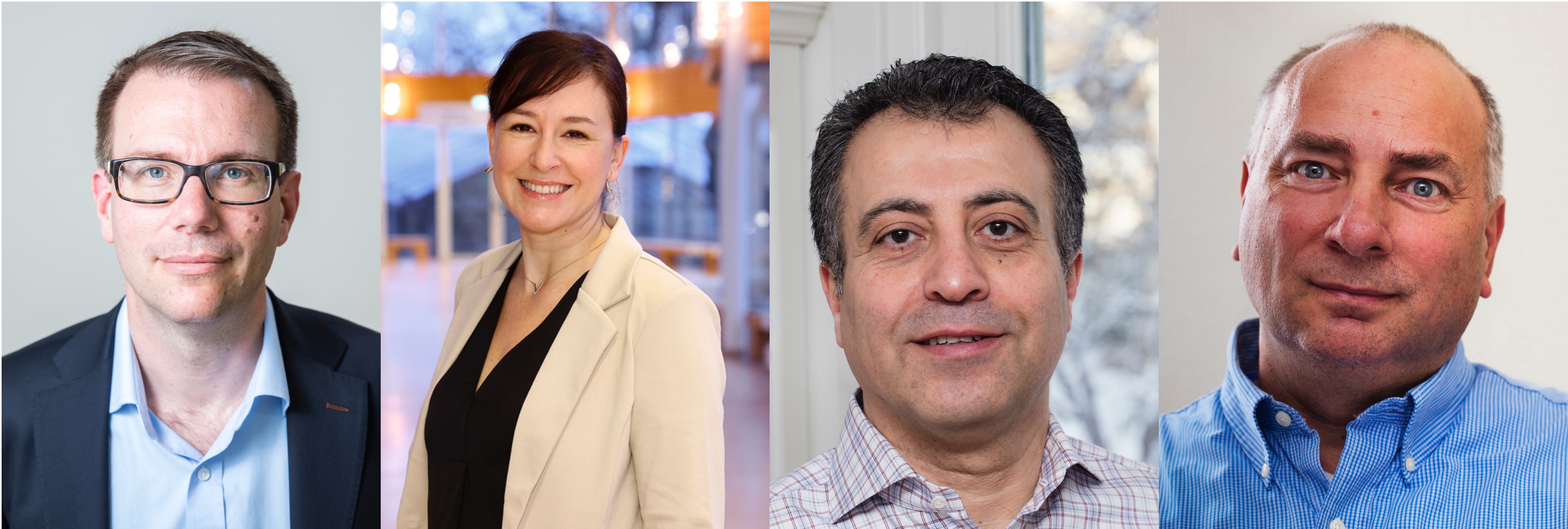
Joseph Samec, Belén Martín-Matute, Fahmi Himo, Kálmán J Szabó.
How did your journey in organic chemistry begin?
Belén: I had the honour of meeting an exceptionally pedagogical teacher at my university whose enthusiasm for organic chemistry inspired me to change my specialty from physical chemistry to organic chemistry. Nowadays I really enjoy both areas of chemistry.
Joseph: I was studying Neurochemistry and during a research project I was asking about how and why things were happening and continuously got the answer: we don’t know, ask an organic chemist. So I started studying organic chemistry and got completely hooked by both the theory and even more the laboratory part.
Fahmi: I actually studied physics at the BSc level. After that, I completed a PhD in the field of quantum chemistry, focusing on the modeling of enzymes. Many years later, I moved to what was then called the Department of Organic Chemistry at Stockholm University, where I began to work more systematically on the modeling of organic and organometallic reactions and catalysis.
What is your role here at Stockholm University, and what do you enjoy most about it?
Joseph: I am the Director of Studies for Master Programs within Chemistry and also the Program Director for the Master’s Program in Organic Chemistry. I even teach on one Fahmi’s course in Methods to Analyze Organic Reactions. Teaching is most fun! I enjoy meeting the talented young students!
Belén: The greatest joy of my job is being able to blend teaching at all levels with active research. Watching students’ enthusiasm grow as they journey from bachelor students to master—and even PhD candidates—is truly inspiring.
Fahmi: I am a professor at the Department of Chemistry, a role that involves many different responsibilities, including research, teaching and administration. Daily discussions about the latest research results are very inspiring, and meeting students in the various courses is always energizing.
What is the best thing about studying organic chemistry?
Belén: One of the aspects I find most fascinating is the ability to construct molecules, even highly complex ones. The diversity of organic chemistry—especially when connected with catalysis and physical organic chemistry—makes this field a very inspiring area of research, full of opportunities to discover, understand, and innovate.
Fahmi: Studies in organic chemistry provide a solid foundation that can be applied across many different areas in chemistry and biology.
Joseph: Organic chemistry is the most creative subject that you can study at a university. Imagine that you get the chemical tools to build any molecule that you can envision either from nature or your own perception.
What skills or qualities help students succeed in this program?
Joseph: Students that study organic chemistry know from their bachelor that organic chemistry is labor intensive. The reason is that there is both a lot of theory and also laboratory skills to master. I think what motivates the students is that they know: when you have mastered these tools you can in principle build any molecule you want.
Belén: I believe that working continuously throughout a course helps students grasp the concepts more deeply and gives them many opportunities to ask questions whenever something is unclear. Active learning is therefore highly recommended. Also, I recommend all students to talk to the teachers about their research, and try to do different projects in different groups, as this is the best opportunity to learn about their own interests!
Why is a master’s in organic chemistry a great choice for someone considering this field?
Joseph: Our master’s program is unique with respect to: intense lab courses, where students will learn to master state-of-the art technologies; world leading researchers as teachers: half the teachers are members in the Royal Academy of Science, which is the academy deciding on the Nobel Prize in Chemistry; the strong research connection, where students get research experience already the first year and many of our Thesis Degrees end up in high end scientific articles.
What keeps you motivated in your research and teaching?
Joseph: Well, research is so fun that I don’t need any further motivation. Think of being able to everyday come up with scientific questions that have not yet been solved, have a meeting with our talented students and formulate hypothesis and then go out in the lab and see what happens. Teaching is super fun! Our students are really talented, and I enjoy discussions with them.
Can you give an example of how organic chemistry can help create a more sustainable society?
Belén: As chemists, we undoubtedly carry significant responsibility for the future. While chemicals are indispensable, they must be produced in a sustainable way that minimizes environmental impact. Our contribution is vital in today’s society as we work to support and protect the generations that will follow.
Joseph: Well, organic chemistry is the only subject that can really contribute to a more sustainable society. Today not only pharmaceuticals are organic but most electronics and materials are built up from organic materials. To find ways to use renewable materials and build up functions: is organic chemistry. The more advanced skills you have, the more sustainable materials you can build!
How has your role in the chemistry class of the Royal Swedish Academy of Sciences broadened your perspective on the field?
Belén: Being a member of the academy has been a great honour and a truly inspiring experience. Following how major discoveries in chemistry have emerged, developed, and ultimately contributed to the benefit of humankind is remarkable. I feel privileged to work alongside my colleagues and to help highlight the outstanding work that chemists can accomplish.
Kálmán: The activities and networking at the Royal Swedish Academy of Sciences have given me a very broad overview of Chemistry in Sweden and world-wide. It is particularly interesting to see, where are the current front-lines of research in Chemistry, as well as the the close connections/synergy with other scientific areas in medicine and physics.
What advice would you give to someone thinking about pursuing a master’s in organic chemistry?
Fahmi and Joseph: Don’t hesitate, go for it!
Last updated: 2026-05-07
Source: Chemistry section