


Latin American Studies - Bachelor's Course
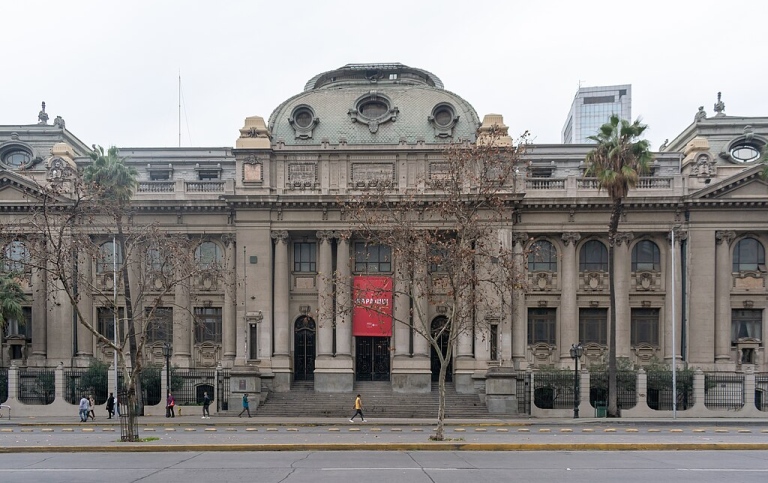
Biblioteca Nacional, Santiago, Región Metropolitana, Chile. Foto: Carlos yo, CC BY-SA 4, Wikimedia
The course comprises an independent project for the Bachelor's Degree and two modules; one with a focus on cross discipline theory and method, one with a focus on a thematic and regional specialization connected to the independent project. The project is carried out as a limited research project the end result of which is a scientific paper. In the initial stages of the project students acquire a deeper knowledge in the design of a scientific research paper.
Modules
Module 1 - Social Science Methods, 7,5 credits
The course deepens the knowledge which was acquired at the level of the intermediate course and surveys the interdisciplinary perspective and its methods as well as gives an more profound understanding of Latin American social theory.
The course deals with among other things the following areas:
-the interdisciplinary perspective and its method
This is a translation of the Swedish original Page 1/3
- Different social science foci and their application to Latin America; e.g. ethnographic method, source
critique, feminist and post-colonial thought.
-Method that in the first instance is research strategy, that is to say principles and approach to formulation and solution of research tasks.
Module 2 - Land, people and power in Latin America and the Caribbean, 7.5 ECTS
The course deals with one of the most intimate relations established by humans - between people and land. It addresses that relation throughout Caribbean history, from pre-Columbian to post-colonial times. It does so based on the main gears of that relation - power. Urban-rural, centre-periphery and continuity-change are other dimensions that come into play.
Module 3 - Independent project, 15 ECTS
The course comprises an independent project for the Degree of Bachelor. The project is carried out as a limited research the end result of which is a scientific paper. In the initial stages of the examination project students acquire a deeper knowledge in the design of a scientific research.
The course deals with among other things:
- the approach for formulating and solving the research problem,
- placing the work in a theoretical context,
- choosing an appropriate method (design and more specific method) in relation to the problem
formulation,
- logic (red thread/logical connection from problem via purpose, research questions, method, result to
conclusion,
- readability (structure, typographical design, and language use)
The course shall provide training to increase the ability to carry out a limited research task with a certain degree of independence.
Teaching Format
Together, the three modules comprise lectures , seminars, group work and individual tutoring. Each module has its own combination of formats. Module 3 is a series of interactive seminars on the process of writing an academic dissertation.
Assessment
Module 1
Oral presentation, written papers
Module 2
Short papers, oral presentation
Module 3
Essay
Examiner
Andrés Rivarola Puntigliano
Magnus Lembke
Kim Teresa Beecheno


