


Wetlands - a Swedish perspective, Introductory course
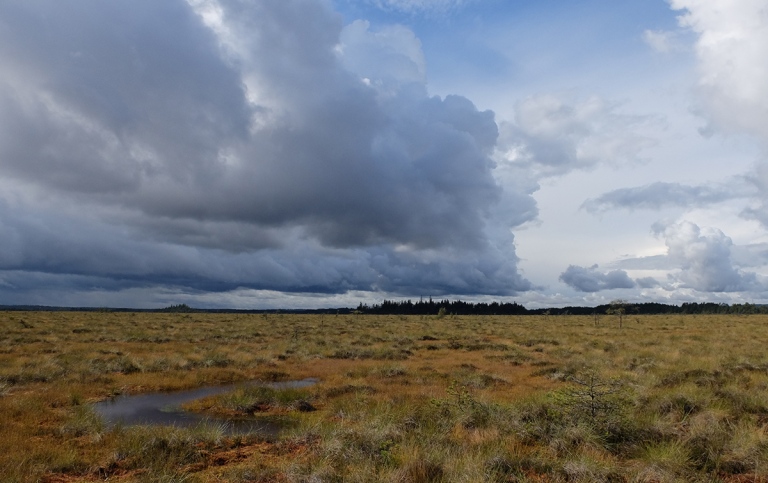
Store Mosse, Sweden. Photo: Malin Kylander
Despite their importance, wetlands have long been impacted by human activities and today many are in a degraded state. This course covers the science behind wetland form and function as well as recent research relating to the future of these important ecosystems. The course is given as a combination of on-line evening lectures and seminars. We will dive into current debates surrounding wetlands and their management and students will have a chance to explore and understand a wetland local to them. Lectures given include:
- Wetland classification and global significance
- Wetland flora and microtopography
- Wetland properties and development
- Wetland biodiversity
- Hydrological functions of wetlands
- Wetlands and the carbon cycle
- Historical perspectives on wetland use in Sweden
- Restoration of wetlands
- Wetlands as climate archives
- Swedish wetlands: remote sensing, mapping, lidar.
There is a mandatory field component where we visit Store Mosse National Park and explore one of southern Sweden’s largest and best-preserved wetlands together. We will look at the geomorphological development of the area and different wetland habitats; observe wetland fauna and flora and links between vegetation and microtopography; and explore the anthropogenic impact on the wetland (peat extraction) and attempts to remedy this (re-wetting).
The field trip for the VT27 will take place May 14 to 17, 2027. We will be outside for full days, so come with appropriate field gear. More information will be added later.
*If the PDF files are not accessible for you to read, kindly contact studies@geo.su.se
Course evaluations allow the possibility to affect and take responsibility for your own learning and gives important information for our work with pedagogical development.
It's important that all students complete the course evaluations after each course, it gives the Department the opportunity to improve the courses' quality.
The course evaluation is composed of a number of questions and specific questions for each course. If you, as a student, want to contribute with more course specific questions you may send them to studies@geo.su.se.
If you haven't received the course evaluation for your finished course, or if you have other questions regarding course evaluations at IGV please contact studies@geo.su.se.
Course evaluation = student's review of the course
Course report = course leader's reflections about the review
- Course report spring term 2026 pdf, 87.1 kB.
- Course evaluation spring term 2026 pdf, 98.8 kB.
- Course evaluation spring term 2025 pdf, 99.1 kB.
*If the PDF files are not accessible for you to read, kindly contact studies@geo.su.se
Student counsellor
elisabeth.dacker@geo.su.se
08-674 78 70
Course leader
Malin Kylander
malin.kylander@geo.su.se


