


The Snowball Earth Hypothesis, Introductory Course
Seven hundred and sixteen million years ago everything stopped. The seas stood still. Rivers did not flow. Temperatures plummeted. The entire world fell into silence as it was buried beneath snow and ice.
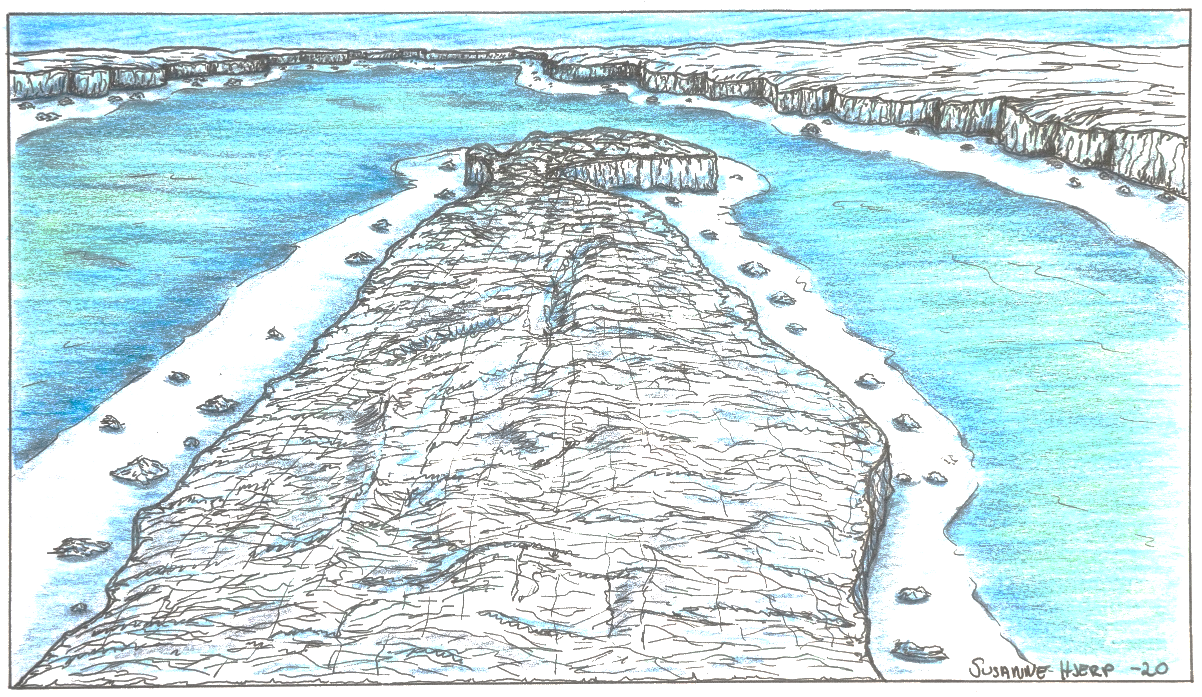
There was one giant landmass at that time – a supercontinent called Rodinia. That supercontinent straddled the equator and, crossing its interior, a vast chain of mountains was rising up from the plains, forced upwards by geological forces.
There were no land plants back then. Their emergence would happen hundreds of millions of years later. This meant that, before the snow began to fall, Rodinia was completely barren. Its landscape was one of wind-scoured rock surfaces amidst endless deserts. The barren surface of that supercontinent was highly reflective (mirror-like) and most of the sunlight that reached it would have been reflected back into space. This mirror-like behaviour is called the albedo effect. It cools the Earth. And, back then, it did so effectively, because Rodinia was positioned where Earth receives most sunlight – at the equator.
And as the Earth became cooler, snow began to fall.
And as snow fell, the whitened surface of Rodinia reflected even more sunlight back into space. The albedo effect was strengthened and the Earth cooled some more.
And more snow fell.
And the albedo effect became even stronger until a tipping point – a point of no return – was passed and not only Rodinia but also the oceans that surrounded it froze over entirely.
This was Snowball Earth. Everything stood still for fifty-eight million years.
This orientation course begins with a brief history of the Earth. We will then explore plate tectonics, the climate system and the climate of the past, after which we will focus on Snowball Earth, evidence for and against this controversial hypothesis, and a case study from the Scottish Hebrides.
The course concludes with a reflection of what we can learn from Snowball Earth as we enter the uncharted territories of the Anthropocene.
Reading assignments are scientific articles in which the key discoveries were first reported or reviewed. These articles can be accessed via Stockholm University Library. Some articles are not available for free online. These can be ordered for you by Stockholm University Library. As this can take some time, I recommend ordering all articles now.
Teaching Format
The course is taught in English.
Lectures are in William-Olsson Lecture Hall from 18h00 to 20h30.
The course is followed by a field study which will be held from April 28 (evening arrival) to May 3 (morning departure) on Islay, Scotland.
The field study is obligatory. However, we provide an alternative home assignment because the field study is physically challenging. This home assignments is also available for any student who is refused a visa to the UK.
You make your own travel arrangements to Islay (Edinburgh/Glasgow to Kennacraig: https://booking.citylink.co.uk; Kennacraig to Islay: https://www.calmac.co.uk). Overnight accommodation in single-gender dormitories (4–6 beds) is provided at Port Charlotte Youth Hostel (https://www.hostellingscotland.org.uk/hostels/port-charlotte/).
You will find practical information concerning the field study below under More information. Please read this information carefully.
Assessment
Reading assignments are scientific articles in which the key discoveries were first reported or reviewed. These articles can be accessed via Stockholm University Library. Some articles are not available for free online. These can be ordered for you by Stockholm University Library. As this can take some time, I recommend ordering all articles now.
The field study is obligatory. However, we provide an alternative home assignment because the field study is physically challenging. This home assignments is also available for any student who is refused a visa to the UK.
Download course information as pdf file pdf, 413.3 kB.
*If the PDF file is not accessible for you to read, kindly contact studies@geo.su.se
Note: some lecture dates have been changed/updated (October 14 2026)
Lecture 1: January 26 | Earth History
Reading assignment
- Lyons, T., Reinhard, C., and Planavsky, N. “The Rise of Oxygen in Earth’s Early Ocean and Atmosphere.” Nature 506 (2014): 307–15. https://doi.org/10.1038/nature13068
- Cawood, P. A. and Hawkesworth, C. J. “Earth’s middle age.” Geology 42 (2014): 503-6. https://doi.org/10.1130/G35402.1
- (Hoffman, P. F., Kaufman, A. J. Halverson, G. P. and Schrag, D. P. “A Neoproterozoic Snowball Earth.” Science 282 (1998): 1342-6. https://doi.org/10.1126/science.281.5381.1342)
Lecture 2: February 2 | Plate Tectonics
Reading assignment
- Wegener, A. “The origins of continents.” International Journal of Earth Sciences 91 (2002), 4–17. https://doi.org/10.1007/s00531-002-0271-1
- Hess, H. H., “History of Ocean Basins,” in Petrologic Studies: A Volume in Honour of A. F. Buddington. ed. A. E. J., Engel, H. L. James and B. F. Leonard (Geological Society of America, 1962). https://doi.org/10.1130/Petrologic.1962.599
Lecture 3: February 9 | Climate System
Reading assignment
- Arrhenius, S. “On the Influence of Carbonic Acid in the Air upon the Temperature of the Ground.” Philosophical Magazine and Journal of Science 41 (1896): 237–276.
Lecture 4: February 16 | Climate of the Past
Reading assignment
- Raymo, M. and Ruddiman, W. “Tectonic forcing of late Cenozoic climate.” Nature 359 (1992): 117-22. https://doi.org/10.1038/359117a0
Lecture 5: February 23 | Snowball Earth Hypothesis
Reading assignment
- Hoffman, P. F., Kaufman, A. J. Halverson, G. P. and Schrag, D. P. “A Neoproterozoic Snowball Earth.” Science 282 (1998): 1342-6. https://doi.org/10.1126/science.281.5381.1342
Lecture 6: March 2 | The Evidence
Reading assignment
- Thomson, J. “On the occurrence of pebbles and boulders of granite in schistose rocks in Islay, Scotland.” Report of the 40th Meeting of the British Association for the Advancement of Science 88 (1871).
- Hoffman, P. F., et al. “Snowball Earth climate dynamics and Cryogenian geology-geobiology.” Science Advances e1600983 (2017). https://doi.org/10.1126/sciadv.1600983
Lecture 7: March 9 | Onset of Snowball Earth: Evidence from the Garvellachs, Scotland
Reading assignment
- Dilshad O. A., Spencer, A.M., Fairchild, I.J., et al. “Indicators of relative completeness of the glacial record of the Port Askaig Formation, Garvellach Islands, Scotland.” Precambrian Research 319 (2018) 65–78.
https://doi.org/10.1016/j.precamres.2017.12.005
Lecture 8: March 16 | Aftermath of Snowball Earth: Evidence from Islay, Scotland
Reading assignment
- Same as above (same article as March 9)
Lecture 9: March 23 | Lessons from the past
Reading assignment
- Crutzen, P., “Geology of mankind.” Nature 415 (2002): 23. https://doi.org/10.1038/415023a
- Steffen, W., Broadgate, W., Deutsch, L., et al. “The trajectory of the Anthropocene: The great acceleration.” The Anthropocene Review 2 (2015): 81–98. https://doi.org/10.1177/2053019614564785
- Lenton, T.M., Held, H., Kriegler, E., Hall, J.W., Lucht, W., Rahmstorf, S. and Schellnhuber, H.J. “Tipping elements in the Earth's climate system.” Proceedings of the National Academy of Science 105 (2008): 1786-93, https://doi.org/10.1073/pnas.0705414105
Exam: April 6
Download course information as pdf file pdf, 413.2 kB.
*If the PDF file is not accessible for you to read, kindly contact studies@geo.su.se
Reading assignments are scientific articles in which the key discoveries were first reported or reviewed. These articles can be accessed via Stockholm University Library. Some articles are not available for free online. These can be ordered for you by Stockholm University Library. As this can take some time, I recommend ordering all articles now.
The field study is obligatory. However, we provide an alternative home assignment because the field study is physically challenging. This home assignments is also available for any student who is refused a visa to the UK.
You make your own travel arrangements to Islay (Edinburgh/Glasgow to Kennacraig: https://booking.citylink.co.uk; Kennacraig to Islay: https://www.calmac.co.uk). Overnight accommodation in single-gender dormitories (4–6 beds) is provided at Port Charlotte Youth Hostel (https://www.hostellingscotland.org.uk/hostels/port-charlotte/).
Please read this information carefully.
Field Study on Islay, Scotland – Practical information
The field study starts and ends at either Port Ellen or Port Askaig ferry terminal on Islay.
We will collect you from one of the ferry terminals on Islay (Port Askaig or Port Ellen) on April 28 (evening). You should have food with you for breakfast and a packed lunch for April 29. We will drop you off at one of the ferry terminals on May 3 (morning). We will confirm arrival ports and times after Caledonian MacBrayne publish their ferry schedules.
Travel to/from Edinburgh/Glasgow by rail: You can travel by rail to Edinburgh/Glasgow from Stockholm. There are several different options, one of which is to travel from Stockholm–Copenhagen–Hamburg (Day 1) and from Hamburg–Brussels–London (Day 2) – Edinburgh (night train). Please see: https://www.seat61.com or https://goingbytrain.eu for other suggested routes and advise on places to stay. If you need individual guidance, please contact me. An interrail pass is strongly recommended (5 days in 1 month) as the cheapest option. It is also flexible in case you miss a connection.
Travel to/from Edinburgh by air: You can travel to Edinburgh on several airlines. On arrival, you will find a tram outside the airport which takes you to central Edinburgh.
What to bring
Clothing
Scotland has lots of weather, both nice and not so nice! You need to be prepared for everything from tropical summer to arctic winter – at any time of year – and all in the same day!
The following clothing items are essential:
- Warm trousers (not denim – when it gets wet, it stays wet)
- Warm sweater (e.g., fleece, wool)
- Extra warm sweater
- Waterproof jacket
- Waterproof over-trousers
- Comfortable hill-walking boots (see image)
- Hat (wool or similar, for warmth)
- Mittens (wool or similar)
Geological equipment
We will provide you with some geological equipment (hand lens, waterproof mapping board, compass-clinometer).
You must provide your own:
- Pencils
- Pens
- Ruler
- Eraser
- Set of coloured pencils (see image)
- Calculator
- Field notebook
Other items: You must bring any medical supplies you might need during the field study.
Optional items: Shorts, sunglasses, sun-tan lotion, telescopic walking sticks, footwear for wading in rivers, camera, laptop computer
//You are not allowed to bring a geological hammer//
Documentation
You need a valid passport (an ID card is not sufficient), a European Health Insurance Card (see https://www.forsakringskassan.se/privatperson/flytta-jobba-studera-eller-fa-vard-utomlands/eu-kort-och-vard-utomlands). You will need an electronic travel authorization or a visa to be allowed to enter the UK (see: https://www.gov.uk/eta).
Accommodation
On Islay, we will stay at Port Charlotte Youth Hostel. We will be sleeping in dormitories with 4–6 beds in each room.
Overnight equipment
Together with comfortable clothing, toiletries etc., you need a towel, but you do not need bedlinen.
Food
You are responsible for purchasing your own food on the excursion. There will be opportunities to buy food during the excursion. There is an excellent self-catering kitchen at Port Charlotte Youth Hostel. There are also a couple of pubs serving food nearby (tables must be booked).
Mobile telephones
Mobile telephone coverage in Scotland is surprisingly good, provided your telephone operator allows international access. However, when we are working together in the field, it’s a classroom situation – so please turn off your mobile phone. Please note that while the electricity supply in the UK is the same as in Sweden, you will need a British plug adapter for (e.g.) mobile phone battery charger. Because the UK is no longer a part of the EU, using a mobile telephone can cost a lot more there. Check with your provider.
Health, safety and physical fitness
The excursion is strenuous and requires good physical fitness. For this reason, we offer a home assignment for students who are unable to participate in the field study. If you have any medical conditions that might affect your own safety or the safety of other participants, you are required to inform an excursion leader. Some of the places we will visit are in remote areas. The weather is unpredictable. You must always have field clothing and good footwear even for short excursions and even if the weather appears to be good. You will be advised about the severity of each part of the excursion in terms of distance, terrain, vertical ascents and steepness of slopes. You should decide yourself if there are any parts of the excursion that you should avoid after consulting with an excursion leader. In all aspects related to health, safety and physical fitness, we will make every effort to help you participate in as much of the excursion as possible, provided this does not risk your safety or the safety of the other participants. We need your support in this matter.
Language
Teaching will be in English. You should always feel free to ask questions in Swedish or English. You may complete your assignments in Swedish or English.
Excursion fee
The excursion fee is 3000 kr. This covers accommodation and transport on Islay. You also need to pay for your own travel to/from Islay and all of your meals on Islay.
Students who are reading one of our undergraduate programs do not need to pay the excursion fee. Paperwork for support from CSN (because you are paying for your own travel) can be provided by Elisabeth Däcker on request.
We recommend making travel arrangements as soon as possible as prices tend to get higher with time.
Download course information as pdf file pdf, 413.3 kB.
*If the PDF file is not accessible for you to read, kindly contact studies@geo.su.se
Student counsellor
elisabeth.dacker@geo.su.se
08-674 78 70
Course leader
Alasdair Skelton (Professor of Geochemistry and petrology)
alasdair.skelton@geo.su.se
08-16 47 50


