


Glacial Environments
The course focuses on glacial environments and the processes that shape them, with particular emphasis on the dynamics of glaciers and ice sheets, and methods for reconstructing past glacial landscapes and climate during the Quaternary period.
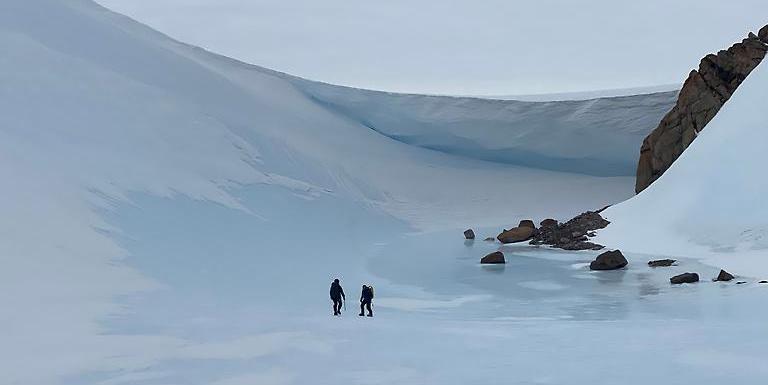
Windtunnels form along the flanks of mountain summits that tower above the East Antarctic Ice Sheet. Photo credit: Arjen Stroeven
Through the course, students gain insights into the physical processes operating in glacial environments, including glacier mass balance, ice dynamics, and glacial hydrology, as well as the formation and identification of glacial landforms and sediments. Field excursions, seminars, and laboratory sessions provide practical experience in sedimentological methods and landscape analysis, supporting the reconstruction of past ice sheet behavior and environmental conditions. The course emphasizes remote sensing and geomorphological mapping and completes with an individual paleoglaciological reconstruction project.
This course is part of the Master's Programme in Polar Landscapes and Quaternary Climate, but may also be taken as a separate course.
Modules
The course is structured around three modules:
Module A – Glaciology, 5 credits
Module B – Quaternary sedimentology, 5 credits
Module C – Paleoglaciology, 5 credits
Teaching Format
The teaching is based on iLectures, lectures, practical’s, self-studies, seminars, excursion/fieldwork, laboratory analyses, and supervision of project, of which parts are taught through the web. Scheduled events are compulsory.
Fieldwork
During the course there are two field trips. We will focus on the study, interpretation, logging, and sampling of sedimentary successions in Småland and the glacial geomorphology of northwestern Dalarna and associated areas in Norway. The transportation will be in minibuses and the lodging will be in hostels or shared cottages. The field trips incur a certain cost for students.
Assessment
For details see syllabus.
Plagiarism and regulations for disciplinary matters
As a student you must be conscientious about clearly accounting for the material used in the texts that are submitted for examination. To use another person’s expressions or ideas without stating the source is plagiarism. To translate and/or change some words in someone else’s text and present it as your own is also a form of plagiarism. Plagiarism is considered cheating and if discovered in an exam or paper, the exam or paper will be failed immediately and disciplinary measures may be taken.
Any student who is caught cheating or disrupting academic activities may be suspended from lectures and exams for a period of up to six months. The Vice Chancellor or the Disciplinary Council decide whether the student is to be subject to any disciplinary measures.
The link to Stockholm University's guidelines for disciplinary matters and expulsion can be found on the website:
During your studies/Plagiarism and regulations for disciplinary matters
We are several persons working with study administration and study counselling. Please contact the Student office for questions concerning course information, registration, schedule, literature lists and exams. If you have questions concerning credit transfer, admission, eligibility or need study advice please contact the Study counsellor.
Course responsible
Arjen Stroeven
E-mail: arjen.stroeven@natgeo.su.se
Study counsellor, student office and other contacts


