


French III - Linguistics II
The course introduces some of the central branches and theoretical frameworks of linguistics. Students acquire relevant concepts and methods for analysing authentic French-language material.
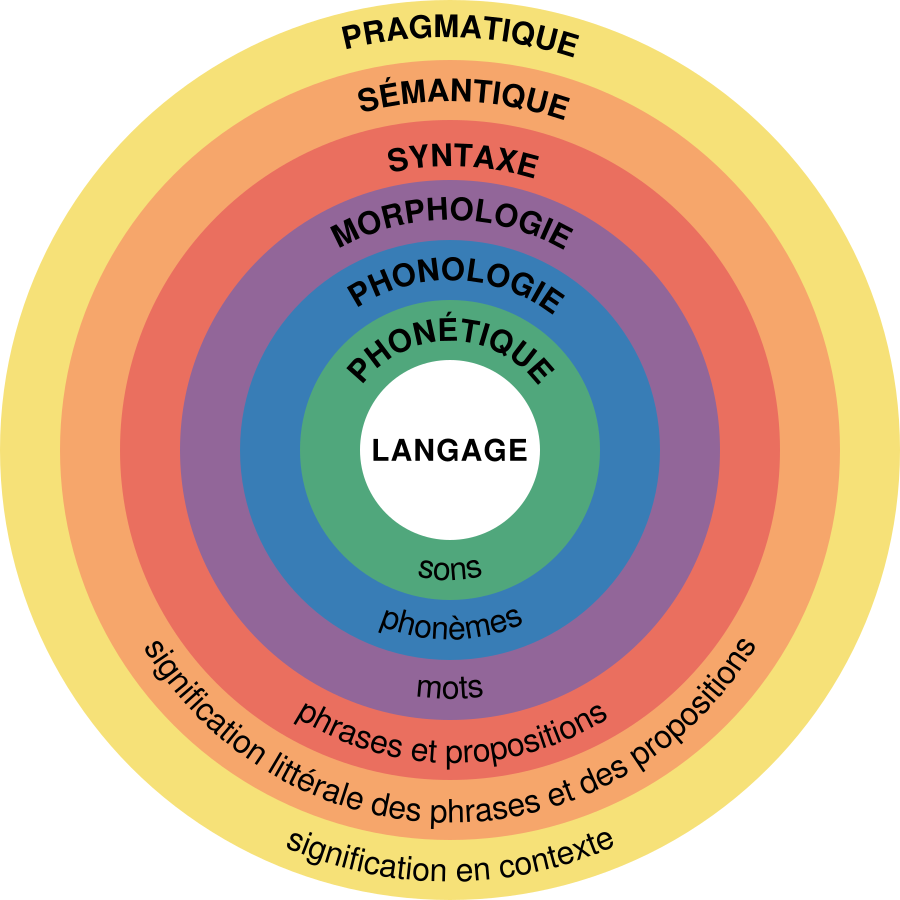
Major levels of linguistic structure: James J. Thomas and Kristin A. Cook (Ed.) derivative work: McSush (talk) derivative work: M0tty, CC BY-SA 3.0, via Wikimedia Commons
The course covers some of the central branches and theoretical frameworks of linguistics, with a focus on the French language. Students are introduced to fundamental linguistic concepts and analytical methods and are trained in applying these to authentic French-language material.
The course covers some of the central branches and theoretical frameworks of linguistics, with a focus on the French language. Students are introduced to fundamental linguistic concepts and analytical methods and are trained in applying these to authentic French-language material. The course covers some of the central branches and theoretical frameworks of linguistics, with a focus on the French language. Students are introduced to fundamental linguistic concepts and analytical methods and are trained in applying these to authentic French-language material.
Through lectures, seminars, and practical exercises, students develop their ability to describe and analyse linguistic structures and phenomena. The course provides a theoretical and methodological foundation relevant for further studies in French and linguistics.
Teaching is conducted in French and consists of lectures, seminars, reviews, and exercises. The lectures introduce central linguistic theories and concepts, while seminars and exercises give students the opportunity to apply these to authentic French-language material.
Teaching Format
The course combines teacher-led sessions with student-centred work and aims to develop students’ analytical skills. Teaching is offered on campus and/or in an online format. In the case of on-campus teaching, some components may be delivered digitally, as indicated in the schedule prior to the start of the course. Active participation in teaching activities is expected.
Assessment
One written exam on campus + 2 oral examinations.
Examiner
Sofia Lodén
Christophe Premat
Malin Roitman


