


Resilience Reflections and Applications
Learn how theories, concepts and methods related to resilience and sustainability science can be applied to the study of social-ecological systems. You will explore how different theoretical, conceptual and methodological choices shape the questions you can ask and the knowledge you can generate about complex and interconnected social-ecological systems. Building on knowledge and perspectives from the SERSD programme, you will design your own research project to be relevant, coherent and feasible.
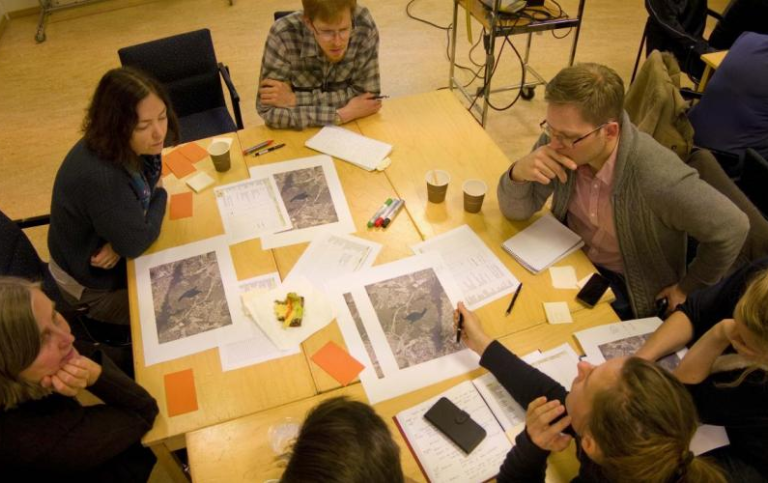
The course is project based, and students formulate individual research proposals. The proposed projects must fall under one of the SRC’s research themes, and should be for a 1-year study that would suit the SERSD Master’s thesis.
The course is project based, and students formulate individual research proposals. The proposed projects must fall under one of the SRC’s research themes, and should be for a 1-year study that would suit the SERSD Master’s thesis.
The first part of the course explores the philosophical foundations of sustainability science and how resilience and social-ecological concepts can be applied in research, with a particular focus on developing an independent project and formulating research questions. Students help each other with brainstorming research ideas and provide constructive feedback to their peers. They are introduced to literature searching and the different types of literature needed to develop a research proposal, and conduct targeted searches to support their own work.
Research ethics are addressed as a recurring theme throughout the course. The course also draws together the diverse research methods introduced across the programme, encouraging students to reflect on different approaches to developing knowledge, including qualitative, quantitative, mixed-methods and transdisciplinary approaches. In the second part, students engage in in-depth peer review, further develop and write their research proposals, and present their work. Self-study, writing and practical exercises are interspersed with in-class activities.
Research design is further informed through instruction and workshops in qualitative and quantitative data collection and analysis . In the third and final part of the course, students participate in in-depth review of peers’ research projects, engage in proposal writing and present their proposals. Self-study, writing, and practical exercises intersperse in-class time.
Teaching Format
Teaching consists of lectures, self-studies and group work lead by teachers from different scientific fields. Students will work in groups to assess and discuss each other’s work. This component will provide a set of alternative approaches to addressing related questions, and will allow students to analyse the strengths and weaknesses of these approaches, to develop skills in critical analysis and providing scholarly feedback.
Learning outcomes
A list of the learning outcomes can be found in the syllabus. Please find the link to the syllabus on the right side of this page.
Assessment
Assessment will be based on proposal- writing and presentation of a research project and an ethical report.
Examiner
Ingo Fetzer
E-mail: ingo.fetzer@su.se
Jan Kuiper
E-mail: jan.kuiper@su.se
No mandatory course book.


