


Our history at Tarfala
The Tarfala Research Stations development and history from the beginning of the 20th century until today.
The station is built around a project that involved following up a glacier's mass balance in detail. During the 1930s and 1940s, the then professor of geography Hans W: son Ahlmann worked with the connection between the warming seen in the early 1900s and how the glaciers in the northern hemisphere became smaller and smaller.
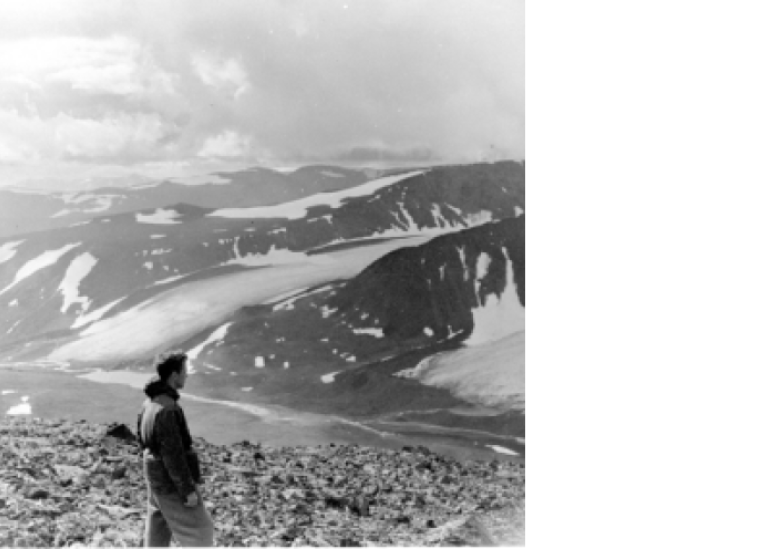
Valter Schytt during his first visit to Tarfala. Storglaciären in the background.
1940 to 1960
In the summer of 1945, Valter Schytt carried out a reconnaissance of suitable premises for a long-term mass balance study and the choice was the Large Glacier in the Tarfala Valley next to Kebnekaise. In 1948, the first cabins were built at the place where the station is now located and in 1950, Prismahuset was built, which has been the station's hallmark over the years. Early on, Tarfala also became a place for training polar explorers and testing equipment intended for polar regions.
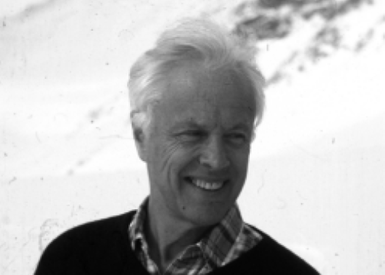
Walter Schytt
1949–52 The Antarctic Expedition was trained here. The most important question for that expedition was whether the ice decreased even there. This would provide an answer to the question of whether global warming was global or not. The training for polar voyages has since continued over the years and has been a component of the business.
During the 1950s, the station was part of KVA's field stations and from 1959, annual field courses in geography were arranged in Tarfala.
Milestones over the time period
1960 Svanö AB presents a cabin to the station.
1959 Annual university courses are started at Tarfala Research Station.
1951 The local Tarfala co-ordinate system is connected to the national Swedish co-ordinate system Rikets Nät. The first map of the glacier is constructed.
1950 The Prisma hut is built.
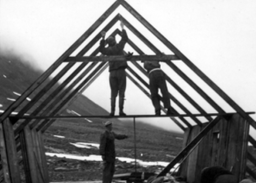
The prisma hut under construction.
1947 The first building is bought from Andreas Niia (native of Nikkaluokta) and placed next to the Swedish Tourist Association hut at the Tarfala lake. One year later the hut is was moved down to the location of the current station.
1946 The 1945/46 mass balance measurements are started on Storglaciären.
1945 Valter Schytt and Gösta Walldén scouts a location for long-term mass abalance project supervised by Hans W:son Ahlmann.
1960 to 2000
In 1960-61, the station was expanded to be able to maintain a course activity at the same time as research projects were run. In August 1961, it was inaugurated as a field station under the newly formed Stockholm University. The ownership thus passed to the State. Over the years, various extensions took place and in some cases, houses demolished in storms had to be replaced by new ones. Electricity was drawn up to the station in 1971.
Milestones over the time period
1998 A professorship in glaciology is installed at Stockholm University.
1996 The Environmental and Space research Institute in Kiruna opens and the staff number in Tarfala significantly increases. Per Holmlund is appointed as director for Tarfala Research Station.
1995 The celebration of fifty years of research activities in Tarfala.
1994 The National Board of Public Buildings shoulders the care-taking of the station.
1993 A hurricane with wind speeds of up to 76 m/s destroys the sauna and laundry house. The Mässen and Prismat buildings are severely damaged. The damage is repaired and a new combined sauna and laundry building is built during the following summer.
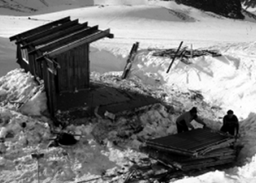
The sauna building being dismantled after being moved 75 m by 75 meter per second wind gusts in 1993.
1992 Wind speeds of up to 81 m/s, the official Swedish wind speed record, are measured during a hurricane in late December.
1991 The laboratory hut at Rännan is destroyed by a slush avalanche.
1990 to 1994 Tarfala co-ordinate net is corrected through GPS measurements.
1990 A telephone cable is laid out to Tarfala making the radio relay station on Kebnetjåkka superfluous.
1988 A relay station for VHF radio communications is established on Kaskasatjåkka.
1988 A new laundry house is built as an extension to the existing sauna building.
1987 A new hut, also supplied with electrical power, is built on the northern lateral moraine of Storglaciären.
1985 The laundry house disintegrates in a November storm.
1985 Valter Schytt passes away in Tarfala valley during a winter visit. Wibjörn Karlén is appointed as new director of the Tarfala Research Station.
1982 The laboratory hut by Rännan is damaged in a slush avalanche. It is repaired during the following summer.
1982 A new generator building was built to generate emergency power. The generator can operate for two weeks without refuelling.
1975 A hut is erected on the glacier as part of a project on glacier meteorology. The hut was connected to the power net through 1986. It was torn down in 1988.
1975 The sauna and food storage buildings are destroyed in a winter storm and are replaced during the following summer with new living quarters and a sauna. Svanö becomes the new food storage.
1974 The messroom building is expanded with an assembly room and a new kitchen.
1972 A telephone linked through a radio transmitter on Kebnetjåkka is installed.
1971 Electric power is installed at the station.
1970 A second Unesco course is held at Tarfala.
1970 The huts Tvillingarna are built to expand living quartes at the station. The huts are funded by the county administrative board of Norrbotten.
1968 A new building housing a laboratory and a lecture room is built.
1968 The hydrological flume station Rännan is built.
1967 A Unesco course is held at Tarfala.
1965 to 1975 The International Hydrological Decade (IHD) spawns hydrological activites in the Tarfala valley.
1963 The National Swedish Board of Public Buildings shoulders the responsibility for the buildings and their maintenance.
1962 A 60 meter long ice tunnel is excavated into the terminus of Isfallsglaciären and Bacho AB presents a sauna to the station.
1961 The station is officially opened as a Research station under Stockholm University. The station is expanded by four buildings through a grant from the Wallenberg Foundation.
2000 to present
A new major extension and renovation took place in 2001-03. In 2017, serious moisture damage was discovered in some of the houses and a renovation and rebuilding was started in 2018 and a new house for staff housing was completed in September 2019.
During the 1960s, the glacier monitoring program was expanded to include about 20 glaciers and reporting took place (and still takes place) to the organization today called the World Glacier Monitoring Service (WGMS).
Since 2010, the Tarfala operation has been a partner in the EU-funded Arctic infrastructure network INTERACT. Within the framework of this project, ‘transnational access’ financing is offered, ie. European researchers can apply for and receive funding to cover travel and subsistence expenses at the station. Through Tarfala, Stockholm University participates in the national network Swedish Infrastructure for Ecosystem Science (SITES), which is a VR-funded investment in support for field research in Sweden. Together with the principals of the nine stations, research support is developed within the network, among other things by making monitoring data available.
Last updated: 2025-10-21
Source: Tarfala Research Station