


Javier García-Martínez: Chemistry as a Catalyst for Systemic Change
Javier García-Martínez approaches chemistry as something far larger than a scientific discipline. With a career spanning academia, entrepreneurship, and international scientific leadership, he has consistently worked at the intersection of catalysis, sustainability, and responsible innovation. Whether developing advanced materials, building companies, or shaping international frameworks, his focus remains the same: ensuring that chemistry delivers tangible value for society.
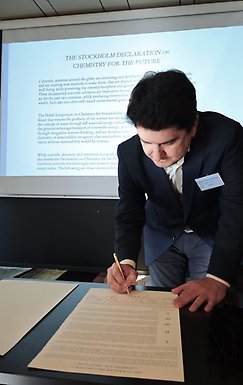
Javier García-Martínez signing Stockholm Declaration
This systems-oriented perspective shaped his role in co-authoring the Stockholm Declaration on Chemistry for the Future. Invited by a small international group of colleagues, García-Martínez joined a collaborative effort to develop a framework intended not merely to reflect on the future of chemistry, but to help guide it. The Declaration outlines a shared vision for the discipline through commitments related to safe and sustainable by design approaches, systems thinking, circularity, transparency, and global collaboration. Bringing together perspectives from academia, industry, and policy, the process reflected the very interdisciplinarity the document advocates.
Through his leadership roles within IUPAC, including as President during 2022–2023, García-Martínez has worked extensively with questions surrounding responsible chemistry, ethics, sustainability, and international scientific coordination. This has also given him a clear view of the Declaration’s international reception. The strong global engagement – from individual signatories to endorsements by major chemical organizations – signals, in his view, a growing recognition that chemistry must evolve to meet contemporary challenges. “The Stockholm Declaration matters because it reminds us that the future of chemistry will be defined not only by what we discover, but by how we put that knowledge into practice,” García-Martínez says.
At the heart of García-Martínez’s thinking lies a clear message: chemistry can no longer focus exclusively on molecules. While molecular innovation remains fundamental, the field must also engage with broader dimensions such as toxicology, environmental assessment, education, and full value chains. Incremental improvements, he argues, are insufficient. Despite decades of scientific progress, environmental pressures continue to intensify. What is needed instead is a deeper transformation – one that combines scientific excellence with systems thinking, long-term responsibility, and practical implementation.
Yet he is equally clear-eyed about the challenges ahead. Structural barriers remain significant: short-term incentives, fragmented institutions, and limited alignment between academia, industry, and policy often slow progress. In addition, there is a cultural challenge. Chemistry education, he argues, must move beyond a narrow focus on efficiency and yield to include life-cycle analysis, societal impact, and sustainability as core elements of chemical design and decision-making.
Education is therefore not a side issue, but a central lever for change. In his own teaching, García-Martínez integrates the Stockholm Declaration into discussions around the 12 Principles of Green Chemistry, using its core commitments as a framework for exploring questions such as safe and sustainable design, elimination of waste, and systems thinking across entire value chains. For students, this creates a clearer connection between chemistry as a technical discipline and chemistry as a profession with societal responsibility.
His own professional trajectory reinforces this perspective. After postdoctoral research at MIT, he co-founded a company based on catalytic technologies designed to improve industrial efficiency and significantly reduce CO₂ emissions. The experience of translating laboratory innovation into industrial implementation strengthened his conviction that chemistry’s role is not only to generate knowledge, but to ensure that solutions are scalable, impactful, and aligned with societal needs.
Looking ahead, García-Martínez expresses concern not about scientific capability, but about collective inaction. In a world increasingly characterized by fragmentation, geopolitical tensions, and declining trust, he emphasizes the urgent need for stronger international collaboration and more coordinated efforts. Scientific discovery alone, he argues, is not sufficient. Progress depends on the willingness to act collectively and align innovation with long-term societal and environmental goals.
For García-Martínez, the Stockholm Declaration is ultimately a call to action. Its significance lies not only in its vision, but in how its commitments are translated into practice – across classrooms, laboratories, industry, and policy. The future of chemistry, he suggests, will not be defined by what is scientifically possible, but by whether the global chemistry community is willing to turn shared ambition into meaningful action.
Fact Box: Javier García-Martínez
- Field: Catalysis, sustainable chemistry, materials science
- Based in: University of Alicante, Spain
- Role in Declaration: Contributor and signatory
- Research trademark: Bridging science, industry, and policy for real-world impact
Last updated: 2026-06-11
Source: Department of Social Work