


Lunch Webinar: How to increase sustainability in research laboratories
Ingress
Webinar
Date:
Wednesday 26 November 2025Time:
12.00 – 13.10Location:
Zoom: https://stockholmuniversity.zoom.us/j/61335959730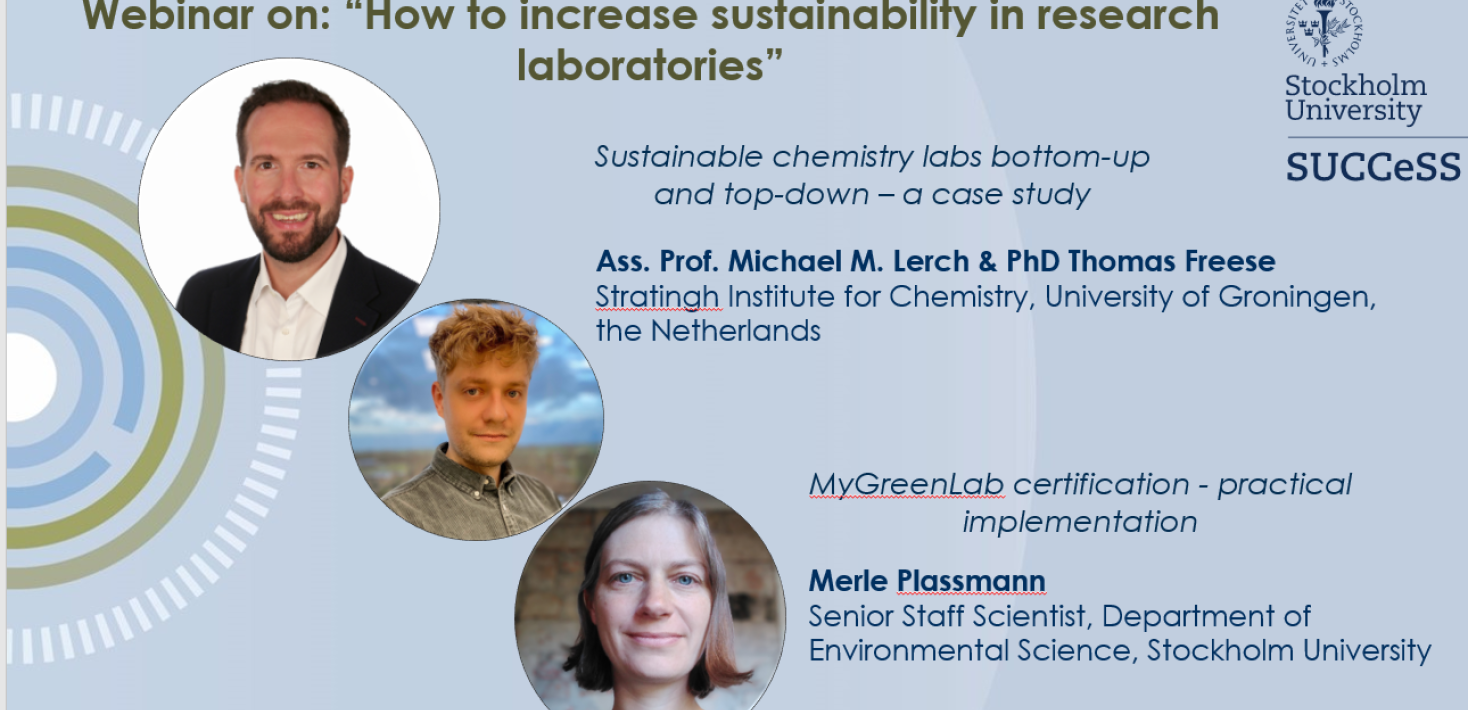
Many of us are dedicated to the development of sustainable chemistry research. But how sustainable are our own labs?
The three speakers of this webinar will present the key sustainability issues in a typical lab environment, from energy consumption and resource consumption to waste generation, and use a case study to guide participants to more sustainable lab practices. You will also learn about the lab certification possibility offered by My Green Lab. We hope to inspire you to turn your own lab, or even department, into a more sustainable environment!
"Sustainable chemistry labs bottom-up and top-down - a case study"
Ass. Prof. Michael M. Lerch & PhD Thomas Freese at Groningen University, the Netherlands.
Laboratories consume five to ten times more energy than office buildings of the same size, consuming large amounts of energy and water, and producing hazardous waste. Single use plastics from research contributes about 2% of global plastic waste, and global R&D contributed to more CO2e emissions than the annual emissions of for example the UK or the Netherlands. We scientists need to promote more sustainable practices and contribute to solve technological and societal challenges both through our research findings and through how we conduct our science from day to day. In this presentation, we will cover our recent work on sustainable lab practices at the University of Groningen, including a case study on easy steps we can take to lessen the impact of our research practices in chemistry laboratories and beyond.
Sustainable chemistry labs bottom-up and top-down – a case study pdf, 115.7 kB. (115 Kb) .
"MyGreenLab certification - practical implementation"
Merle Plassmann, Senior Staff Scientist at ACES, Stockholm University.
To promote sustainability in our laboratories at the Contaminant Chemistry unit, Department of Environmental Science, Stockholm University, we chose to pursue certification through My Green Lab. My Green Lab is a non-profit organization that offers a range of programs designed to help laboratories become more sustainable. The certification process covers key areas such as waste management, purchasing practices, and energy use, and provides tailored recommendations for improvement. This talk will share our experience with the certification process in our unit and offer broader insights into practical steps laboratories can take to operate more sustainably.
Moderator
Prof. Berit Olofsson, Stockholm University, deputy Director of SUCCeSS
Last updated: 2025-11-11
Source: SUCCeSS