


How can workers influence the control of their work?
Working as a care assistant in elderly care is Sweden's most common occupation. It is also one of the occupations with the highest rates of sick leave, and where employers struggle most to find staff. Many municipalities are therefore considering changes in how care work is controlled in order to improve worker wellbeing.
A new dissertation turns the perspective around, examining how care workers’ knowledge about how control should be designed are expressed. The dissertation About time: Workers and Control in Home Care examines how home care workers influence the management systems that determine how home care visits are carried out. It is therefore not only managers and systems that govern how home care operates. In some cases, the staff's own decisions play a decisive role.
In many municipalities, home care work is planned with the help of digital systems. Each service is assigned a set amount of time, and the schedule is expected to run to the minute. The purpose is clear: to increase efficiency and create order. But reality does not always fit the schedule. Care is not only about tasks that need to be carried out, but also about relationships. A person may need extra time on a particular day, or may feel safer with someone they know. These kinds of needs are difficult to capture in a predefined schedule.
When planning falls short, someone has to fill in the gaps. That is where the staff come in. In everyday practice, they make adjustments: they move visits around, reprioritize, and stay longer with the person who needs it most. This often happens quickly and without being documented. For the person receiving care, it appears as though the help is working. For the organization, however, it is rarely visible — even though it is crucial for the service to function.
A hidden responsibility
The dissertation shows that home care staff do more than carry out care work. They also help control it. Through their decisions, experience, and knowledge of care recipients, they shape how the work is actually carried out in practice. This means that an important part of control lies outside the formal systems.
Åsa Plesner defended the dissertation About Time: Workers and Control in Home Care on June 12.
I hope my research will encourage management teams to take staff members’ knowledge, experience, and concerns seriously when considering how the organization should be governed. In the articles included in the dissertation, staff identify operational risks long before management does, and everyone could benefit if those risks were brought to light, says Åsa Plesner.
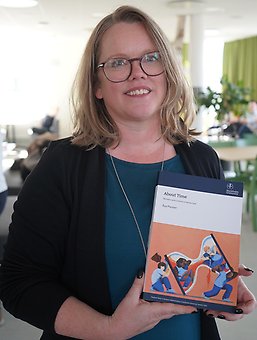
Åsa Plesner with the dissertation About Time: Workers and Control in Home Care. Photo: Maria Stoetzer.
“My dissertation shows that care workers sometimes influence governance in ways that managers higher up in the organization do not foresee, or do not see the value of. This means that governance is not only carried out according to management’s design or on management’s initiative. Those of us who want to understand governance must therefore also pay attention to how staff think and act — not only to how management teams think and act,” continues Åsa Plesner.
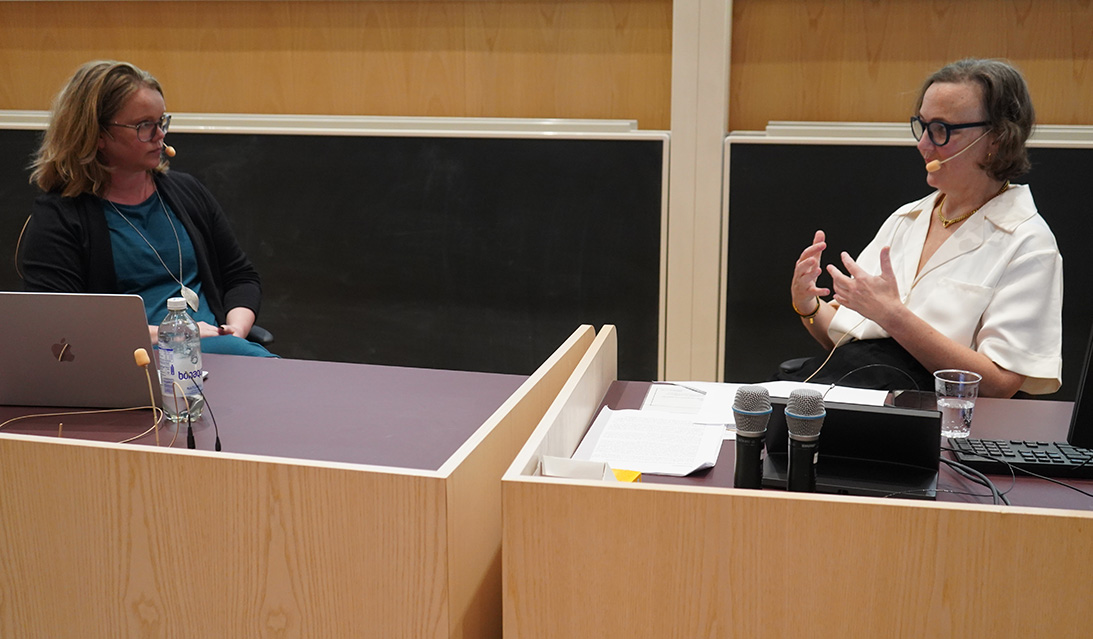
Åsa Plesner and opponent Jane Andrew, University of Sydney Business School, University of Sydney. Photo: Maria Stoetzer.
The dissertation About Time: Workers and Control in Home Care contains three articles. The articles examine how care workers shape control systems at the individual, local, and national levels.
Time to care? The temporal structuring of home care work
The article Time to care? The temporal structuring of home care work is an ethnographic study of the planning and delivery of home care in a small town. It shows how care workers and administrators adapt, modify, or disregard the results of the formal, partly automated planning system. The analysis highlights how control over care services depends to a great extent on the actions of individual workers and on relationships between workers. The article shows that care workers carry out governance work in addition to their care work.
Seizing overflows: exploring how accounting becomes emancipatory
At the organizational level, Seizing overflows: exploring how accounting becomes emancipatory uses archival material to analyze a ten-year reform process in management control within a home care organization. It shows how a financial management reform created stressful working conditions for care workers, who then mobilized occupational health and safety legislation to oppose the changes. The reform was ultimately withdrawn, illustrating how workers can influence governance by highlighting unintended consequences of management decisions.
Winning the debate but losing the message
At the national level, the article Winning the debate but losing the message uses mixed methods to follow a national campaign by care workers’ unions against so-called “minute-based control” in home care. Although the campaign succeeded in raising awareness and criticism of the concept at the national level, local attempts to change governance practices failed because of disagreement over what the concept actually meant. Even though the change was not implemented, the article shows how workers can set the agenda for discussions about governance.
Most research on governance in organizations conceptualizes governance as a top-down process, in which central management is portrayed as the primary architect behind control systems. The dissertation challenges this perspective and instead argues that governance is shaped by multiple actors and should be studied from more perspectives than only that of management.
Read the dissertation About Time: Workers and Control in Home Care.
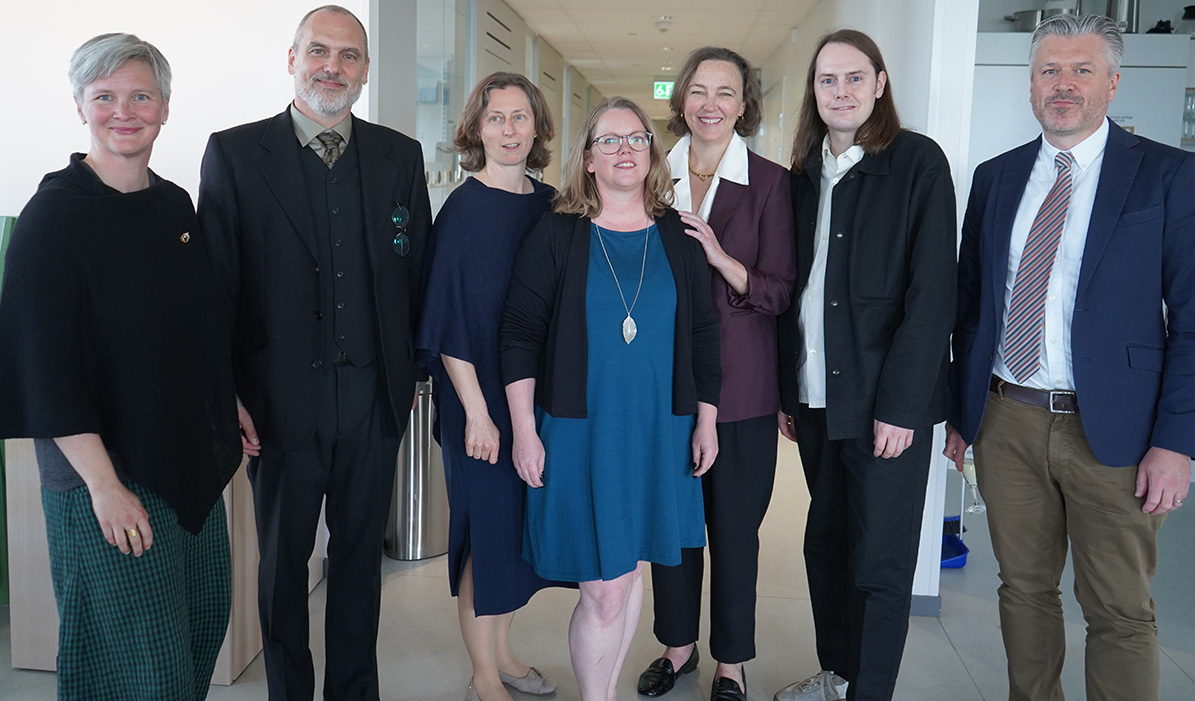
From left: Ebba Sjögren, Mikael Holmgren Caicedo, Berit Hartmann, Åsa Plesner, Jane Andrew, Andreas Sundström, Thomas Carrington. Photo: Maria Stoetzer.
Opponent
Jane Andrew, Professor, The University of Sydney Business School, The University of Sydney
Examination Committee
Berit Hartmann, Associate Professor, Department of Business Administration, University of Gothenburg
Ebba Sjögren, Associate Professor, Department of Accounting, Stockholm School of Economics
Mikael Holmgren Caicedo, Associate Professor, SBS, Stockholm University
Dominic Power, Professor, Department of Human Geography, Stockholm University (substitute)
Supervisors
Andreas Sundström, Associate Professor, SBS, Stockholm University
Thomas Carrington, Professor, School of Business and Economics, Åbo Akademi University
Last updated: 2026-09-18
Source: SBS