


Stockholm Summit connects Ukrainian municipalities with Swedish partners to advance reconstruction projects
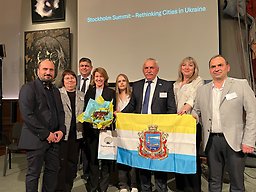
The Stockholm Summit – Rethinking Cities in Ukraine was held on 28–30 April 2026, bringing together Ukrainian municipalities, Swedish authorities, international financial institutions and industry representatives.
The summit was organized by Ragnar Lund at Stockholm Business School and marked the final stage of an eight-month capacity-building programme developed and delivered in collaboration with Ro3kvit Urban Coalition for Ukraine.
The programme has been running since autumn 2022 with support from the Swedish Institute and has supported teams of Ukrainian municipal leaders through training in spatial planning, local economic development and project preparation under wartime conditions. The 2026 Stockholm Summit was also supported by the Swedish Energy Agency.
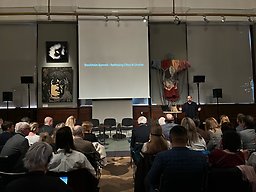
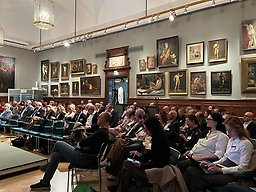
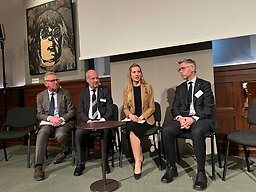
From capacity-building to implementation
The Rethinking Cities in Ukraine programme was designed to strengthen municipalities’ capacity in spatial planning and local economic development, and to support the development of project proposals based on local needs using integrated and participatory approaches. The Stockholm Summit demonstrated how this work can move forward into concrete next steps.
Projects developed within the programme are now being taken forward through collaboration with Swedish and international partners, including industry actors and financing institutions. This reflects a shift from capacity-building towards a platform that also supports project development, partnerships and implementation.
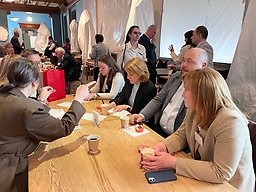
Municipal projects and local priorities
Five Ukrainian municipalities — Kovel, Chornomorsk, Shepetivka, Fastiv and Rokytne — presented project proposals developed during the programme.
The projects focus on:
- resilient and distributed energy systems
- water and wastewater infrastructure
- waste management
- social infrastructure and community services
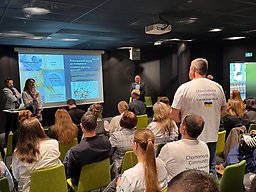
The summit enabled direct dialogue between municipal representatives and potential partners, creating a basis for continued project development.
Energy systems and resilient infrastructure
Energy was a central theme of the summit, reflecting the need to rebuild infrastructure that is both resilient and future-oriented.
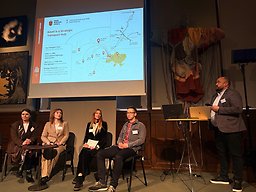
Representatives from Kryvyi Rih, including First Deputy Mayor Yehven Udod, presented a concept for integrated energy systems combining heat, electricity, renewable energy and storage. The discussion highlighted the importance of moving from single solutions to system-level approaches. Similar approaches were presented by Kovel, linking distributed energy systems to local economic development.
Industry perspectives, including Siemens Energy, emphasised the importance of early involvement in project design to ensure technically robust and sustainable solutions. Financial perspectives were also discussed, with contributions from representatives of the European Bank for Reconstruction and Development and the European Investment Bank.
From concept to project development: the case of Lozova
A concrete example discussed during the summit was the municipality of Lozova in the Kharkiv region. Through an earlier cycle of the programme, Lozova developed project concepts in water infrastructure and waste management. These are now being further developed with support from Swedfund and Sida-funded initiatives implemented by SALAR International. The Lozova case illustrates how structured project preparation and early engagement with partners can support the transition from project idea to implementation.
Industry representatives, including Volvo Construction Equipment and Alfa Laval, highlighted the importance of early involvement in local reconstruction projects. Financial perspectives were also discussed, including comparisons between Swedish export credit systems and international models such as Denmark’s, which combine grants and export guarantees to support private sector engagement.
Dialogue with industry, finance and policymakers
The summit brought together representatives from industry, financial institutions and public actors active in Ukraine.
Key discussions focused on:
- the importance of early industry involvement
- the need for stronger financial instruments
- improved coordination between public support and private sector actors
Examples from other European countries, including the Danish export credit agency EIFO, were highlighted as models for combining grants and financing.
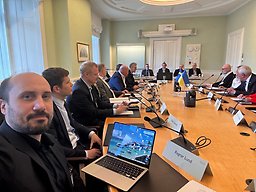
A roundtable discussion at the Swedish Parliament, organised together with the Committee on Industry and Trade, further addressed how to strengthen Sweden’s engagement in Ukraine’s reconstruction.
Study visits and institutional exchange
In addition to the conference, participants took part in study visits, workshops and bilateral meetings with Swedish partners.
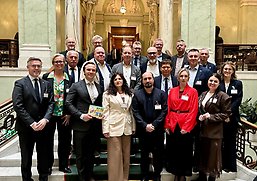
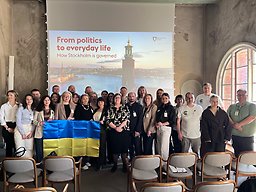
The programme included exchanges with representatives of the City of Stockholm and its municipal companies responsible for water and waste management, as well as meetings at Stockholm City Hall.
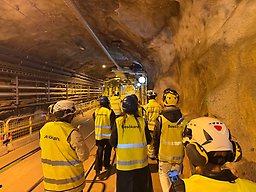
Workshops and discussions were also held with key stakeholders, including Swedfund, WM4U and SWECO, focusing on project preparation, financing pathways and technical solutions. Participants met with the Swedish Energy Agency to discuss energy resilience and crisis management, and visited Södertörn Fjärrvärme AB to explore district heating systems, circularity and cybersecurity in critical infrastructure.
At Käppalaverket, discussions focused on wastewater treatment and the exchange of experience relevant to municipalities working to build robust and resilient water systems.
A platform for continued collaboration
The summit formed part of a broader process rather than a standalone event. Through the programme and the summit, municipalities have established initial contacts with Swedish industry, financial institutions and public actors. The work now continues through more focused collaboration aimed at advancing selected projects towards feasibility, financing and implementation.
Programme completion
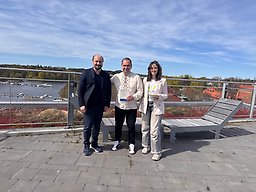
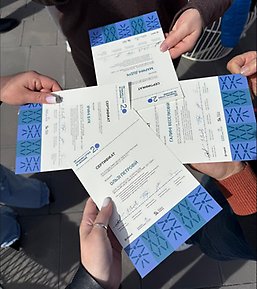
This cycle of the programme concluded at Stockholm University, where participating municipal teams received diplomas following the eight-month training programme.
Looking ahead
The Stockholm Summit demonstrated how local needs, technical expertise, financing and policy dialogue can be brought together to support Ukraine’s reconstruction. By connecting municipalities with partners and resources, the programme contributes to long-term collaboration and the development of resilient and sustainable solutions.
Last updated: 2026-06-10
Source: SBS