


Sean Silvia joins SUITS to study antiquities, heritage and reuse
During his time at SUITS, Princeton PhD candidate Sean Silvia will explore how archaeological practices and heritage policies transformed the use and perception of ancient ruins in Turkey, including the often-overlooked experiences of communities who inhabited and reused them.
Sean Silvia is visiting SUITS as a PhD candidate from Princeton University. His research focuses on the reuse and reinhabitation of ancient remnants in the long-nineteenth-century Aegean Sea region, the mobility of antiquities reuse communities, the history of international relations with an emphasis on trans-border propagation and enforcement of antiquities management, the history of archaeological science and other epistemologies of antiquities, and the coalescence and consequences of global ruin aesthetics.
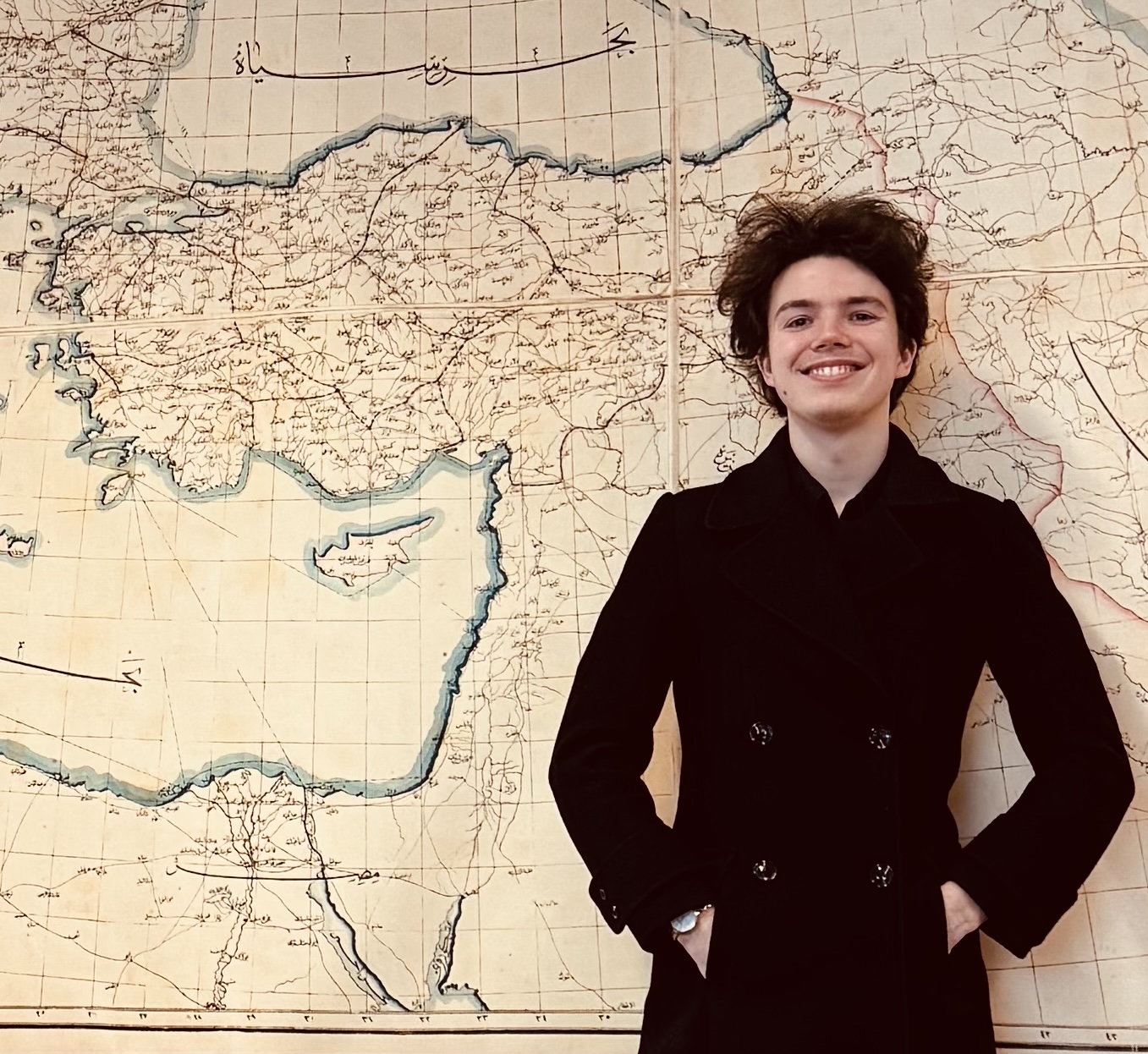
At Princeton, Sean Silvia is a Seeger Center for Hellenic Studies funding recipient. During the previous academic year, he was a joint research fellow at the British Institute of Archaeology in Ankara and the Koç University Research Center for Anatolian Civilizations (ANAMED) in Istanbul. He earned a Classical Archaeology MSt with distinction at Oxford University as a fellow of the Ertegün Graduate Scholarship Programme, and earned a BA in History and Archaeology from the University of Southern California, where he received the Lois Banner Award for best History honors thesis. He is a recipient of the Fulbright-Hays American Research Institute in Turkey award and Critical Language Scholarship award, both for the acquisition of Turkish.
He has performed archaeological excavation at the site of Aphrodisias with Oxford University, and engages in ongoing fieldwork in Anatolia, especially in the Taurus Mountains of south and southwestern Turkey. In addition to archaeological, historical, and art historical methodologies more broadly, Sean Silvia draws from new diplomatic history, phenomenology, postcolonial analysis with an emphasis on Critical Ancient World Studies, environmental history, and spatial sciences.
At SUITS, he will perform research for his larger dissertation project. Briefly, while scholarship on heritage policy in Anatolia has largely emphasized protection against colonial-era extraction of antiquities, my dissertation examines the less-studied consequences of those policies, including the displacement of communities who inhabited reused ancient ruins and the cessation of a trans-Mediterranean trade of antiquities destined for reuse inhabitations. A central component of that displacement of reusers was a global ruin aesthetic that idealized uninhabited ruins. Sweden, whose archaeologists worked in the Ottoman Empire and then the Republic of Turkey, differed from the other global archaeological powers in its lack of direct material link to Mediterranean antiquity. Stockholm is therefore a useful vantage point from which to analyze the history of archaeological science and the way its assumptions about ideal ruin became a universalizing rhetoric unmoored from geographic contingency and applied across borders. As adaptive reuse and alternative ways to view the landscape have become ever important during today’s crises, to explore expulsive consequences of heritage policy, recover alternative histories of reuse, and explore why and how they became marginalized is an especially salient topic.
Last updated: 2026-08-31
Source: Communications Office