


European Solar Telescope promoted to Landmark status
The European Solar Telescope (EST) has been promoted to Landmark Status by the European Strategy Forum on Research Infrastructures (ESFRI). This promotion recognizes the importance of the project for Europe, its progress towards construction, and the strength of the scientific case for this next generation research infrastructure. Researchers at the Department of Astronomy and the Institute for Solar Physics are involved in the planning for the construction of the telescope and how to use it to make new great discoveries.
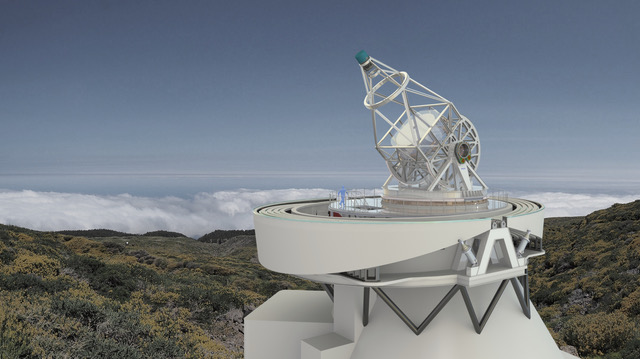
Artist's impression of the EST at Roque de los Muchachos on La Palma (one of the Canary isles) in Spain.
EST will be built at the Roque de los Muchachos Observatory on La Palma, Spain. Its 4.2-metre-class mirror and instruments are designed to observe the solar atmosphere at multiple heights simultaneously and at different wavelengths. Researchers will be able to follow the emergence of magnetic fields at the solar surface and study how energy is transported to higher altitudes in the atmosphere.
These processes are central to understanding solar activity, including the mechanisms behind solar eruptions. The Sun is the only star whose surface and lower atmosphere can be examined in such detail. EST will therefore help researchers investigate physical processes that are also relevant far beyond solar physics and will provide astronomers with unprecedented insights into the Sun as well as its effects on the near-Earth space environment. It will complement and enhance space missions by delivering crucial ground-based data to better understand solar phenomena that directly affect space weather conditions.
At the Institute for Solar Physics at Stockholm University, Professor and Institute Director Jorrit Leenaarts, is leading the Swedish involvement in the project. A number of other researchers (both junior and senior) are involved.
What excites me most about EST is the possibility of tracing the Sun’s magnetic field from the lower layers into the chromosphere with exceptional spatial resolution and sensitivity. This will allow us to better understand how magnetic energy is stored, transported, and released, and how these processes shape the dynamics and heating of the solar atmosphere, says Matheus Aguiar-Kriginsky Silva, postdoctoral fellow at the Institute for Solar physics and Department of Astronomy.
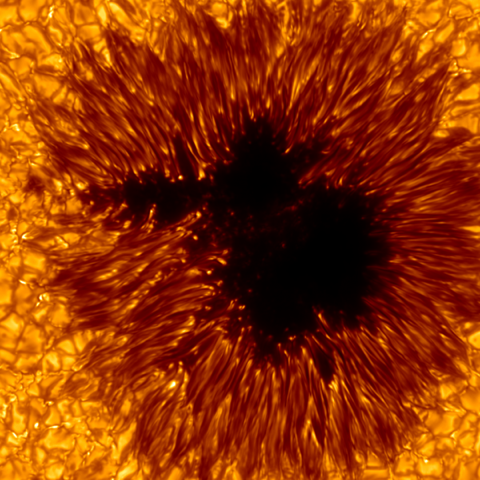
Regular sunspot observed with the CHROMIS instrument on the Swedish Solar Telescope.
ESFRI granted EST status as a Landmark project at its 97th meeting, held in Cork on 23-24th of September 2026. EST was previously recognized as a project on the ESFRI roadmap from 2016. ESFRI projects are evaluated after ten years to monitor their evolution. The upgrade to Landmark status thus recognizes the progress made and the role that EST is expected to play in European research. ESFRI Landmarks are research infrastructures that are already operating or have reached an advanced stage of implementation.
Manuel Collados, EST Coordinator, explains,
EST is, by its very nature, a European project. No single institution or country could undertake an infrastructure of this scale and ambition alone. Its recognition as an ESFRI Landmark is therefore a recognition of the strength of the European partnership that has been built around the project. The task before us now is to turn that shared scientific ambition into the long-term commitments needed to bring EST into construction.
Coordinated by the EST Foundation, with strong support and commitment from the IAC (Instituto de Astrofísica de Canarias), EST brings together institutions from across Europe. The European Solar Telescope Foundation steers the project through its current phase and is preparing the steps towards construction. The telescope will provide European researchers with a shared observing facility, built around scientific questions that existing instruments cannot yet fully address.
The promotion of the European Solar Telescope to ESFRI landmark status is a testament to its high scientific importance. Sweden is heavily involved in the design of the telescope and its instrument suite. With funding from the Swedish Research Council, the Institute for Solar Physics has started building the first instrument for the EST, says Jorrit Leenarts.
Facts about EST
The European Solar Telescope (EST) will be the largest solar telescope ever built in Europe, pursuing unique observations of the magnetic processes taking place on the Sun.
EST will have a 4.2-m primary mirror and the latest technology available, giving astronomers the most powerful tool ever conceived for observing the Sun.
EST will be deployed in the Canary Islands, a first-class location thanks to the sky quality and excellent conditions for astronomical observations.
In 2023, the EST Foundation was established by nine institutions (including Stockholm University) in seven different European countries as the legal entity that will advance the project towards the creation of the European Research Infrastructure Consortium (ERIC) and thus the construction of the telescope.
More information
Read more about EST on the project web page.
Contact
Dan Kiselman, dan@astro.su.se,
Jorrit Leenaarts, jorrit.leenaarts@astro.su.se, +46855378550
Last updated: 2026-10-16
Source: Institute for Solar Physics