


Can Big Firms Slow Down Economic Growth?
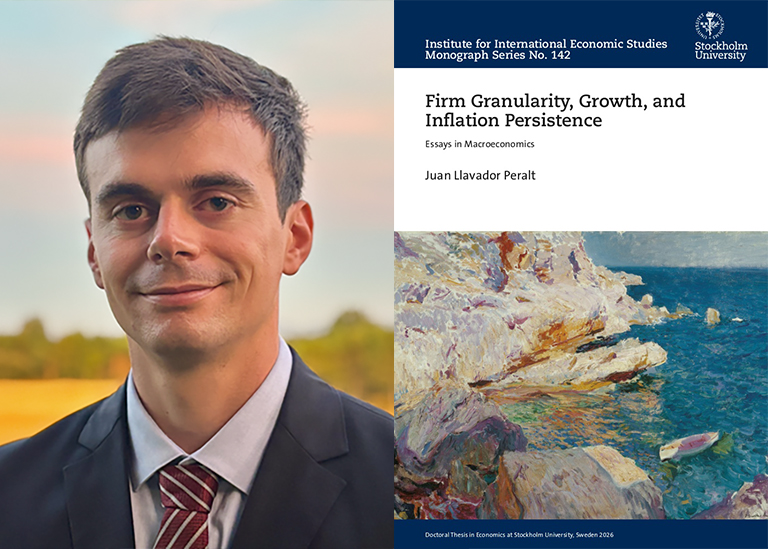
Why do some industries grow faster than others? And why does inflation often remain high even after the original shock has passed? In his doctoral thesis, IIES graduate student Juan Llavador Peralt explores how the behavior of firms (especially large ones) can help answer both questions.
When big firms hold back growth
A common assumption is that large, successful firms drive economic progress. But Juan identifies a counterintuitive effect: too much market concentration can actually slow down productivity growth.
Using firm-level data from Sweden and other countries, he shows that when a few firms dominate an industry, resources are less likely to shift toward the most productive companies. This mechanism—what he calls a “granular drag”—reduces overall innovation and efficiency.
The numbers are striking:
- A 10 percentage point increase in market concentration is linked to a 3 percentage point drop in productivity growth over five years
- In more distorted markets, the decline can be as large as 13 percentage points
In short, when markets are dominated by a small number of players, economies may grow more slowly.
Small differences between firms can shape entire industries
The research also highlights how much the fortunes of individual firms matter.
Even when firms face similar conditions, random differences in productivity can lead to persistent gaps in performance across industries. Some sectors grow faster than others simply because of how market shares are distributed among firms.
To better understand these dynamics, Juan develops a new modeling approach that uses machine learning techniques to track how firms adjust their behavior over time. The results show that even a relatively small number of large firms can have outsized effects on long-term growth patterns.
Why inflation tends to stick around
The thesis also offers a new explanation for a familiar problem: why inflation is so persistent.
Standard models struggle to explain why inflation remains elevated even after the initial shock fades. Juan shows that this persistence can arise naturally from how firms set prices.
In reality, changing prices is costly, so firms do not adjust them continuously. Instead, they wait and adjust at specific moments. This creates two effects:
- Some firms adjust prices immediately
- Others delay changes, creating a lagged, gradual response
This staggered behavior makes inflation depend on its own past, helping explain why it doesn’t quickly return to normal levels.
Importantly, this mechanism emerges from firms’ optimal decisions, without needing to assume artificial “rules” in the model.
A new perspective on growth and inflation
Taken together, the research offers a fresh perspective on how modern economies work.
The broader lesson is that macroeconomic outcomes, like growth and inflation, are deeply shaped by what happens inside firms.
As policymakers grapple with sluggish productivity and persistent inflation, understanding these micro-level dynamics may be key to designing more effective economic policies.
Juan will defend his thesis “Firm Granularity, Growth, and Inflation Persistence: Essays in Macroeconomics” on June 12.
Last updated: 2026-06-02
Source: Institute for International Economic Studies