


Why do healthcare choices vary, and why do inequalities endure across generations?
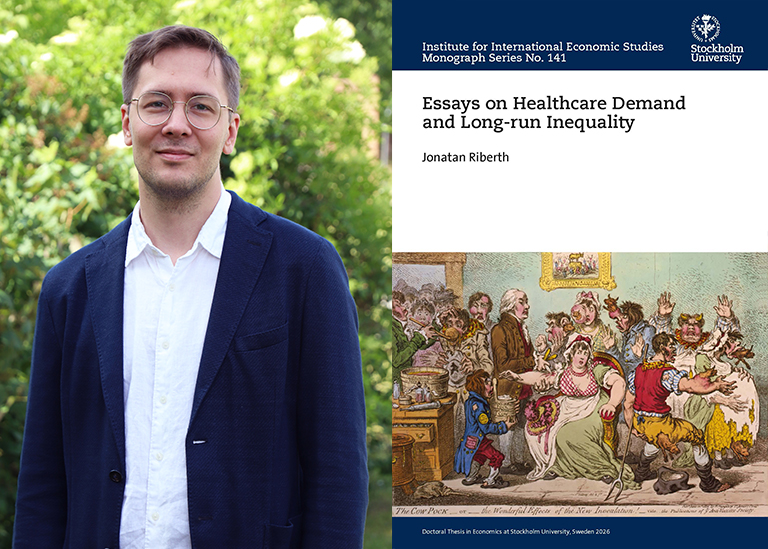
In his doctoral thesis, IIES graduate student Jonatan Riberth examines how personal experiences influence healthcare decisions, and how wealth and human capital are passed down across generations.
Personal experiences leave lasting marks
One of the thesis’ central findings is that direct personal experiences strongly influence health decisions.
Jonatan studies a well-known case in Sweden: the small number of people who developed narcolepsy after receiving the 2009 swine flu vaccine. More than a decade later, they and people close to them were significantly less likely to get vaccinated against COVID-19.
This suggests that people rely heavily on their own experiences when making healthcare decisions. But the pattern is not simply that bad experiences make people distrust healthcare in general.
What matters is the type of experience: adverse reactions to medicines that are less closely connected to vaccines have much less impact on later vaccine decisions.
Mistaking coincidence for cause
Another part of the thesis studies how people interpret health problems after vaccination when the cause is uncertain. During the COVID-19 campaign, rare blood clots were widely discussed in the media. Jonatan shows that people who experienced a blood clot shortly after vaccination, even when it was not caused by the vaccine, were more likely to stop getting further doses.
Wealth can shape inequality for centuries
The thesis also examines the long-term effects of wealth redistribution. In 1680, the Swedish Crown confiscated about half of all noble estates. Jonatan finds that descendants of affected families were less wealthy up to five generations later. While the wealth effects persisted across generations, Jonatan finds little evidence that the shock affected other outcomes, such as education, marriage patterns, or elite careers.
Is inequality really about groups, or families?
Finally, the thesis challenges a common explanation for differences between groups of descendants of immigrants.
A common explanation is “ethnic capital”: the norms, expectations, and barriers associated with a family’s country-of-origin group.
Jonatan shows that much of what looks like an origin-group effect disappears once extended family background is taken into account. In other words, differences between groups often reflect who migrated in the first generation, combined with strong persistence within families over time.
A deeper look at inequality and health decisions
Taken together, the thesis shows that both personal experiences and family background can have lasting effects. Personal health experiences influence later healthcare decisions, while family resources and human capital drive the persistence of inequality across generations.
Jonatan will defend his thesis “Essays on Healthcare Demand and Long-run Inequality” on June 11.
Last updated: 2026-06-01
Source: Institute for International Economic Studies