


Who participates, who benefits, and who pays?
What determines who participates in politics, how resources are distributed, and who benefits from major policy decisions? In his doctoral thesis, IIES graduate student Mattias Folkestad explores these questions through a series of chapters that reveal how power and policy interact, often with long-lasting effects.
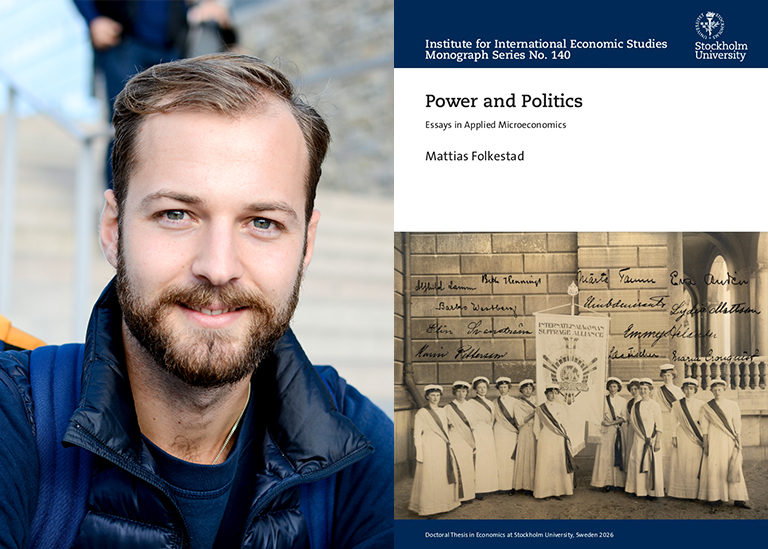
How female teachers helped change women’s lives
In the late 19th century, Sweden opened the teaching profession to women. What might seem like a simple reform turned out to have far-reaching consequences. Mattias shows that girls who were exposed to female teachers were more likely to pursue work outside the home and engage in politics later in life. By the 1910s, they were:
- 18% more likely to participate in the women’s suffrage movement
- 9% more likely to work in non-domestic occupations
Female teachers didn’t just educate, they also acted as role models and political organizers, helping accelerate women’s economic and political emancipation. The effects were especially strong in the political sphere.
Local control over wind farms comes with trade-offs
The construction of wind farms for clean electricity production is a vital ingredient in the green energy transition. One of the most challenging policy problems is getting the institutional framework for siting decisions and permits right. While renewable energy benefits society as a whole, it often imposes local costs, such as changes to landscapes or property values. Mattias studies the consequences of empowering local politicians with veto rights over wind farm construction in their municipalities.
Mattias finds that when local governments have veto power, they tend to reject projects that impose higher costs on their own residents. This reduces local burdens but creates broader consequences:
- Projects are placed less efficiently in terms of electricity production.
- Costs are shifted to neighboring municipalities.
- The local political environment determines which projects get approved.
- Disproportionately affects disadvantaged communities.
The result is a clear trade-off between local fairness and overall efficiency.
Early political experience shapes future participation
Political engagement is not just about preferences—it also depends on timing. Using detailed data on Swedish politicians, Mattias shows that first experiences with elections matter a great deal. Individuals who have already participated once are much more likely to take on deeper political roles the next time.
Compared to first-time participants, those with prior experience are:
- 10–14% more likely to run for office
- 60–70% more likely to be elected
Interestingly, this effect is not about voting itself, but about more demanding forms of participation. Early exposure (and opportunities to engage) can strongly shape who becomes politically active.
Do more school resources improve outcomes?
Finally, the thesis examines whether directing more funding toward disadvantaged students improves education outcomes. Looking at a school reform in Stockholm, Mattias finds that increased funding leads to more spending, particularly on staff and student support. However, there is not an overall positive effects on student performance.
The key result is more targeted:
- Positive effects are concentrated among disadvantaged groups, especially recently arrived immigrant students
- Gains are strongest for boys in these groups
This suggests that redistributing resources can reduce achievement gaps, even if it does not raise average outcomes.
Power and politics
Across the these chapters, a common theme is that institutions shape who gains influence, who receives resources, and who bears the costs of public decisions. The thesis studies these questions across different policy areas, from historical education reforms to contemporary energy and school policy.
Mattias will defend his thesis “Power and Politics: Essays in Applied Microeconomics” on June 10.
More information on the defense.
Last updated: 2026-05-29
Source: Communications Office