


What Makes a Good Manager? It’s in the Feedback
As the economy shifts toward digital, nonroutine, and team-based work, traditional management practices may be less effective than before. In this changing workplace landscape, Jinci Liu’s thesis studies how productivity and retention depend on managerial practices, organizational design, and workers’ preferences over workplace environments in the modern economy.
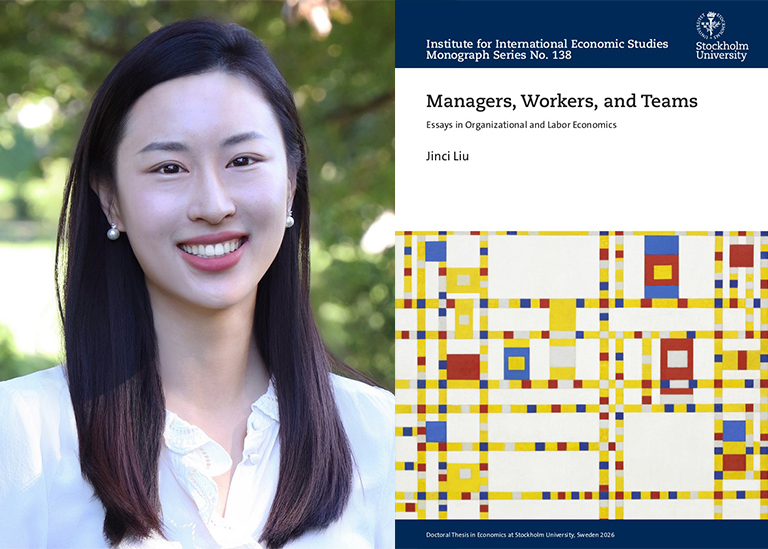
What makes teams productive, and what motivates workers to stay? This is a question every workplace faces, from technology companies to public institutions. In her thesis, IIES graduate student Jinci Liu sheds new light on this question using large-scale data from millions of workers and teams. Her findings point to a surprisingly simple factor: how we give feedback.
The impact of everyday feedback
Managers often focus on what they say when evaluating workers. Jinci’s research shows that how they say it matters even more.
Analyzing over 200 million feedback messages in software teams, she finds that toxic feedback has significant detrimental effects: it reduces both the quantity and quality of work and makes workers more likely to leave.
By contrast, positive feedback increases productivity and retention, and even improves the performance of coworkers, as good morale spreads within teams.
Interestingly, not all criticism is harmful. Non-toxic, constructive criticism does not reduce productivity. This suggests that the tone of feedback, rather than criticism itself, drives the negative effects.
When helpful advice has unexpected costs
Jinci also finds that constructive feedback can sometimes lower output quality in the short run. One reason is that workers spend time revising existing work instead of producing new work.
This finding highlights a common tradeoff in modern workplaces. Improving what already exists can sometimes come at the cost of creating something new.
Overall, her research shows that feedback alone explains 22 % of the differences in manager performance. This makes feedback a central, but often underestimated, management tool.
Does specialization really make teams more productive?
Another common belief is that dividing tasks into specialized roles makes teams more efficient. Jinci’s findings challenge this view.
Studying tens of millions of task assignments, she finds that highly specialized teams perform worse on several dimensions, including output quantity, output quality, and problem solving speed.
When work is distributed more evenly, and team members take on a broader range of tasks, productivity improves significantly in terms of both output quantity and output quality.
The key mechanism appears to be knowledge sharing. When team members understand each other’s work, they collaborate more effectively and generate better ideas.
This suggests that for complex and creative tasks, too much specialization can limit innovation rather than improve it.
Political environment can affect where talent goes
Jinci’s thesis also looks beyond organizations to ask a broader question: what determines where skilled workers choose to live and work?
Her findings show that political environments matter, especially for college-educated workers. In the United States, growing political polarization has made college-educated individuals more sensitive to who governs a state.
The research finds that conservative political leadership can reduce the inflow of college-educated workers. Over time, this may affect regional economies and inequality.
Small changes, big effects
For managers, the implications are clear:
- Prioritize respectful, positive communication
- Encourage broad participation rather than strict specialization
- Recognize that workplace culture can ripple outward
In modern organizations, success may depend less on formal structures and more on how people interact, collaborate, and communicate day to day.
Jinci will defend her thesis “Managers, Workers, and Teams: Essays in Organizational and Labor Economics” on June 8.
Last updated: 2026-05-26
Source: Institute for International Economic Studies