


Why Your Coffee, Rent, and Wages Matter for Central Banks
When central banks raise or lower interest rates, the goal is simple: keep inflation stable and the economy on track. But the way these decisions ripple through society is anything but simple, and it’s changing over time. In his doctoral thesis, IIES graduate student Tiago Bernardino explores how shifts in what we consume, how prices behave, and how policies are designed are quietly reshaping the effectiveness (and fairness) of economic policy.
From factory goods to haircuts and healthcare
Over the past 50 years, advanced economies like the United States have undergone a “structural transformation.” In plain terms, we’ve moved from spending most of our money on goods (like cars, clothes, and appliances) to spending more on services such as healthcare, education, and dining out.
This shift turns out to matter a great deal for how monetary policy works. Tiago shows that prices in the service sector tend to change more slowly than prices for goods. Think of how frequently the price of gasoline fluctuates compared to a haircut or a gym membership. Because service prices are more “sticky,” an economy dominated by services reacts differently when interest rates change.
Using an economic model calibrated with real-world data, Tiago estimates that this long-term shift has made monetary policy about 21% more effective in changing real economic outcomes such as consumption. At the same time, however, these changes also tend to amplify short-term impacts — especially for households with fewer resources.
Who feels economic shocks the most?
A key insight from the thesis is that economic shocks (like recessions or sudden changes in interest rates) do not affect everyone equally. Lower-income households typically spend a larger share of their income on essential goods, such as food, energy, and housing. When the prices of these necessities rise, the burden falls disproportionately on them.
In a coauthored chapter, Tiago and his coauthors show that this inequality becomes especially pronounced when recessions are driven by disruptions in sectors producing essential goods. In such cases, the relative price of necessities rises, squeezing the budgets of lower-income families much more than those of wealthier households.
Interestingly, not all policy responses help equally. Governments sometimes try to shield consumers by cutting taxes on essential goods. But the research finds that such price-based subsidies can backfire, even if they are fully transmitted to consumer prices: higher-income households tend to benefit more in absolute terms, even though necessities make up a smaller share of their spending.
A more effective approach, the thesis suggests, is direct cash transfers—particularly when targeted at lower-income households. These transfers better compensate those who are most exposed to price increases.
Do tax cuts actually lower prices?
One of the most tangible parts of the research examines a real-world policy: a temporary cut in value-added tax (VAT) on food in Portugal. Using detailed daily price data, Tiago and coauthors find that the tax cut was fully passed on to consumers — prices dropped accordingly, stayed low for the duration of the policy, and then returned to their prior trend when the tax was reinstated.
This is a noteworthy finding because economists often debate whether such tax cuts actually reach consumers or are absorbed by businesses. In this case, the policy reduced inflation by nearly 0.7 percentage points at its peak. A meaningful impact, especially during a period of high inflation.
Two factors likely explain this success: the tax cut was highly visible to consumers (who were already paying attention to rising prices), and producers’ costs were falling at the same time, making it easier to pass on the savings.
Immigration and the cost of an aging society
The thesis also tackles a broader, long-term issue: how to finance aging populations in Europe. As birth rates fall and people live longer, fewer workers must support more retirees. One controversial policy lever is immigration.
In the fourth chapter of the thesis, Tiago and coauthors show that restricting immigration can significantly increase the tax burden on the working population. In fact, halting immigration could raise taxes by the equivalent of about €845 per year for an average young adult.
Even low-skilled immigration, often debated in public discourse, can improve government finances (provided migrants contribute more in taxes than they receive in benefits over their lifetime). Strikingly, increasing birth rates does not offer the same fiscal relief, because it takes decades for newborns to enter the workforce and start being net positive contributors to public finances.
A more nuanced view of economic policy
Taken together, Tiago’s research highlights a central message: the effectiveness of economic policy depends not just on broad indicators like inflation or growth, but on deeper structural features of the economy — what we consume, how prices behave, and who is most exposed to change.
For policymakers, this means that “one-size-fits-all” solutions are increasingly inadequate. For the rest of us, it’s a reminder that the everyday choices we make (what we buy, how we spend) are quietly shaping the very tools used to steer the economy.
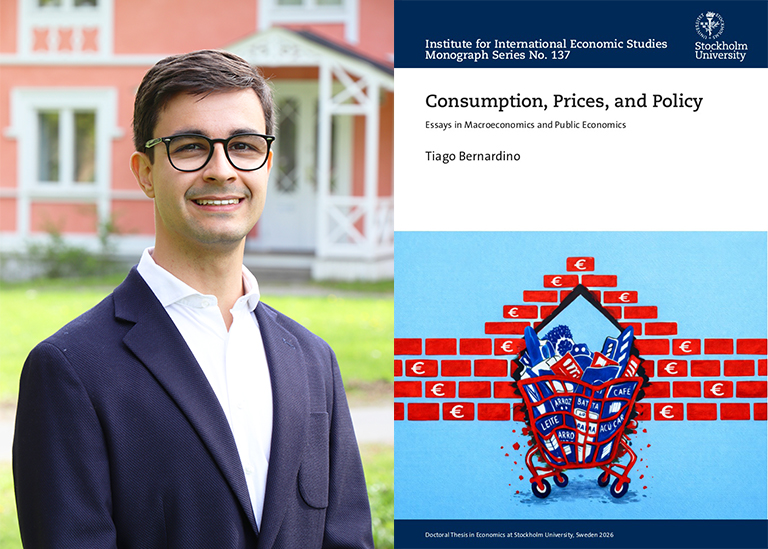
Tiago will defend his thesis "Consumption, Prices, and Policy: Essays in Macroeconomics and Public Economics" on June 5.
Last updated: 2026-05-25
Source: Institute for International Economic Studies