


Huminfra Conference 2025: A venue for connecting people, tools, methods and infrastructures
Two gray November days in Stockholm were brightened by inspiring presentations, engaging demos, and eye-catching posters mixed with lively discussions, networking, coffee breaks, and a long-awaited book launch. Huminfra's second conference, HiC 2025, brought together over 100 participants from a variety of disciplines.
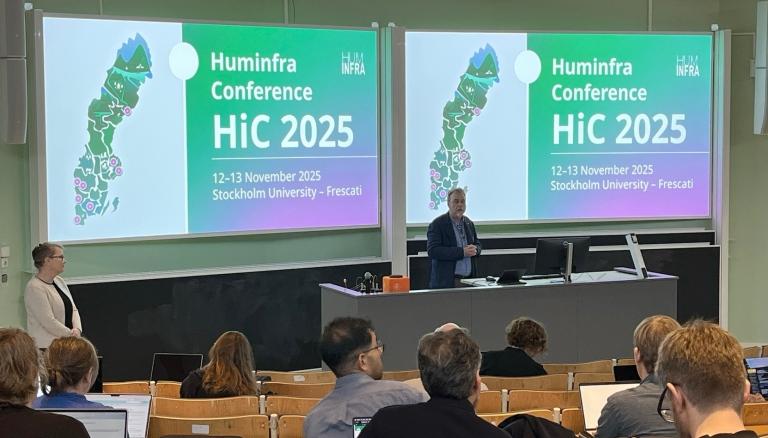
Huminfra's director Marianne Gullberg, professor of psycholinguistics at Lund University, and Harko Verhagen, professor in computer and systems sciences at DSV and director of Digital Human Sciences at Stockholm University, introduced the conference. Photo: Anna Blåder
Taking place on 12–13 November, 2025 at Stockholm University, the Huminfra conference was organised by Digital Human Science (DHS) at Stockholm university, one of Huminfra's 12 nodes.
The conference was officially opened by Hans Adolfsson, Vice-chancellor at Stockholm University. This was followed by two action-packed days of presentations, demonstrations and posters showcasing tools, methods, and case studies in areas ranging from experimental AI in research, and qualitative studies with LLM chatbots to data pseudonymisation standards, multilingualism in teaching, interactive 3D environments, and motion capture workflows.
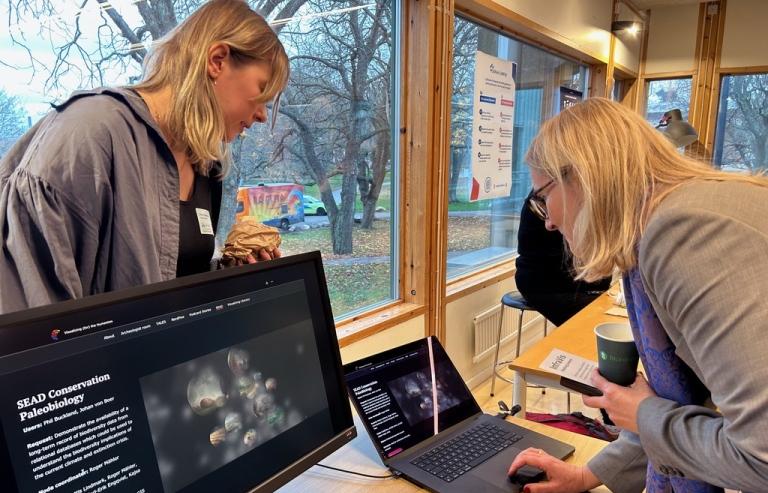
Linnéa Tjernström (to the left), communicator at Umeå University, demonstrates InfraVis – the national research infrastructure for data visualization that helps researchers visualize their research data. To the right, Susanne Tienken, researcher in the German language. Photo: Elin Sahlin
”This year’s HiC conference expanded by having submissions from outside the Huminfra nodes network and an addition of social science research. This shows that the borders between humanities and social science research in many cases is a mental construction rather than a principled difference”, says Harko Verhagen, conference chair and professor at the Department of computer and systems sciences at Stockholm University.
The conference also aimed to build bridges and increase cooperation between infrastructures, both locally and internationally. The two keynote speakers represented their respective infrastructures: Åsa M. Larsson from the national infrastructure Swedigarch, who discussed cultural heritage in the digital age, and Vicky Garnett from the pan-European infrastructure for arts and humanities scholars, DARIAH ERIC. Since July 2024, Huminfra has hosted Sweden's national membership in DARIAH (DARIAH-SE), enabling researchers to engage more deeply with the European research community and access digital resources.
Harko Verhagen likened planning the conference to putting together a jigsaw puzzle without really knowing what the finished picture would look like. The format was updated from that of Huminfra's first conference, HiC 2024. For example, it was organized via research domains or themes, rather than having categories of resources as an organizing principle, as was the case at the Huminfra’s first conference HiC 2024.
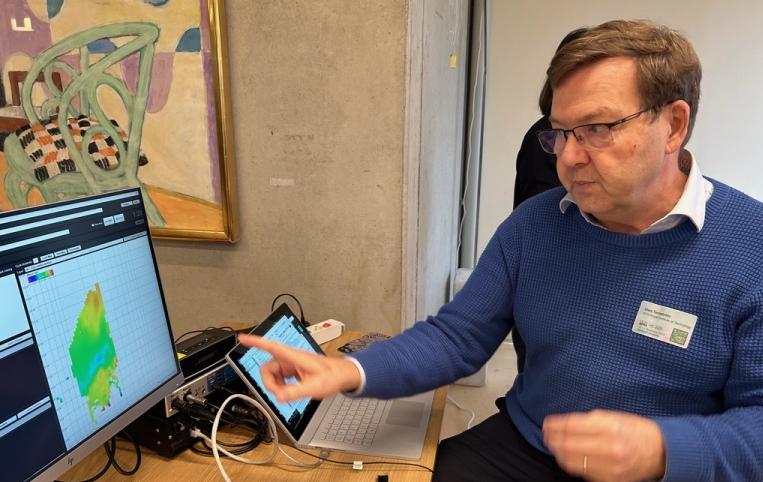
Sten Ternström, Professor at KTH, demonstrates FonaDyn – a realtime interactive analysis application software which works as a voice mapping tool that can be used for example by clinicians, voice teachers or professional singers. Photo: Elin Sahlin
The conference concluded with the much-anticipated launch of the Huminfra Handbook, a result of Huminfra’s first conference, HiC 2024, designed as a practical textbook to support researchers in navigating the resources available through Huminfra. This milestone marked the end of HiC 2025, summed up by Huminfra's director Marianne Gullberg, professor of psycholinguistics at Lund University:
”I return from HiC 2025 truly energised – it felt like a vitamin injection. Two wonderful days of exciting presentations and demos showcased the impressive breadth and depth of Huminfra’s activities and expertise. I was especially happy to see new areas and tools represented, with researchers and experts engaging with Huminfra across both digital and experimental approaches. HiC is rapidly becoming a key venue for connecting people, tools, methods, and infrastructures.”
For further reading, read the news article at Huminfra’s website.
Last updated: 2025-12-02
Source: Digital Human Sciences