


Thesis Defence in Scandinavian Languages. Annika Høeg: Stød beyond the lexicon
Annika Høeg will publicly defend her thesis in Scandinavian Languages: Stød beyond the lexicon. Behavioral evidence from the distribution of stød in nonce words. The defence is free of charge and will be held in English. Department of Swedish Language and Multilingualism at Stockholm University.
Annika Høeg. Photo: private.
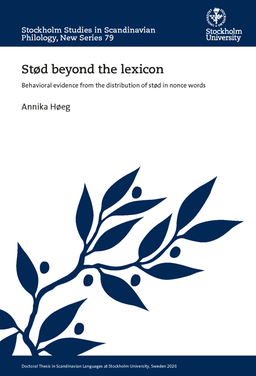
Phonological analyses of stød are generally based on the distribution of stød in the lexicon and on introspection, whereas empirical testing of speaker behavior is limited. The aim of this thesis is to investigate Danish speakers’ generalizations of stød by examining how different patterns are extended to nonce words. Nonce words are unknown to the speaker. Therefore, nonce words cannot have any stored pronunciation or lexical specification. If a process is productive, speakers should apply it to nonce words. The thesis is based on three studies that investigate speakers’ behavior in relation to different distributional patterns of stød.
Study I examines the relationship between the occurrence of stød and the position of the stressed syllable in monomorphemic words. In a production task, 10 participants read aloud nonce words with stress on the ultimate syllable (oxytones), the penultimate syllable (paroxytones), or the antepenultimate syllable (proparoxytones). The results showed that participants assigned stød categorically to oxytone nonce words. The paroxytone nonce words were mostly pronounced without stød, but the participants also showed a tendency to pronounce them with stød when the post-tonic syllable was ‑el. The proparoxytone nonce words were pronounced both with and without stød, with non-stød being most frequent.
Study II investigates whether speakers’ generalizations for stød are the same for all paroxytones, regardless of the segmental structure of the post-tonic syllable. This was tested in an experiment using a two-alternative forced-choice task, in which 35 participants were asked to choose between pronunciations of nonce words ending in ‑e, ‑en, ‑er, or ‑el with or without stød. The results showed that participants’ preference for stød increased in the same direction as the distribution in the lexicon, from ‑e to ‑en, from ‑en to ‑er, and from ‑er to ‑el. This shows that stød generalizations are more fine-grained than syllable count alone and that they can reflect statistical patterns in the lexicon.
Study III examines the assignment of stød in nonce words in relation to morphological structure. In a production task, 49 participants read aloud nonce words in the infinitive, the present tense, and as agent nouns, in simple forms as well as in compounds. In the compound forms, the first member was either a preposition or a noun. Participants only assigned stød categorically in the simple infinitives. As in real words, they were almost never pronounced with stød. In the other morphological contexts, participants’ assignment of stød was more variable and did not always reflect the distribution of stød in real words. In the simple agent nouns, stød was more frequent than expected, and in all compound forms, stød was less frequent than expected. In the simple present tense, participants’ assignment of stød was similar to the distribution in real verbs in the present tense.
The main contribution of the thesis is to provide an empirical ground against which claims about productive assignment of stød can be tested. Together, the three studies show that not all patterns found in existing words are applied to nonce words to the same extent. The results indicate that stød is the default in oxytones, but not in proparoxytones. In paroxytones, non-stød is not the default. Instead, gradient patterns are generalized, relating to the segmental structure of the post-tonic syllable as well as morphological information.
About the defence in Swedish
Disputation i nordiska språk. Annika Høeg: Stød beyond the lexicon
Find your way
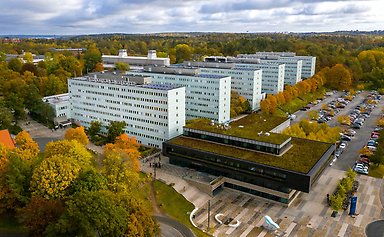
Södra huset (the light-blue high-rise buildings) with from left to right Building A–F (address Universitetsvägen 10 A–F), the brown Student House (Studenthuset) and the South parking lot Södra parkeringen. Photo: Sören Andersson.
Address
Auditorium 7 (Hörsal 7), Floor 3, Building D, Södra huset, Campus Frescati.
- Floor 4 – the Northern entrance, coming from the metro station "Universitetet" or bus stop "Universitetet norra". Address: Universitetsvägen 14 D.
- Floor 2 (the high-rise buildings facing the parking lot) or floor 3 (stairs leading up to the entrances between the high-rise buildings) – the Southern entrances, coming from the bus stop "Universitetsvägen" or the South parking lot "Södra parkeringen". Address: Universitetsvägen 10 D.
Accessibility
The link below leads to accessibility information on how to find your way to the Department, but is still useful since Auditorium 7 is located in the long corridor connecting Building A–F, close to the Department in Building D.
Travel routes
- Metro, the red line to station "Universitetet", approx. a 10 min. ride from T-Centralen. Follow the walkway to the right, to Södra huset (the six light-blue high-rise buildings A–F), a 5 min. walk.
- Train Roslagsbanan to station "Universitetet", approx. a 5–10 min. walk to Södra huset.
- Bus 50 from Odenplan to bus stop "Universitetsvägen", right by Södra huset, or
- bus 50 from "Stora Lappkärrsberget" to bus stop "Universitetet norra" (by the metro station) or the next bus stop "Universitetsvägen" by Södra huset, or
- bus 540 from bus stop "Tensta Centrum" to bus stop "Universitet norra" (by the metro station).
- Some of the 600-buses (between bus stop "Östra station" and the Roslagen area) also stop at bus stop "Universitetet norra" (by the metro station).
- Approx. a 5 min. walk to Building D, Södra huset.
- Car / taxi via highway E4 / Roslagsvägen. There is a parking lot, Södra parkeringen, below Södra huset (on the South side of Campus). There is a parking fee.
Google maps pin- There is also a parking lot on the other side of Campus, by Svante Arrhenius väg. Approx. a 10 min. walk.
Googe maps pin - One can drive up to
- Universitetsvägen 10 A (turning area), close to the accessible entrance door on floor 3, Building A, Södra huset. A long corridor connects Building A–F on floor 3. (All the other entrances on floor 3 are located between the high-rise buildings with stairs leading up to the entrance doors.) This might be the easiest way to take, if one uses a wheel chair, baby stroller etc., since one does not need to use an elevator.
- Universitetsvägen 10 D, Building D, by the accessible entrance door on floor 2 (drive around the parking lot up to the building). It is closer to Auditorium 7, Building D, from there, than from Building A, but you need to take the elevator or the stairs up to floor 3. Follow the corridor on floor 2 , which "makes a turn" to the right, where the elevators are located, or keep going straight from there to the (orange) stairs up to floor 3.
- There is also a parking lot on the other side of Campus, by Svante Arrhenius väg. Approx. a 10 min. walk.
- Bike or walk, for example along Brunnsviken, Roslagsvägen or through the forest Lill-Jansskogen. There are bike racks along Södra huset, floor 2.
Last updated: 2026-11-13
Source: The Department of Swedish Language and Multilingualism