


Conference keynote // Research seminar with Andrew Mathews: "Invasiveness as a response to ecological escape, landscape change and disturbance: Rapid evolution in human transformed landscapes"
"Invasiveness as a response to ecological escape, landscape change and disturbance: Rapid evolution in human transformed landscapes" with Andrew Mathews
Welcome to an open keynote session with Professor Andrew Mathews! This event will kick off the 2026 BIOrdinary Conference titled, The Ordinary Anthropocene: Biodiversity in the other 70%!. In broad strokes, this end-of-project conference explores how humans might live alongside—and responsibly dwell with—the biodiversity shaped by deep histories of human mobility, habitation, agriculture, and industrial activity. In doing so, we seek to seriously consider alternative ways of relating to, and engaging with, emergent ecologies and future natives.
Conference abstract:
In 2022, the UN’s Convention on Biological Diversity committed to set aside 30% of the earth’s surface for protected areas. In this con-ference we ask, what about the biodiversity in the other 70%? While the Anthropocene is framed as a spectacular rupture and a catastrophic loss that demands protection for the remaining Holocene patches, we are interested in the life going on beyond the confines of these patches: the ordinary Anthropocene. As the concluding conference for the research project BIOrdinary: Biodiversity Dilemmas in Ordinary Places, we invite participants to join us in exploring the latent possibilities found in regular sites of more-than-human habitation, outside the spectacular.
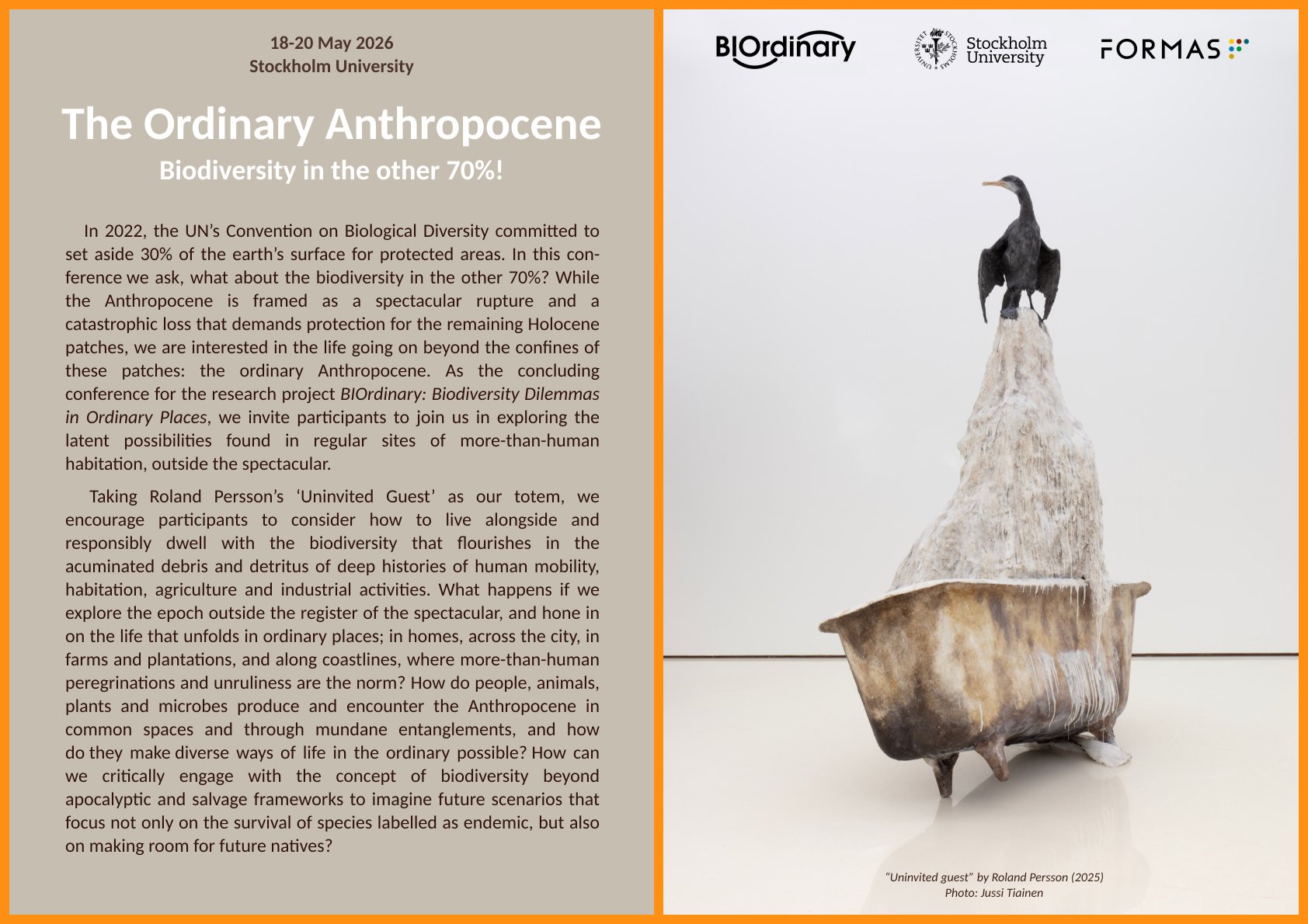
Taking Roland Persson’s ‘Uninvited Guest’ as our totem, we encourage participants to consider how to live alongside and responsibly dwell with the biodiversity that flourishes in the acuminated debris and detritus of deep histories of human mobility, habitation, agriculture and industrial activities. What happens if we explore the epoch outside the register of the spectacular, and hone in on the life that unfolds in ordinary places; in homes, across the city, in farms and plantations, and along coastlines, where more-than-human peregrinations and unruliness are the norm? How do people, animals, plants and microbes produce and encounter the Anthropocene in common spaces and through mundane entanglements, and how do they make diverse ways of life in the ordinary possible? How can we critically engage with the concept of biodiversity beyond apocalyptic and salvage frameworks to imagine future scenarios that focus not only on the survival of species labelled as endemic, but also on making room for future natives?
Bio:
Professor Andrew Mathews is currently employed by the Department of Anthropology at the University of California, Santa Cruz. He has a MSc in Forestry and Its Relation to Land Use from Oxford University, and earned his PhD in Environmental Anthropology from Yale University in 2004. Mathew's research interests span environmental anthropology, environmental history, forests and forestry in Mexico and Italy, historical ecology, community forest management, and more. In 2022, he published his book Trees Are Shape Shifters – an exploration of the anthropogenic landscapes of Lucca, Italy, and how its people understand social and environmental change through cultivation.
Invitation to the Ordinary Anthropocene BIOrdinary conference pdf, 1.7 MB.
Last updated: 2026-05-13
Source: Department of Social Anthropology