


Language influences whether witnesses are perceived as credible – but not how reliable they are
New research shows that witnesses who speak a second language are just as reliable as native speakers, but risk being judged differently by the legal system.
In his doctoral thesis, Arman Raver has investigated how language and ethnic discrimination can influence the assessment of witness testimony in legal contexts. The focus is on people who testify in a second language—and on the difference between how accurate their statements actually are and how they are perceived. The results show that witnesses who do not speak their native language are at least as reliable as native speakers. Despite this, they are assessed as less credible and also feel more uncertain when testifying.
“Overall, we saw that language can influence credibility assessments in a way that does not reflect the reliability of memory. This makes it important to distinguish between how confident the witness feels and how others interpret and assess the person,” says Arman Raver, researcher at the Department of Psychology, Stockholm University.

Cover of the thesis (detail). Illustration: Cihangir
The study also challenges common assumptions about body language as a sign of untrustworthiness.
“We found that common nonverbal cues such as fidgeting or facial expressions could not be linked to accuracy, certainty, or perceived credibility.”
Psychological research for the judicial system
Arman Raver's field of research is legal psychology – psychological research that can be applied in the judicial system. At the intersection of memory research, witness psychology, and legal certainty, he found the topic for his dissertation: how language affects witness testimony.
“I have always been interested in how people remember important events and how their statements are used and evaluated in criminal investigations and trials. Quite early on, I also became fascinated by credibility assessments – why certain stories and certain people are taken more seriously than others, even when they seem equally honest or have equally good memories.”
KEY CONCEPTS
In order to examine how testimony is affected and perceived based on whether the witness is allowed to use their native language, the thesis draws on the established distinction between reliability and credibility.
Reliability: Reliability refers to how reliable a piece of information is – whether specific statements are accurate, consistent, stable over time, and unaffected by internal or external factors.
Credibility: Credibility is about how the witness is perceived as a person and source of information – whether they appear honest, accurate, consistent, cooperative, and whether their statements are perceived as useful.
In this thesis’ studies, reliability is measured by how accurately witnesses remember and how easily they are influenced by different questions. Credibility is measured based on how other assessors perceive the testimony and the witnesses.
In many countries, including Sweden, it is not uncommon for witnesses, victims, and suspects in legal proceedings to have to use a language that is not their strongest. Most modern legal systems recognize the right to an interpreter if you do not understand or cannot express yourself sufficiently well in the language of the trial.
How common is it to have to testify in a language other than your mother tongue?
“My thesis does not provide any answers as to how consistently the right to interpretation is upheld, but it illustrates why the issue is central: if language primarily affects credibility assessments – without necessarily impairing reliability – then language choice and the use of interpreters are not technicalities but part of the core issue of equal treatment before the law,” says Arman Raver.
A multi-stage study
Fundamentally, reliability is about the quality of information, while credibility is about how we perceive the person providing it – two things that are often closely linked.
As researchers, we can approach the reliability of a witness statement by designing studies that allow us to compare the statement with the “true” event in a staged crime video.
“In real court cases, there is rarely such a definitive answer,” says Arman Raver.
In the studies, participants watched a short film depicting a staged crime: a knife attack in a parking lot. They were then interviewed as if they were real witnesses: they were asked to give testimony and answer follow-up questions either in their native language (Swedish) or in English as a second language. The statements were recorded and then used in all parts of the thesis.
Memory accuracy (number of correct and incorrect details), susceptibility to leading questions (e.g., “He had a knife, didn't he?”), and how confident the witnesses felt about what they had said were then examined. The witnesses also rated their own credibility and cognitive effort.
After that, a new group of participants got to be the “interrogators” and judge how believable the witness was based on stuff like how accurate their memory seemed, how honest and confident they came across, and how useful their testimony would be for an investigation. The group then came up with follow-up questions for the witnesses. In a subsequent study, a new group of assessors read these questions (without seeing the actual testimonies) and classified them as open-ended, leading, or expressing doubt.
In a final study, nonverbal behaviors in the testimonies—such as fidgeting, gaze, gestures, facial expressions, head and body movements—were examined and categorized to test whether any of these affected the accuracy of individual statements, the witness's own confidence, or the observers' credibility assessments.
Uncertainty creates a gap between reliability and credibility
Throughout the various parts of the study, a clear gap emerged between reliability and credibility. Witnesses who testified in a second language were just as reliable as those who testified in their native language—they remembered roughly the same number of correct and incorrect details and were no more susceptible to leading questions—but they felt less confident and were judged to be less credible by observers.
“There you can clearly see the gap between reliability and credibility,” says Arman Raver.
Arman Raver and his fellow researchers have systematically examined key components of witness psychology: reliability, certainty, credibility, and nonverbal communication—and investigated how they relate to language. For example, the dissertation tests the notion that honesty, uncertainty, or correctness can be read through body language.
“We found no connection between our nonverbal behavior and who was actually more correct, felt more confident, or was judged to be more credible. This runs counter to many intuitions among both the general public and professionals in the legal system,” says Arman Raver.
Why is this research important?
"It is important because judges, jurors, police officers, and prosecutors rely on their assessments of who appears credible. If these assessments are systematically biased against people who testify in a second language, we risk devaluing testimony that is in fact reliable. This can have consequences for who is taken seriously and what decisions are made in investigations and judgments."
What changed was the experience and impression. The witnesses felt less confident when testifying in a second language, and observers rated them as less credible, even though their memories were just as accurate.
Lost in translation, or prejudice?
One of the starting points for the thesis was the question of whether there is a risk that parts of the content itself are lost when a witness switches from their first language to their second language. According to Arman Raver, there is reason to believe that certain things may be lost in translation. Previous research on language and memory has shown that it is sometimes easier to recall an event if you recount it in the same language in which you experienced it. In a second language, it can be more difficult to find the right words and nuances.
“Trying to remember an event during an interrogation is cognitively demanding in itself, and doing so in a language other than your mother tongue requires even more effort.”
When conditions are favorable, people tend to be more confident about correct details than incorrect ones.
“If decision-makers use confidence, linguistic fluency, or eloquence as shortcuts to credibility, they will systematically underestimate second-language speakers. Language, expectations, and confidence become closely intertwined and can create a kind of structural skepticism toward those who do not express themselves in the ‘right’ way,” says Arman Raver.
What impact does the use of a language other than the one in which the event was experienced have on the recounting of testimony?
“In my data and studies, we saw no clear signs that memory accuracy was impaired by testifying in a second language compared to the mother tongue, given our relatively favorable conditions with good English skills, structured interviews, and short time intervals. What changed was the experience and impression. The witnesses felt less confident when testifying in a second language, and observers rated them as less credible, even though their memories were just as accurate. So, it wasn't the memory itself that was ‘lost in translation,’ but rather how confident one feels and the social assessment.”
Are there other linguistic factors that may play a role in how testimony in another language is interpreted?
“Yes. Language conveys a great deal of social information. A prominent accent, a more limited vocabulary, or slightly choppy grammar can evoke ideas about a person's background, education, competence, or honesty. This can color how we interpret a testimony, even when the content is accurate. Very articulate and fluent speakers are often perceived as more competent and convincing, regardless of whether their memories are actually better or not.”
%20Foto%20disputation%201.jpeg)
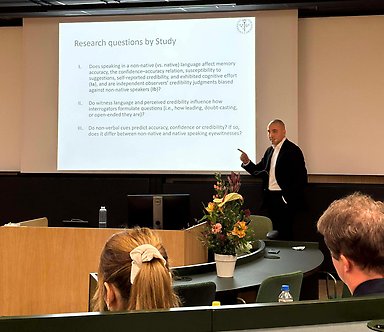
Arman Raver during his thesis defense. Photo: Private
What is the next step for you and your research?
”In terms of research, I would like to replicate and further develop the design with new samples, and test similar questions in more vulnerable and more diverse groups – people with lower language skills and different ethnic backgrounds. I also want to delve deeper into how professionals in the legal system actually assess credibility.”
“For my part, I hope to continue working in the borderland between research and practice – conducting research that is directly relevant to the legal process.”
Footnote: Arman Raver defended his thesis in December 2025 with the title Testifying in a non-native language as an eyewitness undermines credibility judgments but not reliability.
Last updated: 2026-01-30
Source: Department of Psychology