


Newly published: The snowball effect – light from snow makes us more alert
The short days and lack of daylight in winter make it difficult for many people to stay alert. A cover of snow, which reflects light and makes it brighter, can help us.
People who spend a lot of time indoors and also live in northern latitudes find it difficult to get enough natural light in December and January to keep their spirits and alertness up. A snowfall can then be a welcome feature, at least if we want to feel more alert.
A new study from Stockholm University has investigated how snow affects people's biology and behavior. A group of people in Uppsala were closely monitored for two weeks—one with snow and one without. The researchers looked at the participants' activity, sleep, and mood. The study shows that the light brought by snow can help our bodies wake up, but that it is not enough to lift our mood.
The study in short
Study method
The researchers followed 45 people living in Uppsala (northern latitude 59.9°) from December to February, during one week with snow and one week without snow. The research participants were asked to use activity trackers, keep a diary, and provide saliva samples to measure melatonin levels in the morning.
Results
The snow cover helped by providing more morning light, lowering melatonin levels, and increasing alertness and activity during the day. However, during December and January, the snow had almost no effect on sleep habits, sleep quality, or how the participants assessed their mood during the day. But by February, there was a marked improvement in mood and increased alertness.
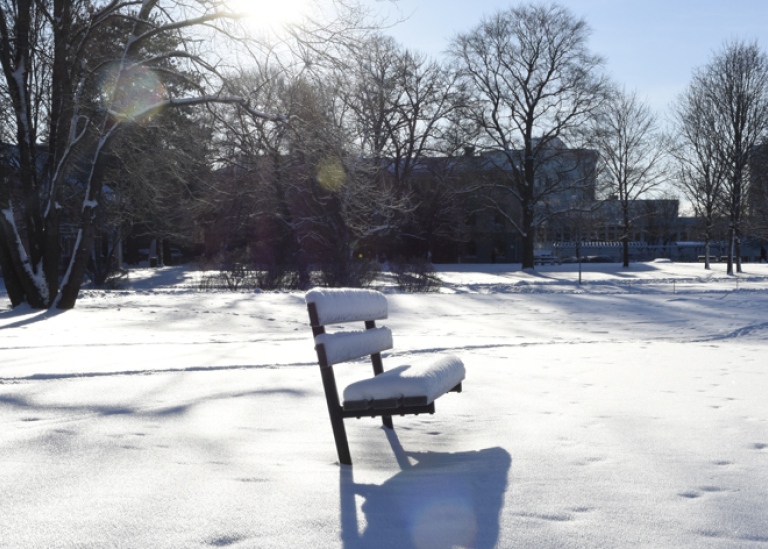
A cover of snow that makes it brighter helps combat fatigue. Photo: Ingmarie Andersson
We have to make sure we get enough light to maintain a good circadian rhythm and feel good.
In places far north, the snow can make us more alert by reflecting what little daylight there is. The snow thus acts as nature's own light amplifier. But to really feel better during the darkest winter months, more measures may be needed in everyday life.

Arne Lowden. Photo: Niklas Björling
Arne Lowden, associate professor and one of the authors of the article, comments on the study:
– Our modern lifestyle means that we spend more time indoors. This means that we have to make sure we get enough light to maintain a good circadian rhythm and feel good. The results show that the closer we get to the winter solstice on December 22, the harder it gets for us due to the lack of daylight. Snow helps combat fatigue, but to improve mood, we need the help of electric lighting, for example in the form of light therapy or good indoor lighting.
Read the scientific article
Arne Lowden & Seren Dincel (2025). The Snowball Effect: Snow cover increases light exposure, suppresses melatonin, and improves alertness in an urban population at northern latitudes. Chronobiology International. DOI: 10.1080/07420528.2025.2571190
Last updated: 2025-12-10
Source: Department of Psychology