


Psychology All the Way – Erik Is Now a PhD Student
What began as a curiosity about human behaviour has evolved into the start of a research career. Today, Erik Bojerud is a PhD student at the Department of Psychology, investigating how social norms shape relationships between different groups in society.
When Erik Bojerud was choosing what to study, he was initially drawn to other behavioural science disciplines.
“When I was trying to decide what to study, I was inspired by the educational backgrounds of the authors whose popular science books I enjoyed reading. Most of them were behavioural scientists of one kind or another.”
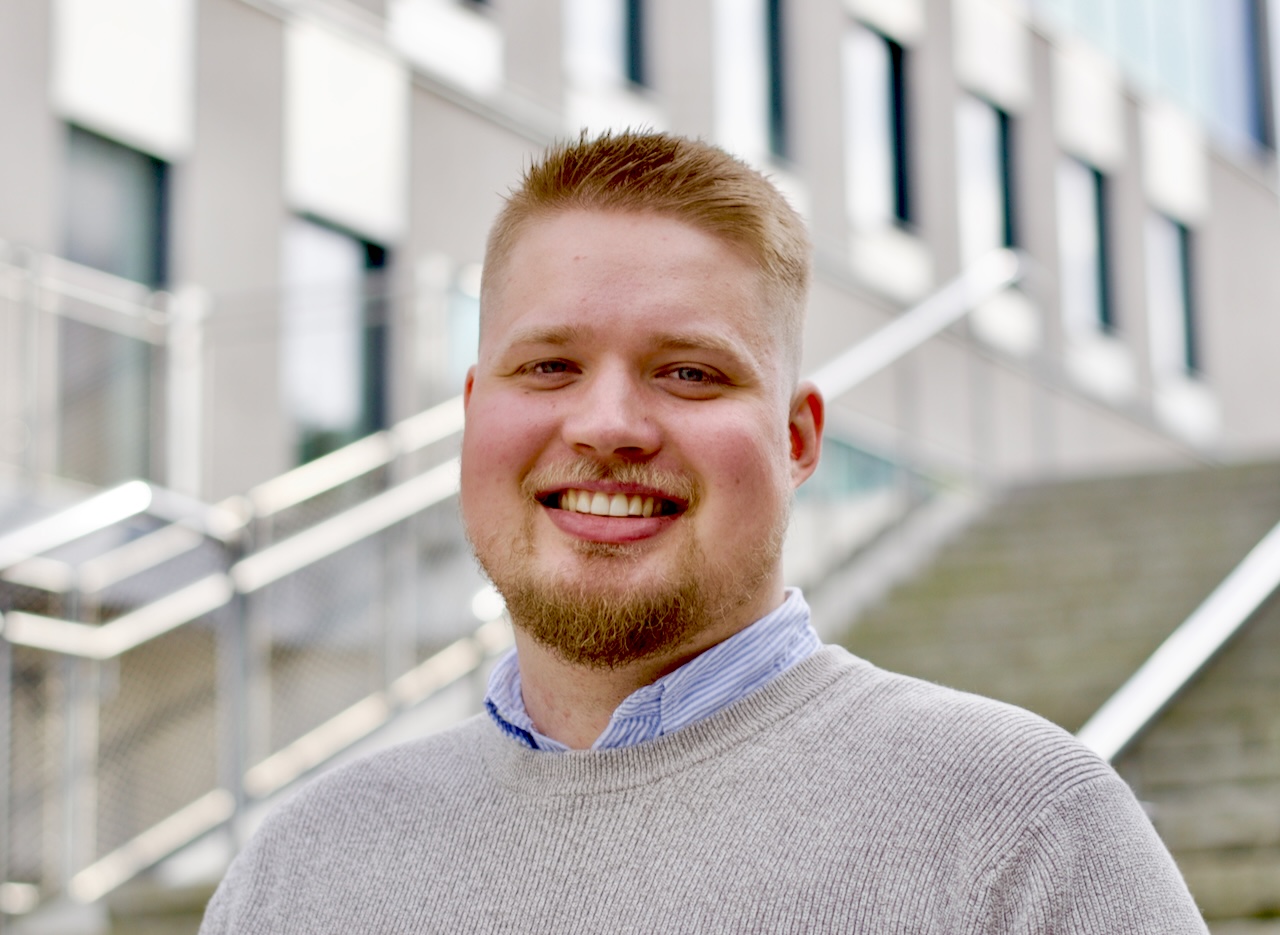
Erik Bojerud. Photo: Henrik Dunér
I didn’t just want to answer other people’s questions – I wanted to ask my own
Erik began his university studies in social anthropology and later studied sociology and criminology. But psychology kept drawing him back.
“I remember telling my mother, rather confidently, that I already knew everything about psychology because I had studied it in upper secondary school. I couldn’t have been more wrong! I took the introductory psychology course and was hooked.”
Although he continued exploring other disciplines and found them fascinating, he soon realised that psychology was the subject he wanted to pursue in depth.
“I realised that psychology was going to be my subject, and I haven’t regretted that decision for a second.”
From Learning to Researching
After completing his bachelor’s degree, Erik was not ready to leave academia behind. On the contrary, he became increasingly fascinated by how scientific knowledge is created.
“After finishing my bachelor’s degree, I felt there was still so much left to learn, and I didn’t feel finished with the subject. That was one of the reasons why I continued on to the master’s programme.”
During his master’s studies, his interest deepened even further. He not only gained new perspectives on psychology but also became fascinated by the research process itself.
“During my master’s studies, I became completely fascinated by learning how we generate knowledge about phenomena and behaviour.”
Working as a research assistant proved to be a decisive experience. Being closely involved in ongoing research inspired him to formulate his own research questions and conduct his own studies.
“I didn’t just want to answer other people’s questions – I wanted to ask my own. Applying for doctoral studies at Stockholm University was never part of a predetermined plan. It turned out that I could investigate the topics I was most interested in without having to move to the other side of the world. All the pieces simply fell into place at the same time.”
Student, Researcher and Project Manager
Today, Erik is in his second year as a PhD student at the Department of Psychology. He describes the transition from bachelor’s and master’s studies to doctoral education as a gradual process in which personal responsibility steadily increases.
What is the biggest difference between being a bachelor’s or master’s student and being a PhD student?
“I would say that the further you progress, the more responsibility you are expected to take for your own learning and the more in-depth knowledge you are expected to acquire. As a PhD student, you are not only a student but also an informal project manager of your own dissertation project and an employee of the department, with everything that entails. There is much more emphasis on producing your own research and participating in meetings, both with supervisors and with colleagues across the department, in order to be an active member of the work place.”
The focus is on developing independent research, collecting data and contributing to the department’s academic environment.
“You can think of bachelor’s and master’s studies as laying the foundation for developing your own research question, whereas doctoral studies are just as much, if not more, about putting that knowledge into practice and learning the craft of conducting research.”
ERIK'S TOP FIVE STUDY STRATEGIES
- Treat your studies like a full-time Job. Study during fixed working hours, for example from 9 a.m. to 4 p.m. on weekdays. This helps you stay on top of your studies and makes it easier to disconnect in the evenings and at weekends.
- Study smart. Look at previous exams, create concept lists and find the learning methods that work best for you. Reading course chapters before lectures can give you an overview and help you use lectures as opportunities for revision and deeper understanding.
- Prioritise recovery. Pulling an all-nighter is rarely a good idea. The brain learns best when study time is balanced with recovery and rest, so it is important to schedule time off as well. This is perhaps even more important during a PhD, when you could easily work around the clock if you let yourself.
- Study in intervals. The Pomodoro Technique worked very well for me. Study intensely for a set period, for example in one-hour blocks consisting of 45 minutes of focused studying followed by 15 minutes doing something completely different, such as stretching or playing the guitar. This allows you to study for a full day without feeling completely mentally drained.
- Don’t forget to have fun! Learning is always easier when you are studying something you are genuinely passionate about. If you are driven by a real desire to learn, both knowledge and good results often come as a bonus.
An International Student Life in Stockholm
For Erik, the years at Stockholm University have been shaped by both academic studies and encounters with people from all over the world. He also sees the combination of studying in a vibrant capital city while being close to nature as one of Stockholm’s greatest advantages.
How would you describe your student life in Stockholm and at Stockholm University?
“Fun and enriching! I should be honest and say that, as a born and raised Stockholm resident, studying here has also been very convenient. Even after 26 years in the capital, I am always discovering new things, and if I had the choice, I would stay here, where everything happens, for as long as I can. Even though campus life is not as centralised as I have heard it can be in traditional university towns, there are always plenty of events and activities taking place, both at the university and beyond.”
“I have made many friends during my studies, and many of them have become friends for life. Stockholm University is also a highly international university, particularly at the master’s and doctoral levels, which leads to many enjoyable exchanges of cultural experiences and perspectives.”
Researching Social Norms and Intergroup Relations
In his doctoral thesis, Erik studies how social norms and the social context influence how people think, feel and behave towards individuals who do not belong to their own group.
The research is conducted both in Sweden and in countries where different groups have lived with conflict and tensions for extended periods of time.
The aim is to gain a better understanding of how norms are formed and how knowledge about what other people think and do can be used to improve relations between groups.
At the moment, the research is entering an intensive phase.
“I am submitting my first study in October, and I am currently analysing data from my second study, so things are moving full speed ahead!”
Last updated: 2026-10-01
Source: Department of Psychology